
The Aistaland GX7 goes on pre-sale at 249,900 yuan. Huawei equips it with 4 lidars and 3 motors.
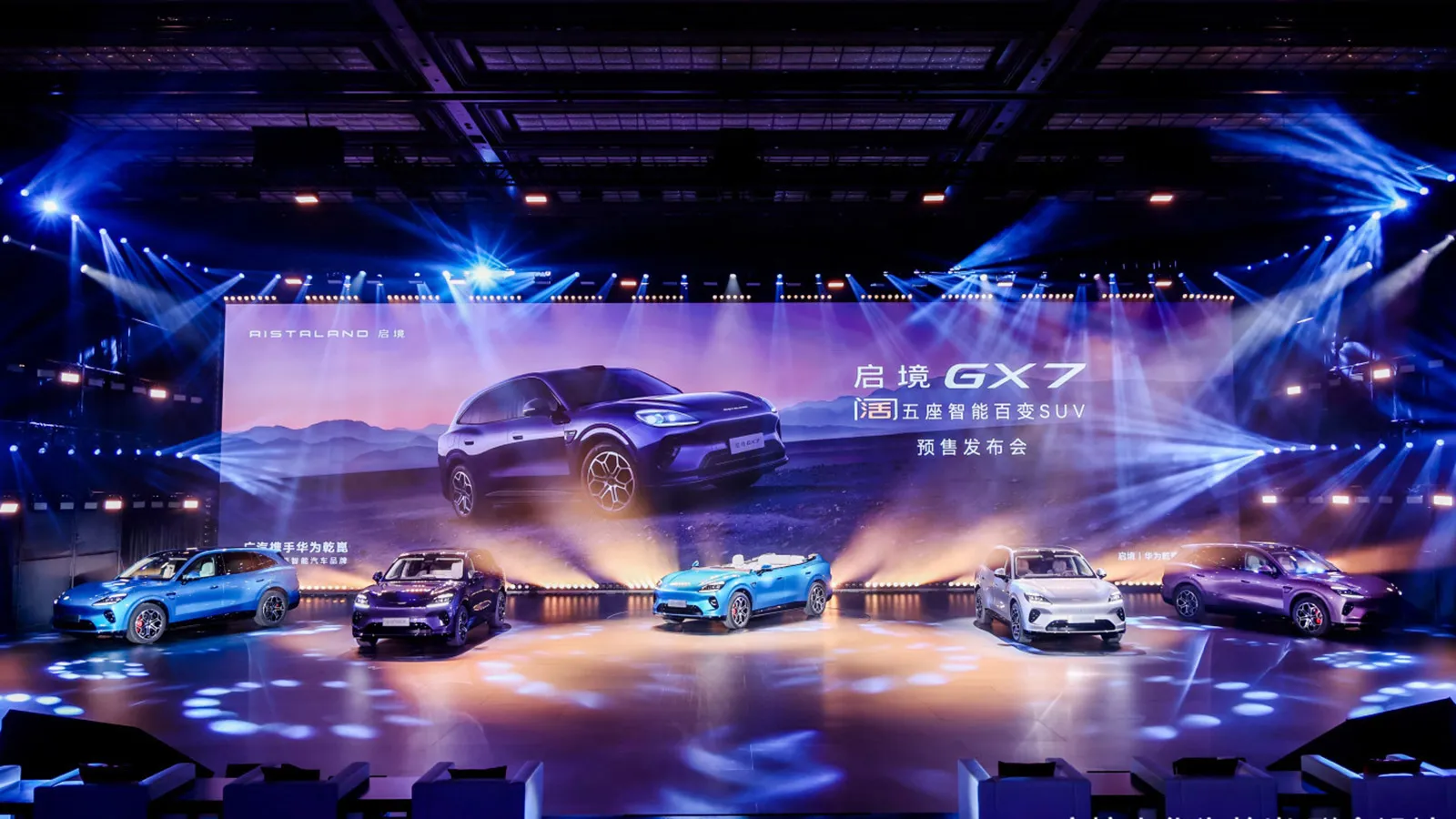
Aistaland, a joint brand of GAC and Huawei, has launched pre-sales for the GX7 model in China. It is a large 5-seater EREV SUV with prices ranging from 249,900 to 311,900 yuan, which is approximately 135,000–169,000 Polish zlotys, and comes equipped with Huawei Qiankun ADS 5.
The GX7 is set to hit the market in autumn. For the brand, this represents a more significant test than its earlier shooting brake model, GT7, as it targets the much larger family SUV segment.
What’s in the Aistaland GX7
The GX7 measures 5,099 mm in length, 2,006 mm in width, and has a wheelbase of 3,070 mm. It aims to compete with vehicles like the Aito M7, Li Auto L6, and Xiaomi YU7, so it isn’t compact in size. And that’s good, as this format still sells best in China.
The strongest feature is said to be the electronics. Aistaland claims that the GX7 is one of the first models to feature Huawei Qiankun ADS 5, along with 4 lidars and 38 sensors. The package includes an 896-channel lidar with a dual optical path and 3 high-precision semiconductor lidars.
The manufacturer also mentions eightfold redundancy for autonomous driving at L3 level. On paper, this sounds impressive, but as is common with Chinese claims about L3, it’s better to wait for actual proof of the manufacturer’s responsibility and the system’s operational range.
Inside, there are two 15.6-inch screens, HarmonySpace 6 system, a 32-inch projector in the cabin and another 46-inch one outside, along with Huawei Sound audio featuring 21 speakers. The rear seat folds into a flat surface in 20 seconds over 180 degrees. So there’s some gadgetry and some family-oriented practicality.
EREV, 800 V and up to 550 kW
The GX7 is not a battery-powered BEV. It is an EREV with a 1.5T gasoline range extender and three drive configurations: rear-wheel drive, AWD with two engines, and AWD with three engines.
The base RWD version costs 249,900 yuan, the two-engine AWD version costs 269,900 yuan, while the top-tier three-engine model costs 311,900 yuan. The latter delivers 550 kW of power and a 0-100 km/h acceleration time of 3.9 seconds. The two less powerful versions achieve 0-100 km/h in 7.6 seconds and 4.9 seconds respectively.
All versions use CATL batteries. Customers can choose between 52 kWh LFP or 67 kWh NCM battery packs. The 800 V platform supports 5C charging, and the manufacturer claims it can charge the battery from 30% to 80% in less than 10 minutes. This sounds impressive, but since we’re still talking about Chinese testing conditions and an EREV vehicle, real-world power figures would be more interesting in Europe.
The electric range according to CLTC is 325-385 km, with a total range of 1,500-1,580 km. The CLTC standard itself is optimistic, but even after adjusting for Chinese exaggerations, the figures still seem reasonable for a large vehicle with a range extender.
The second point is simple. The brand’s first model, the GT7, was launched on June 26 and has not yet taken over the market. In July, Aistaland sold 2,658 cars, while in August only 1,100 were sold, a 58.62% drop month over month. The GX7 is intended to reverse this trend, as a family SUV offers the brand much better prospects than a niche shooting brake.
If this model fails to boost sales, just having lidars and projectors may not be enough. What do you think? Would such an EREV with three engines make sense in Europe, or is it too much gadgetry and not enough of a car?
LovEV Newsletter
Want more content like this?
Sign up — we’ll send you a weekly summary once the newsletter starts.