
Goodbye Miireille? The BYD Dolphin Surf enters the market
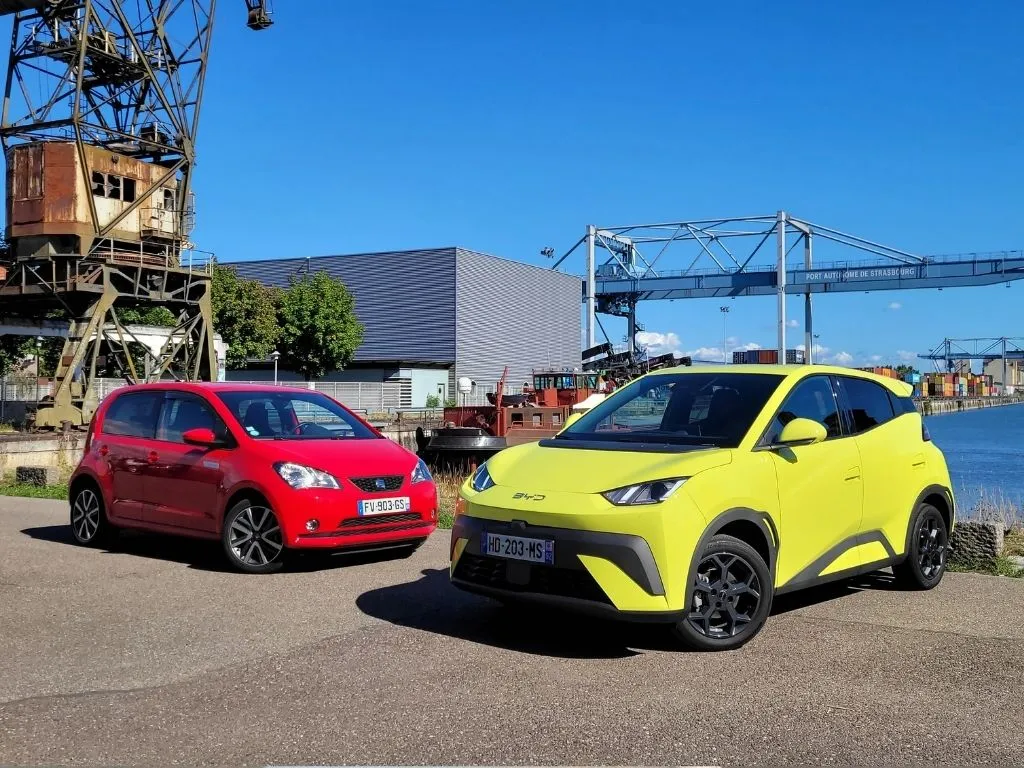
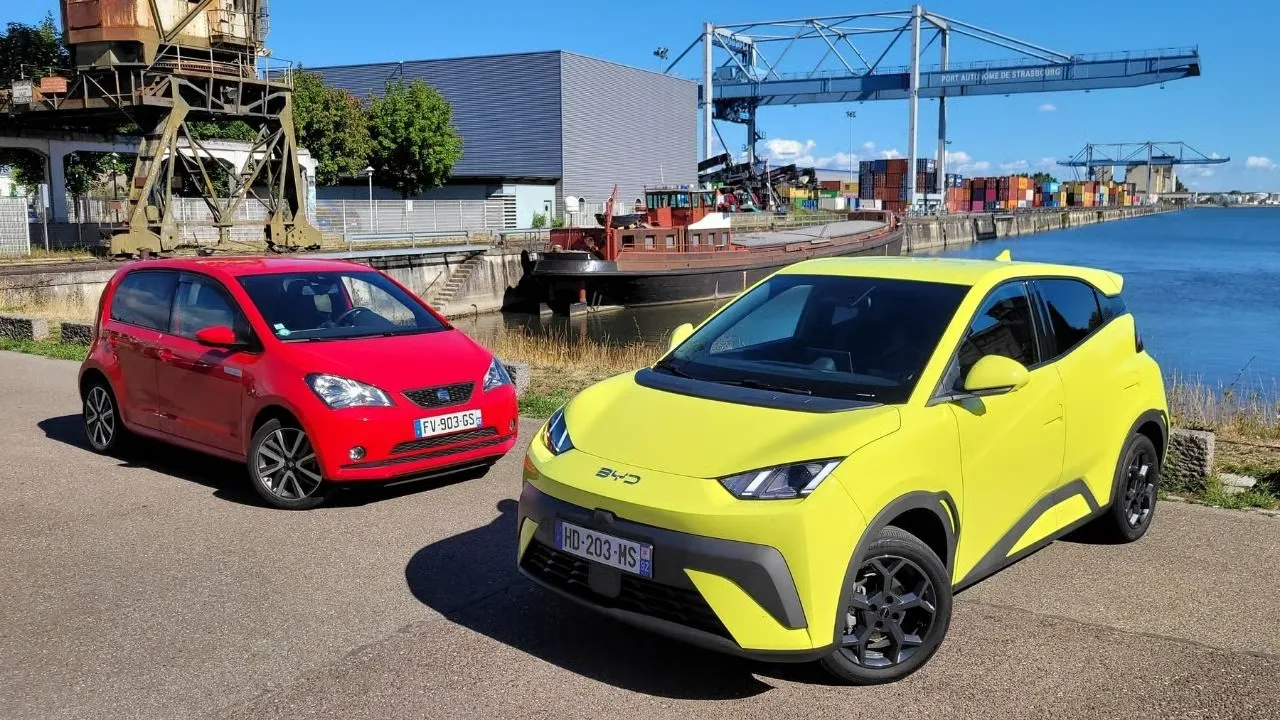
Almost 4,000 kilometers and a full month: the BYD Dolphin Surf had all the time needed to prove itself as a replacement for my Seat Mii Electric. Behind its unique design lies a comfortable, compact electric vehicle with solid equipment and far more versatility than one might expect from a city car. Enough to convince me?
A short introduction for newcomers who might be lost: you can find a comprehensive and unbiased review of the BYD Dolphin Surf by clicking on the link below. What follows are the passionate, personal yet relatable struggles of an editor looking for a replacement for his Seat Mii Electric, whose only flaw is that it’s now too small. It’s not the car—it’s me.
Also read
Review: BYD Dolphin Surf, can it outshine the Renault 5?
Since its launch on April 27, 2023, the BYD Seagull, a city car with a length of 3,780 mm, has become one of the most popular electric vehicles in the world, with over 700,000 units sold across all markets where it was introduced—from China to South America, including Indonesia, Thailand, Australia, and South Africa. Of course, Europe is also included; there it was renamed Dolphin Surf upon its arrival in 2025, and its wheelbase was extended to 3,990 mm. This likely contributed to it earning five stars in Euro NCAP crash tests but also prevented it from benefiting from the aesthetic updates of the Chinese model. “There are almost as many buyers as residents in Calvados—surely they can’t be wrong,” I thought, adding it to my shortlist of candidates to replace the Miireil.
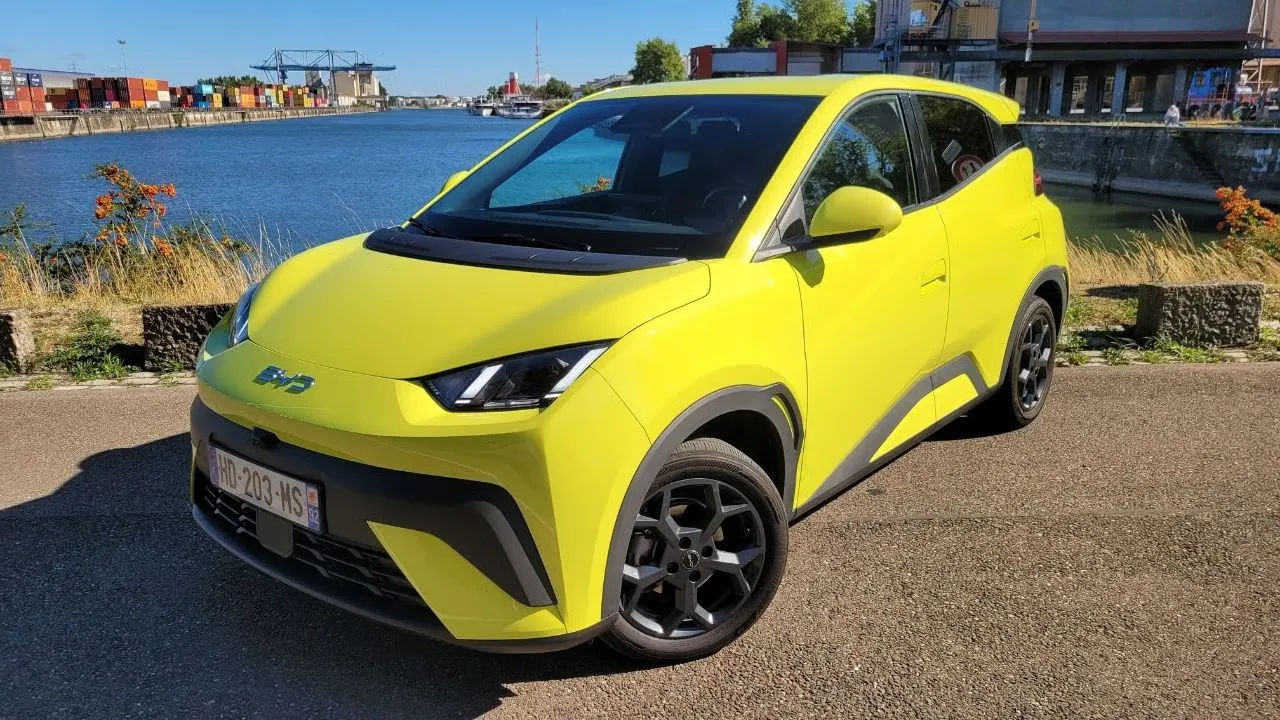
Aesthetically, the BYD Dolphin Surf is impossible to ignore, as one would politely put it. Some of its design elements even seem familiar: sharp headlights, a hood contour matching the car’s paint color in a prognathic vampire style, a large insert at the bottom of the windshield, a chassis that rises sharply toward the doors, and taut lines running along the sides all evoke the image of a dynamic Italian sports car. It appears that Wolfgang Egger, who had left his role as Lamborghini’s design chief just 4 months before the Huracan was unveiled at the 2014 Geneva Motor Show before returning to the same position at BYD in 2017, took with him some royalty-free design sketches, along with a mug from Sant’Agata Bolognese’s tourism office and his ficus benjamina named Ferruccio. Additionally, it features a floating roof in the style of the original BMW i3.
Ending with a robust bumper overhanging the rear window, a light bar across the entire width, and a diffuser.Well, you know what? It took me several days of discovering it again every morning in my parking spot before I concluded that I don’t actually hate it. I’d also say I’m absolutely convinced that if it were Japanese, it would be unanimously considered kawaii—like a hybrid of the Suzuki Swift Sport and Ignis or a revival of the Daihatsu YRV from the early 2000s. However, there are a couple of details that bother me, such as the handles that distort the vehicle’s silhouette by being oddly placed low on the doors, or the fact that BYD added a heavy SUV-style touch with unpainted fender extensions and enough space between the wheel and fender to slip your head through (don’t do that). This gives it an unattractive tall-wheeled appearance (even though the ground clearance is only 154 mm).
only 9 mm more than a Renault 5), making the 16-inch wheels appear even smaller than they are.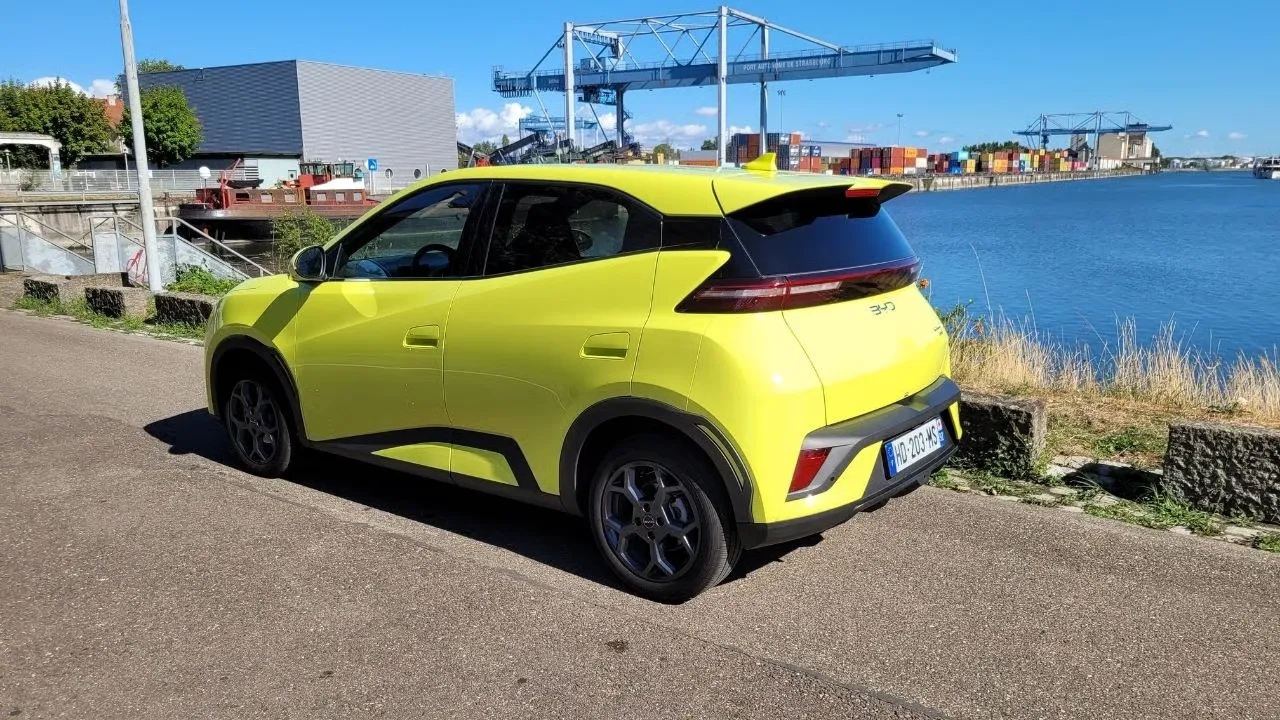
Otherwise, I hope you like the Lime Green color of our test model, which looks very much like Andre Agassi from the 1990 US Open finals, because you have to pay 650 € to avoid it—it’s the only paint option that’s free. Again, after a month, I admit it bothers my eyes less than at first, even though I was worried it might attract trawlers to the reefs if painted near the coast of the Quiberon Peninsula.
Also read
3,000 km on a Chinese electric city car for vacation: duration, cost, problems—here’s the full breakdown
Our version is a Comfort, which refers to both the finish as well as the engine and battery: a permanent magnet synchronous motor producing 156 hp and 220 Nm of torque, powered by a Blade LFP battery with a net capacity of 43.2 kWh. According to the promotional material, this results in a 0-100 km/h acceleration time of 9.1 seconds and a WLTP range of 310 km, which is only slightly worse than the figures offered by a Renault 5 with 120 hp and 40 kWh of net capacity. So it’s not extraordinary on paper, but in terms of performance, it seems more than sufficient for road trips: there’s a fun, playful ratio between power and the chassis, which will surely appeal to this old enthusiast whose first car was a Saab 900 Classic, who feels nostalgic at every slight turn. On dry roads and in straightaways, the hood rises and the rear settles in.
It’s an outboard engine that delivers powerful acceleration, but with just a little moisture on the asphalt or a few degrees of steering input that seems disconnected from the front wheels due to excessive tread, the Dolphin Surf causes roll (and handling issues) by widening the track and making the front tires work hard before electronic systems intervene.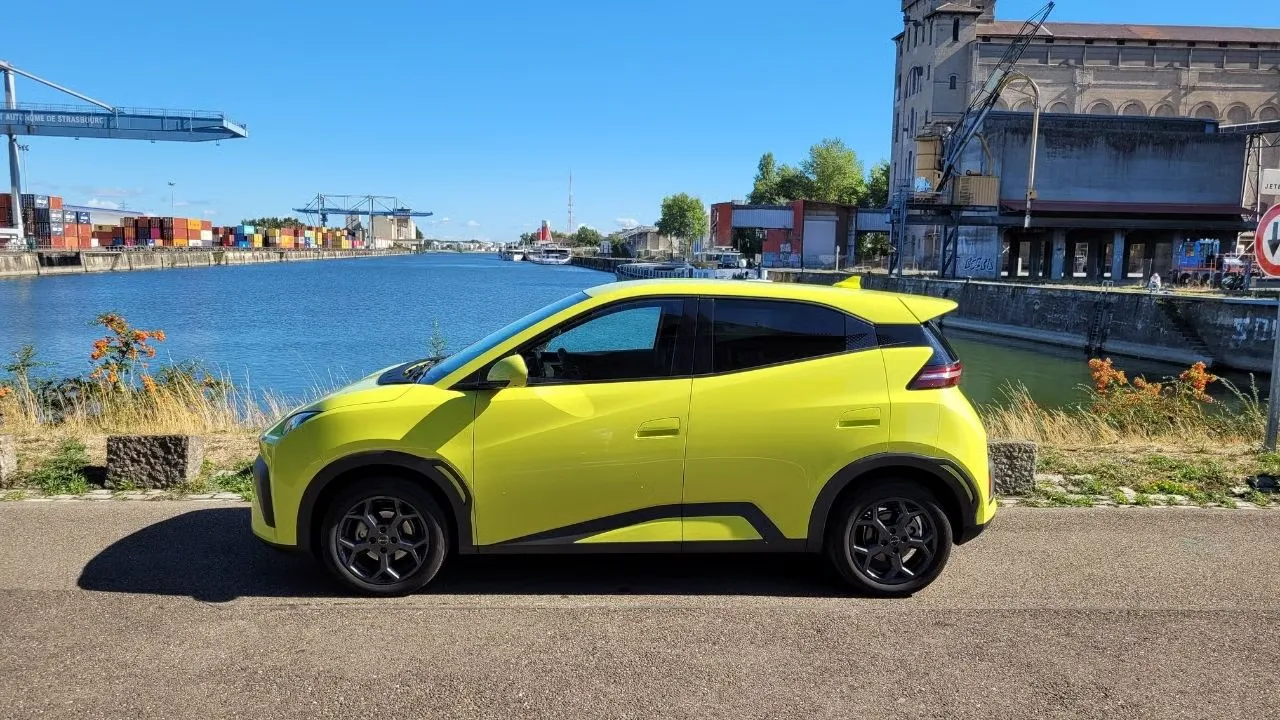
A flaw? On the contrary: I dare say it’s quite refreshing in 2026, when we consistently praise excessively stiff suspensions, oversized tire sidewalls, and hyper-responsive steering to achieve that so trendy yet quickly worn-out “kart feel.” Relax, future Gilles Panizzis: shivering while driving over a cigarette butt might be fun for a short segment to grab your traditional baton from down the street, but some of us also enjoy covering kilometers in plush comfort, even if it bounces a bit. Looking back, and even though it was just a coincidence of the calendar, I’d say it was the perfect model for crossing France from east to west and then back again, from Bas-Rhin to Morbihan and vice versa, all on secondary roads without needing to sign up for a driving service.
Regenerative braking on return.As for range, the advertised 310 km is easily achieved and even exceeded without needing to stay in urban areas: I’ve never seen more than 14 kWh/100 km outside the highway, usually around 11 to 13 on a daily basis, and it can drop below 10 in the city. This brings up two problematic issues: as is common with BYD, the consumption displayed on the dashboard is limited to that recorded over the last 50 kilometers, and as is typical of Chinese manufacturers, the regenerative braking system hardly deserves to be called that, offering only two modes—minimal or non-existent. This is the worst dealbreaker for me, as I really enjoy driving purely on engine power.
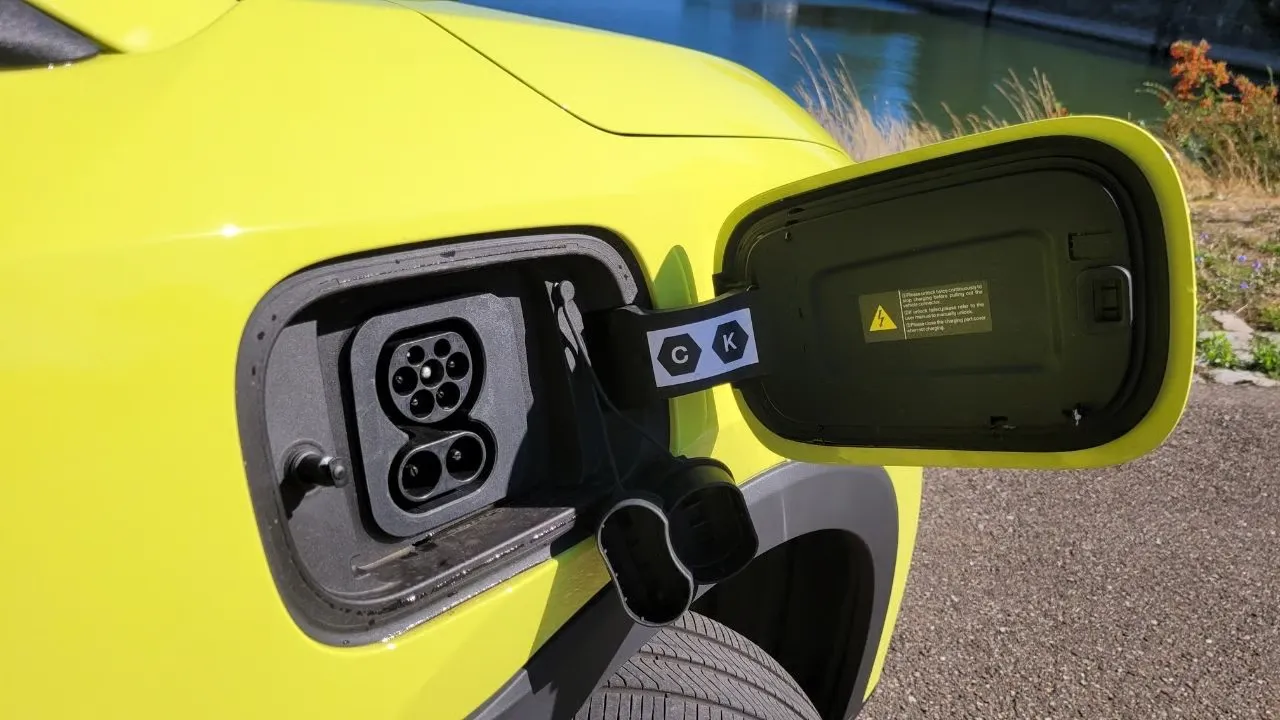
Regarding charging, the BYD Dolphin Surf Comfort can accept up to 11 kW in AC and 85 kW in DC according to the technical specifications. These figures are within the average range for this category and roughly match real-world performance, with a consistently similar charging curve in terms of percentage, including peaks of up to 87 kW. I even created a chart for my Soufyane. During their tests, some journalists complained about the battery’s sensitivity to heat when rapid charging was done consecutively, but after performing five separate two-hour charges on a scorching day, I didn’t notice anything such as that.
Based on my repeated experiences, the official 30-minute time to reach 80% from 10% actually corresponds more to reaching 80% from 15%, but it remains fully acceptable for an urban vehicle.
"But wait, is he finding tons of excuses for this BYD Dolphin Surf or what?" you exclaim, even though you clearly see this isn’t the end of the article and that you should by now be used to my sudden shifts in tone like the one coming up next.
Because the dashboard alone deserves its own paragraph. Its own article. Its own book.
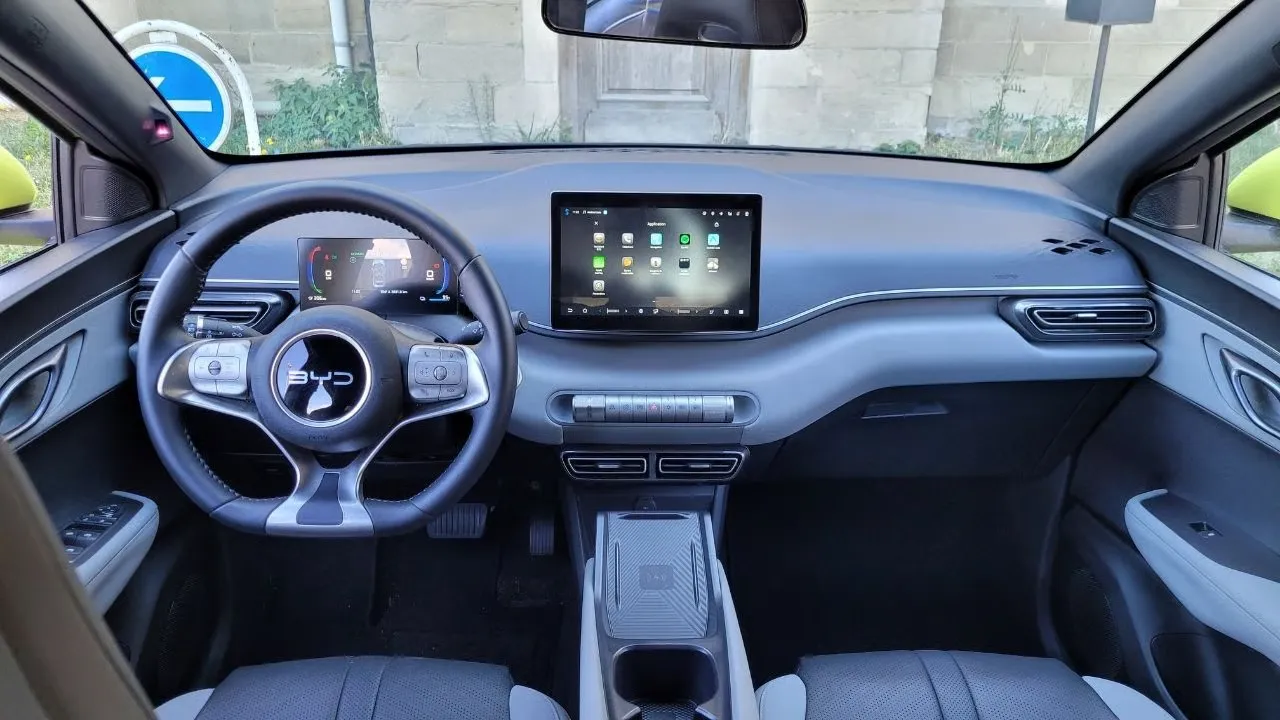
It’s actually a link between daycare centers and nursing homes. It begins with Montessori sensory toys, represented by a series of central controls that all look identical, requiring one to remember how to operate them to activate functions that have nothing in common with each other—ranging from emergency signals and driving modes to air conditioning and volume control. Should you press it like a button? Lower or raise it like a switch? Turn it like a knob? It’s a mystery that must be clarified over and over again. Opposite this age pyramid lies the presbyopia test, represented by instruments with uncomfortably tiny labels despite my progressive glasses (hello, young people), as well as the Parkinson’s test, embodied by a touch screen that demands robotic precision in finger movement to apply pressure.
It’s set at exactly 90° to activate the associated function: any impact, even just one-tenth of a millimeter, will have no effect. Shall we continue? The air vents at the sharp angles are perfectly positioned to release tension from your knees, and the large storage space under the central armrest is only accessible if you have extremely flexible elbows. That’s it.However, not everything in the cabin is completely negative—far from it. The very vertical steering wheel placed directly on your knees, even with the seat adjusted all the way down, at least offers an unobstructed and direct view of the road, which is a pleasure after driving a Renault Twingo for a month, which instead puts you in the role of a postcard from the Lorient Celtic Festival, waiting for mail through the slot in the mailbox.
In terms of comfort and seating quality, the seats match perfectly with the soft suspension, offering a plushness reminiscent of a grandparent’s sofa during Sunday Martin. There is also enough space in the back for a couple of adults (but not more, as it’s a four-seater), with ample room for knees and headrests, along with a seatback that’s angled enough to allow you to rest your head gently on the inner edge of the C-pillar for a perfect nap.
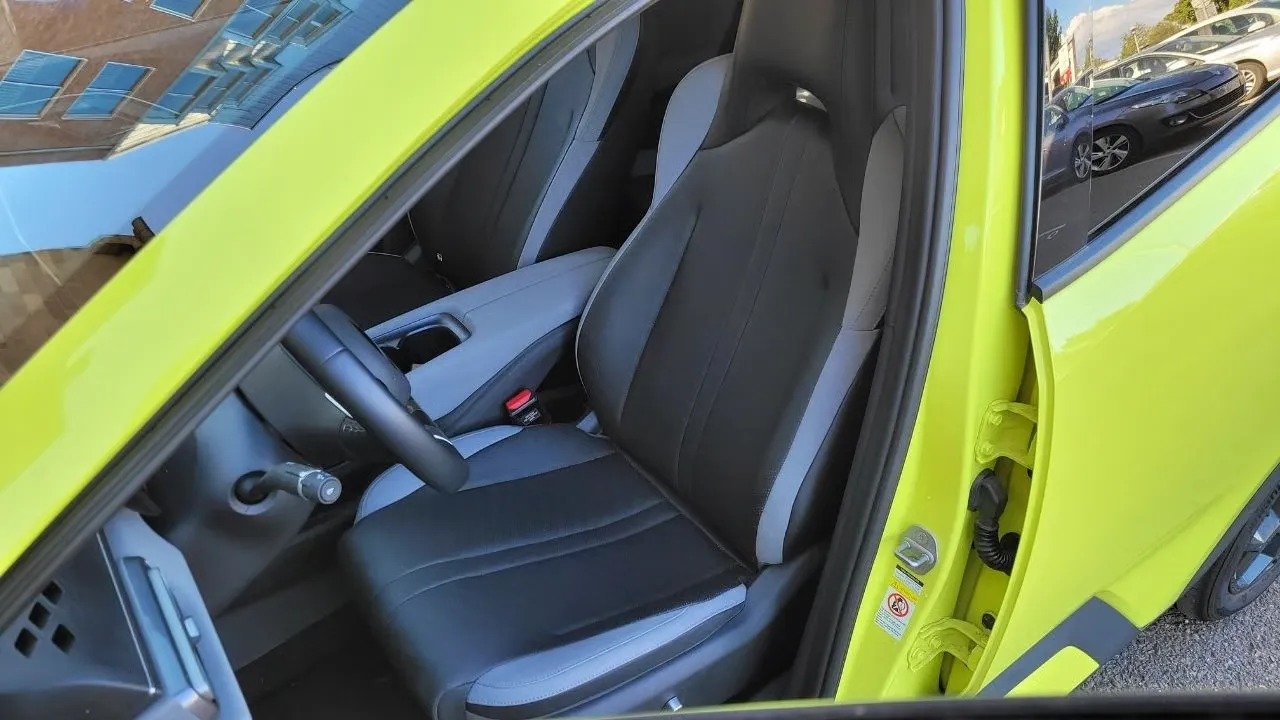
This steep angle, however, has undesirable consequences for the cargo volume, which amounts to a rather modest 308 liters, and it’s in an impractical triangular prism shape. But this is still better than the alternative: you can always place one or two suitcases on the seat, while it’s considered bad etiquette to close the trunk lid with a passenger in a fetal position. Additionally, there is a fairly spacious area under the trunk floor that can be utilized if you’re willing to give up your charging cable.
Regarding the equipment, surprising choices were made when compiling what is still a long list of rare standard features for this category, along with others surprisingly absent: a 360° camera, but no front proximity radar (which is all the more unfortunate given the location of the charging port), a karaoke system to keep passengers entertained during charging, but no rear speakers, heated seats, yet manual climate control. Additionally, it can be said without hesitation that the gimmick of the rotating central screen is already outdated. Finally, no electronic stabilizers are included, along with the annoying overzeal typical of all modern cars. A special mention, however, goes to what I thought was an anti-laughter system the first time it activated during a burst of laughter (my passengers were dying of laughter).
nts): It’s actually the fatigue detector that watches for yawns, which sounds loudly as soon as it spots a tongue, regardless of the reason for that display.Let’s conclude this overview with the prices: in this premium Comfort version, the BYD Dolphin Surf retails for 25,990 €. Its main competitors, based solely on specifications without negotiation or various discounts and bonuses, are the Nissan Micra Autonomie Urbaine starting at 27,500 €, though it would need the more expensive Advance version costing an additional 2,000 € to match its equipment level, and the less fast Hyundai Inster 42 kWh in Intuitie trim at 26,850 €, which offers more features than the Japanese model but still less than the Chinese one. However, subtract 3,535 to 6,186 € from the Micra’s price and 3,600 to 5,800 € from the 5-seater Inster’s price depending on your income as a financial incentive, while the Dolphin Surf must settle for the 365 € CEE Bonus for now. This completely changes the balance, it’s up to you, as the Chinese model then ends up, in the
The least unfavorable option for her would be among the aforementioned Micra 40 kWh Advance or Inster 49 kWh Creative models. Tough choice indeed. However, it seems that BYD is quite open to negotiation—take it or leave it.Also read
Farewell Miireille? Why my electric Seat Mii won’t be replaced by the Fiat Grande Panda
What can I take away from my month-long experience with the BYD Dolphin over nearly 4,000 kilometers? Calling it a “city car” does it no justice: it certainly has the dimensions for urban use and performs well there, but its true strengths emerge beyond city limits, where it excels on small country roads paved with asphalt and where its lack of effective regenerative braking is less of a drawback. Ultimately, it’s an honest workhorse — neither the best nor the worst in every category — but ready to handle any challenge thrown at it, with reliable performance during rapid charging even in high temperatures. And most importantly, despite its competitively low price that comes at the cost of a long list of omitted features, it never gives the impression of being a cheap product.
The cost is high. But to take the place of the Mii is a step I simply can’t make without One Pedal… especially with this folkloric dashboard around.