
ACEA statistics: Electric trucks excel in early markets, electric buses perform well almost everywhere
European customers are buying more buses and trucks again. This is evident from the latest commercial vehicle figures for the first three quarters of 2026 released by the European Automobile Manufacturers Association ACEA. Overall, markets across all propulsion types in the EU increased by 7.5% to 245,079 trucks (3.5 tons and above) and by 15.2% to 32,695 buses. ACEA describes the growth in trucks as a “recovery from a low level,” as demand had cooled significantly in 2025. The association, on the other hand, interprets the figures for the bus market as “strong development” and “solid growth.” Meanwhile, the share of electrically rechargeable vehicles in the overall fleet continues to rise.
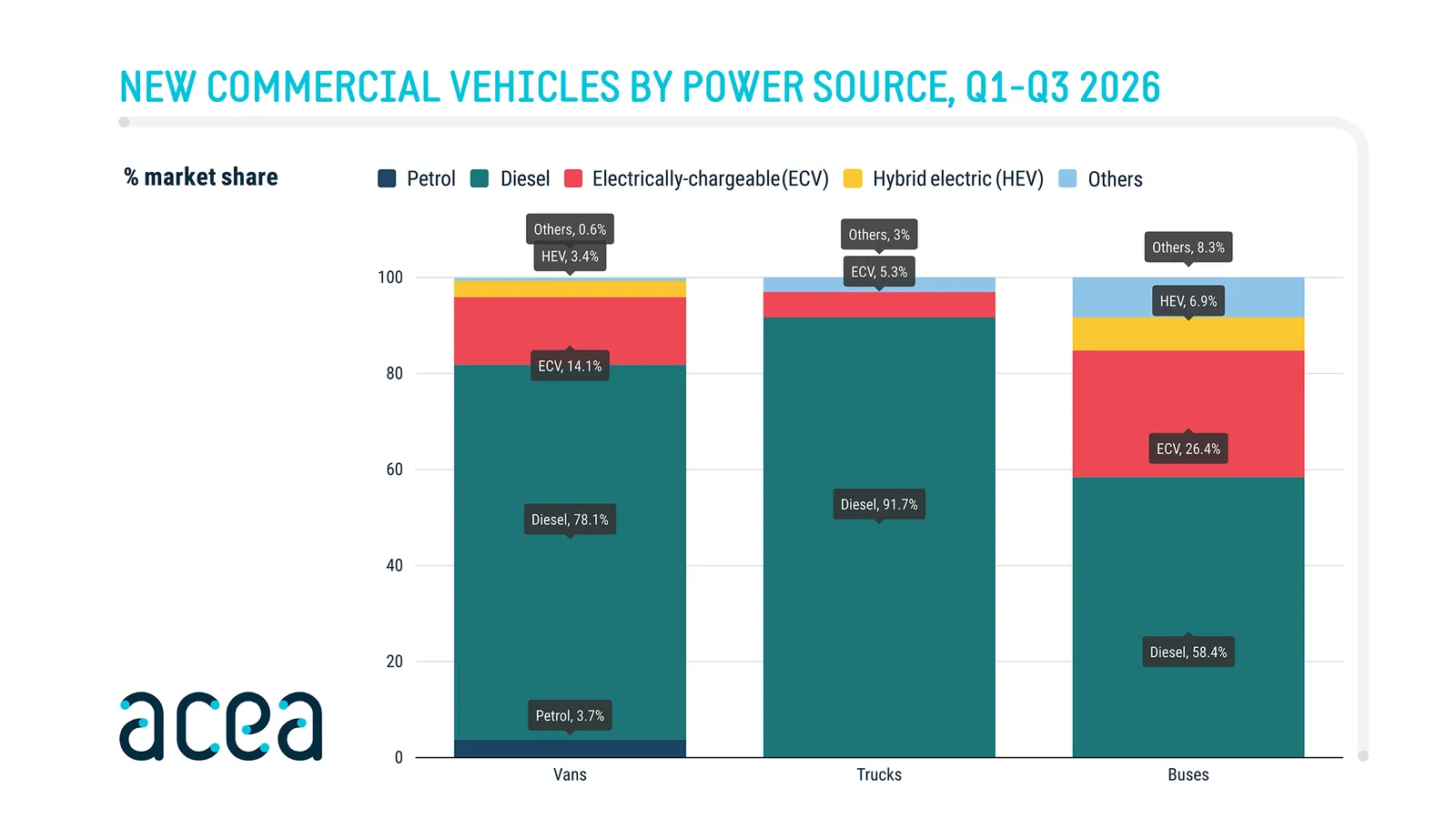
But step by step: quarter by quarter, ACEA tracks the development of commercial vehicle markets in the EU and across Europe. Although the association also provides figures for vans, we are excluding these in this report and focusing solely on trucks over 3.5 tons and buses. In the first three quarters of 2026, diesel accounted for a dominant 91.7 percent share of new EU truck registrations (+6.6% year-on-year). The share of electrically rechargeable trucks rose by 49.9%, reaching a market penetration of 5.3% (compared to 3.8% the previous year). In other words, one in every 20 new trucks is now an electric vehicle. Germany (+77.2% year-on-year), France (+60.2% year-on-year), and the Netherlands (+57.5% year-on-year) led this expansion. Together, these three markets accounted for 74 percent of total registrations in this segment.
Poland Shows Remarkable Growth in Electric Buses
In terms of buses, new electric bus registrations increased by 37.6 percent in the first nine months of the year, raising their market share from 22.1 percent to 26.4 percent. Italy, now the largest market based on total registrations, experienced particularly strong growth in electric buses (+116% year-on-year). Notable is also the development in Poland, where 1,000 new electric buses were registered after just three out of four quarters (+557% year-on-year). More on this shortly. According to ACEA, registrations of diesel buses and non-externally chargeable hybrid buses also rose (+5% and 24% year-on-year), accounting for 58.4 percent and 6.9 percent of the market respectively from January to September.
Before we take a closer look at the country rankings, let’s briefly clarify some terms: In the truck category, ACEA divides its statistics into different weight ranges. It classifies trucks with 3.5 to 16 tons as medium-duty trucks, while all vehicles over 16 tons are considered heavy-duty trucks. Anything under 3.5 tons falls under the category of vans, which are not the focus here. For buses, ACEA does not differentiate by weight class; it simply includes all vehicles designed for passenger transport weighing 3.5 tons or more. Additionally, the association does not distinguish between purely battery-electric vehicles and plug-in hybrids, grouping them together as “electrically chargeable” vehicles.
Medium-duty electric trucks account for 20% of registrations
Looking at the statistics: When focusing on medium-duty trucks with a weight range of 3.5 to 16 tons, it becomes clear that this segment managed only a slight increase across the EU, with just over 39,000 units registered (+2.5% year-on-year). However, within this class, plug-in vehicles saw a significant rise, with 7,753 units registered (+44% year-on-year). As a result, externally chargeable trucks in this weight category now account for 19.8% of registrations. For comparison, during the same period in 2025, their market share was only 14.1%. This once again shows that it is primarily medium-duty electric trucks driving the electrification of Europe’s truck market.
In the first nine months of 2026 alone, 3,879 medium-weight electric trucks hit the roads in Germany, accounting for exactly 50 percent of all newly registered electric trucks across the EU. Thus, Germany’s growth rate of 72 percent is significantly higher than the EU average. The Netherlands (1,195 units, +40% year-on-year), France (974, +86% year-on-year), Spain (320, +36% year-on-year), and Poland (135, +90% year-on-year) also recorded high growth rates in terms of relevant numbers. In contrast, figures in Italy (200, -56%) and Belgium (42, -58% year-on-year) dropped sharply. Sweden saw little change (443, +5% year-on-year). Looking at the entire Europe, the United Kingdom is Germany’s closest competitor, with 2,960 electric trucks up to 16 tons (+55% year-on-year). EFTA countries Iceland (94, +571% year-on-year) and Norway (445, +104% year-on-year) are also making strong progress in this segment.
Germany Leads in Heavy Electric Trucks
These heavy trucks weighing 16 tons or more account for the much larger volume in the EU. Out of 205,857 total registrations (+8.5% year-on-year), there were 5,120 electric trucks between January and September — representing a 2.5% share of electric vehicles (compared to 1.7% the previous year). Germany again stands out here with 1,722 units (+91% year-on-year), reflecting strong growth compared to the entire year 2025 (+38% from 2024). This also means that 33.6% of all heavy electric trucks in the EU were registered in Germany during the first three quarters, driving growth across the entire EU. Above the average growth rate in this segment within the Union (+59.9% year-on-year) are the Netherlands (1,022 units, +84% year-on-year), Austria (393, +84% year-on-year), and Denmark (271, +62% year-on-year).
Switzerland once again stands out among electric trucks. This small Alpine country registered 605 electric trucks over 16 tons so far this year (+62% YoY), achieving an electric vehicle share of 24% in this weight class. This is the highest rate in Europe. For comparison, ACEA reports an electric vehicle share of 4.2% among heavy trucks in Germany. Only Norway (14.4% electric share among new heavy trucks), the Netherlands, and Sweden (11.1% and 10.3% respectively) have double-digit rates.
Next, we look at the ACEA statistics on the pan-European bus market. Here, plug-in vehicles have long been established as a standard. Of the 32,695 new buses (+15.2% year-on-year) in the EU between January and September, 8,633 were electrically chargeable—accounting for 26.4%. For comparison, the average share of electric buses across the entire year 2025 was still 23.8%. The trend is clearly upward.
The overall bus market, regardless of propulsion type, is on the rise, largely due to large markets such as Italy (+34.4%), France (+10.5%), and Germany (+10.1%), each with over 5,000 new registrations. Meanwhile, Poland saw a remarkable increase in registrations of 69%, reaching around 3,100 units—and thus became the fourth-largest bus market in the EU.
Italy to Become the Largest EU Bus Market
In terms of electric bus registrations, Italy also leads the way—with 1,970 new plug-in buses registered so far this year (+116% YoY), followed by rapidly growing markets such as Poland (999, +557% YoY) and Portugal (642, +379% YoY), as well as stable market countries like the Netherlands (783, +86% YoY) and France (665, +33% YoY). In contrast, Germany, Sweden, and Belgium have seen significant declines. The Federal Republic registered 836 units in the first three quarters, 30% below the same period last year when 1,202 units were registered. Sweden and Belgium experienced even steeper drops of -40% and -71%, respectively. For context, 2025 as a whole was also a very strong year in the Federal Republic, so the figure cited by ACEA likely reflects normalization of electric bus registrations.
Notably, electric buses show a much more homogeneous picture across the EU compared to electric trucks. Seventeen of the 27 EU countries reported double- or triple-digit registrations of electric buses last year. On a pan-European scale, the UK remains the leader in total bus registrations — but not as unchallenged as before. In the first nine months of the year, the country recorded 5,672 new registrations (-27% YoY). Interestingly, in terms of new plug-in buses, the UK lost its top position to Italy (1,970 units) this year, with only 1,727 units registered (-22.7% YoY). The share of electric buses among the new leaders has now risen to 37%, while it stands at 30% in the UK. Interestingly, Romania and the Netherlands have the highest penetration of electric buses according to current statistics, with an electric bus share of 82%.
or 75 percent.