
At 20,000 km/h, this ‘oblique detonation’ aviation engine would allow crossing the Atlantic from one side to the other in 2 minutes

The idea of detonation engines (oblique or rotary) is not entirely new. Similar concepts emerged in the United States and other powers during the Cold War with the goal of propelling aircraft and missiles at hypersonic speeds, but they were abandoned due to their technical complexity.
Researchers at the Chinese Academy of Sciences (CAS) have reported progress in hypersonic propulsion by applying theoretical concepts from decades ago and testing them under simulated flight conditions. The revival of these concepts in China reflects both advances in materials and computational modeling as well as a renewed global interest in hypersonic propulsion that could overcome the limitations of scramjets or traditional rocket stages.
Challenging the laws of physics
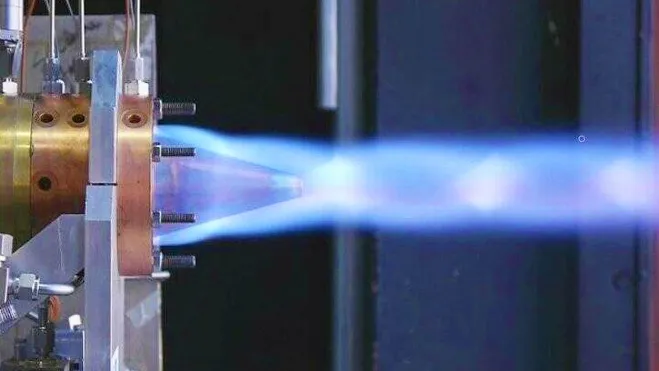
The research was conducted in Beijing’s JF‑12 shock tunnel, a facility capable of replicating high-altitude flight conditions above 40 km, allowing for the simulation of hypersonic speeds without leaving the ground. The technology involves an oblique detonation engine (ODE) that uses standard aviation kerosene (RP‑3) to attempt to achieve speeds approaching Mach 16, or about 19,600 km/h.
During the tests, the teams managed to generate and maintain what is known as an oblique detonation wave—self-stabilizing shock structures that complete the combustion of air and fuel mixtures in extremely short times, with combustion rates reported to be 1,000 times faster than those of traditional scramjet engines.
In practice, such theoretical performance would allow an aircraft to reach speeds that, if sustainable in actual flight, would radically transform travel times. For example, crossing the Atlantic Ocean in about two minutes would have been impossible so far with conventional propulsion systems.
However, the officials making the announcement and propulsion experts note that these figures still refer to test environments in wind tunnels, not operational vehicles.
What it is and how it works
The oblique detonation engine relies on a principle different from that of conventional jet engines. Unlike turbojets or scramjet engines, which require multiple stages of compression and air mixing before combustion, ODE uses oblique shock waves to detonate the air-fuel mixture directly within the combustion chamber.
A key element in the design tested by Chinese scientists is the use of a component just 5 mm in size strategically placed in the combustion chamber to induce these self-sustaining detonations, referred to in reports as “detonation diamonds.” This configuration simplifies the engine’s architecture and improves thermodynamic efficiency while potentially reducing the overall weight of the system.
The bad news: there is no electricity here. The use of RP-3 kerosene, a common fuel in both civil and military aviation, has two implications: on one hand, it simplifies logistics and production if the system proves viable; on the other hand, it keeps this technology separate from systems that rely on exotic or highly specialized fuels.
From laboratory tests to operational reality
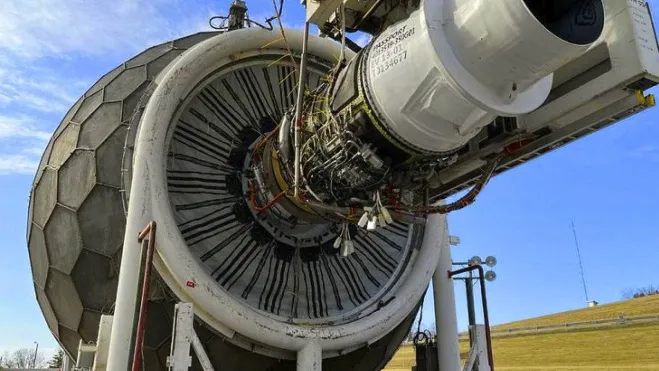
The aerospace and defense industries warn that these achievements are still a long way from translating into operational hypersonic aircraft or missiles. Wind tunnel tests are essential for testing concepts, but replicating those conditions in an engine that functions stably in actual flight presents significant additional technical challenges: thermal management, structural integrity, flow control at varying altitudes, and adapting propulsion to the real flight environment, to name a few.
In addition, although an engine may produce spectacular results in simulation or a controlled environment, moving on to a flying prototype introduces uncertainties. Many previous experimental hypersonic systems have shown promising capabilities in test beds, but they stall at development stages when faced with problems such as vibration, thermal stability, or integration with guidance and flight control systems.
Advancements of this kind typically have a strong military component as well. Hypersonic speeds not only accelerate civilian transportation but also transform the landscape of weapons and strategic defense systems. A system capable of flying at Mach 16 would greatly complicate existing interception strategies and could grant attack vectors as well as reconnaissance platforms unprecedented range and speed capabilities.