
8 m³ of volume, 1,200 kg of payload, 460 km of range, and 23 versions: this is the KIA PV7, the most innovative electric van on the market
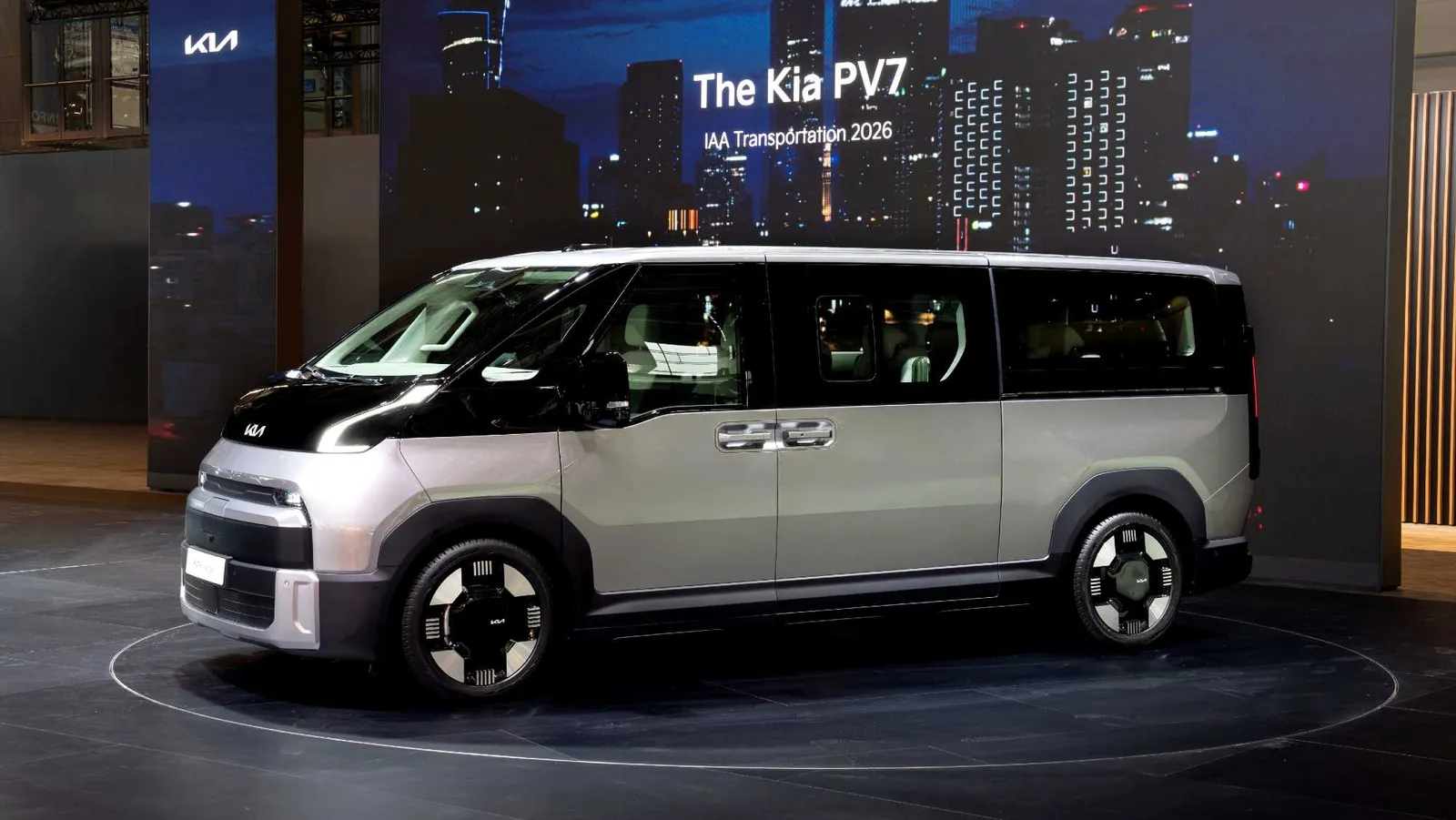
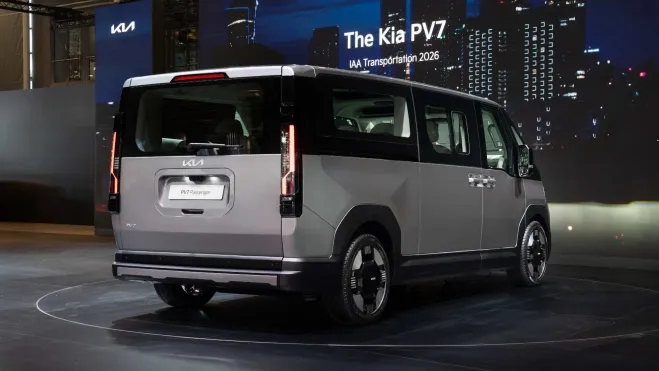
Kia unveiled the PV7 at IAA Transportation 2026 in Hannover, Germany, as the second model in its lineup of electric light commercial vehicles developed on the PBV (Platform Beyond Vehicle) platform, following the PV5. It will initially be available in Cargo and Passenger versions and reach South Korea and Europe during the second half of 2027, with the range later expanding to include new variants, derivatives, and markets.
The PV7 uses the specific E-GMP.S electrical architecture with a flat floor to make better use of interior space. Its development is based on the “Tool Box” concept, aimed at adapting the vehicle to various professional needs. Unlike the more urban-focused PV5, the PV7 offers larger dimensions, capacity, and load capacity for logistics, delivery, fleet, passenger transport, and other applications. It has a length of 5,350 mm, width of 1,995 mm, height of 1,990 mm, and a wheelbase of 3,500 mm.
Up to 23 different versions
The PV7 Cargo is available in two or three-seater configurations. The Cargo Long version offers up to 6.1 m³ of cargo volume per VDA standards, while the Cargo High Roof model reaches 8.0 m³. The maximum payload is 1,165 kg in the Long version and 1,200 kg in the Compact version. The Long model has a cargo height of 550 mm and can accommodate up to three European pallets measuring 800 × 1,200 mm. Additionally, the floor can be adapted for different uses, and there are two options for the rear door: a double-door design that opens fully or a conventional liftgate. Its specific features include automatic closing of the electric side door when the driver moves away using a smart key, remote checking of the cargo door status, a partition with walk-through access, and independent locking and unlocking of the cargo doors.
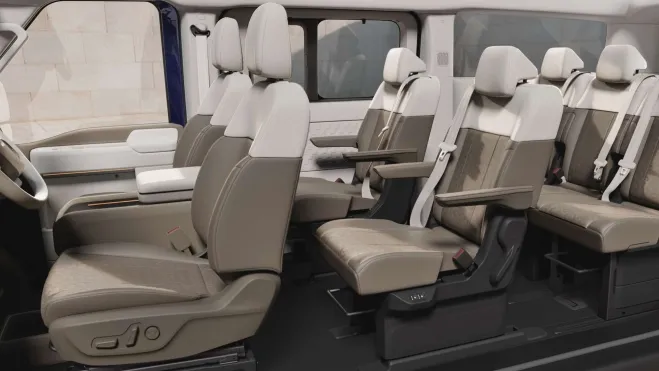
The PV7 Passenger is designed for transporting workers, shuttle services and rentals, as well as tourism and family use. It can carry up to nine passengers in international markets and up to 11 in Korea, while the seven-seater version features Long-Rail Easy Remove seats that allow for adjusting the interior layout. The nine-seater model can have or not have a fourth row. It also comes equipped with rear air conditioning, 100 W USB-C ports, and various storage solutions.
In either case, it uses nickel-cobalt-manganese (NCM) batteries with capacities of 71.5 and 96.2 kWh, depending on the configuration and market. The electric system delivers up to 200 kW of power and 420 Nm of torque, which are sent to the front wheels, though an all-wheel-drive version is planned for the future. The PV7 Cargo Long is the most powerful model, achieving over 460 km of electric range according to the WLTP cycle. Its 800-volt architecture allows it to go from 10% to 80% charge in about 20 minutes using a 350 kW fast DC charger. Notably, it features two charging ports: one front port with AC/DC capabilities and another rear side port for alternating current, which is optional.
Kia President and CEO Ho Sung Song said, “By combining hardware developed for specific applications, software tailored to business needs, and exclusive services for PBVs, the PV7 goes beyond being just a vehicle to offer a comprehensive business solution that helps customers achieve greater productivity, flexibility, and long-term value.”
A highly comprehensive suite of features
The Pleos Connect multimedia system, based on Android Automotive OS, provides connected navigation, various screen configurations, an open app store, and wireless updates. It also integrates the Gleo AI voice assistant, and the Vehicle-to-Load (V2L) function allows using the battery to power tools, work equipment, and other devices through interior and exterior outlets.
In terms of safety, the PV7 is equipped with seven airbags, including a front airbag for the passenger seated in the roof area, as well as the Pedal Misapplication Safety Assist 2.0 system designed to reduce the risk of unintended acceleration from incorrect pedal use. The driving assistance features include emergency autonomous braking (FCA), lane keeping assist (LKA 2.0), navigation-based intelligent cruise control (NSCC), highway driving assist (HDA 2.0), front, side, and rear parking sensors, remote parking assistance (RSPA), a rear camera, and 360-degree surround view.
The planned lineup will include 23 variants, covering the Cargo Compact, Cargo Long, and Cargo High Roof versions, Passenger Compact and Passenger Long models, a Chassis Cab variant for special applications, and various converted models.