
783 km of range, 10% to 97% charging in 9 minutes, starting at 24,660 euros: BYD’s new model impresses
BYD’s brand focused on more adventurous models to date, Fangchengbao, has just made a significant shift in its lineup with the launch of its first electric sedan models. The new Fangcheng S and Fangcheng S GT now have official prices in China, with a range that has even surprised the most optimistic observers.
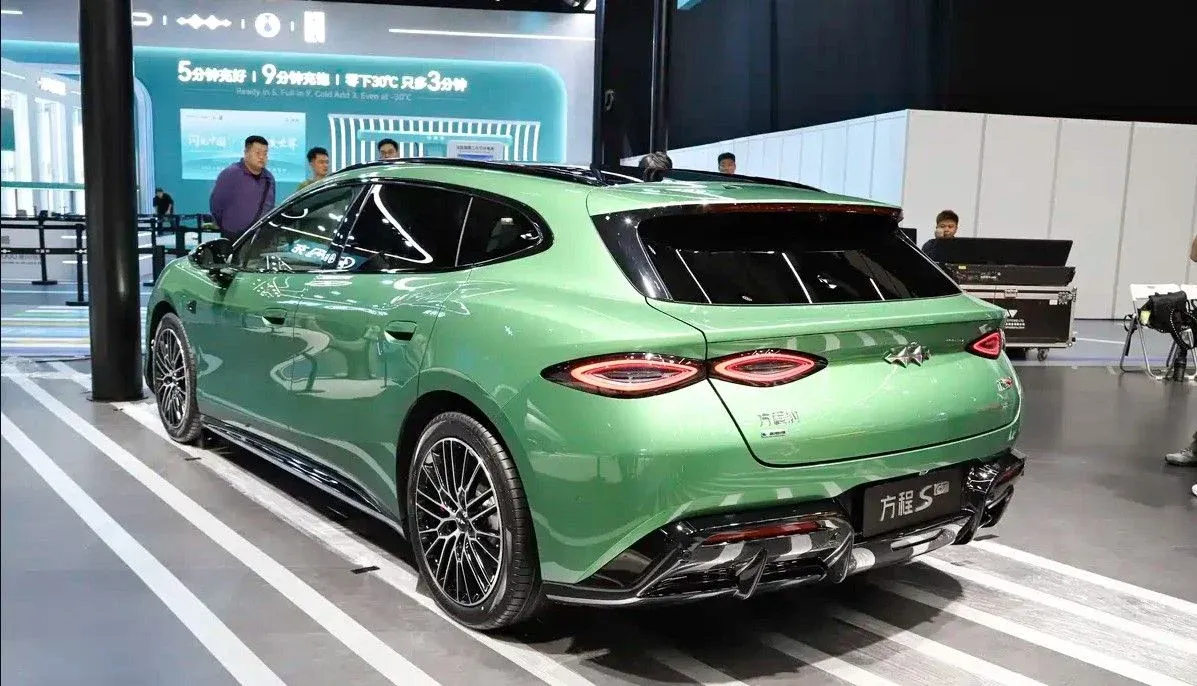
The Fangcheng S features a sporty sedan layout, while the Fangcheng S GT adopts a sporty-style family wagon body. Both are large-sized models that share much of their technology, including the 800-volt platform, BYD’s second-generation Blade batteries, and in certain versions, the new Yunian-M intelligent suspension with magnetorheological technology. The maximum range claimed is 900 kilometers under China’s CLTC cycle, which translates to approximately 783 kilometers according to the equivalent WLTP estimate.
The launch took place on September 16, marking Fangchengbao’s entry into a segment entirely different from its well-known SUVs. The brand retains for these vehicles the design language it previously showcased with the Formula X sports car, but applied to a body style more practical for everyday use.
A very sporty design and two body styles for the same concept
The Fangcheng S features very low and wide proportions. It measures 5.06 meters in length, 1.97 meters in width, and 1.48 meters in height, with a wheelbase of 2,960 mm. The Fangcheng S GT is slightly shorter at 5.03 meters in length, while maintaining the same 1.97 meters width, 1.48 meters height, and wheelbase.
Both models adopt a design language called “living metal aesthetics,” inherited from the Formula X. The front is dominated by the “Fengbao Eye” headlights, featuring a luminous design made up of two U-shaped elements, while the lower part includes several air intakes. A laser radar associated with the driving assistance system is also located on the roof.
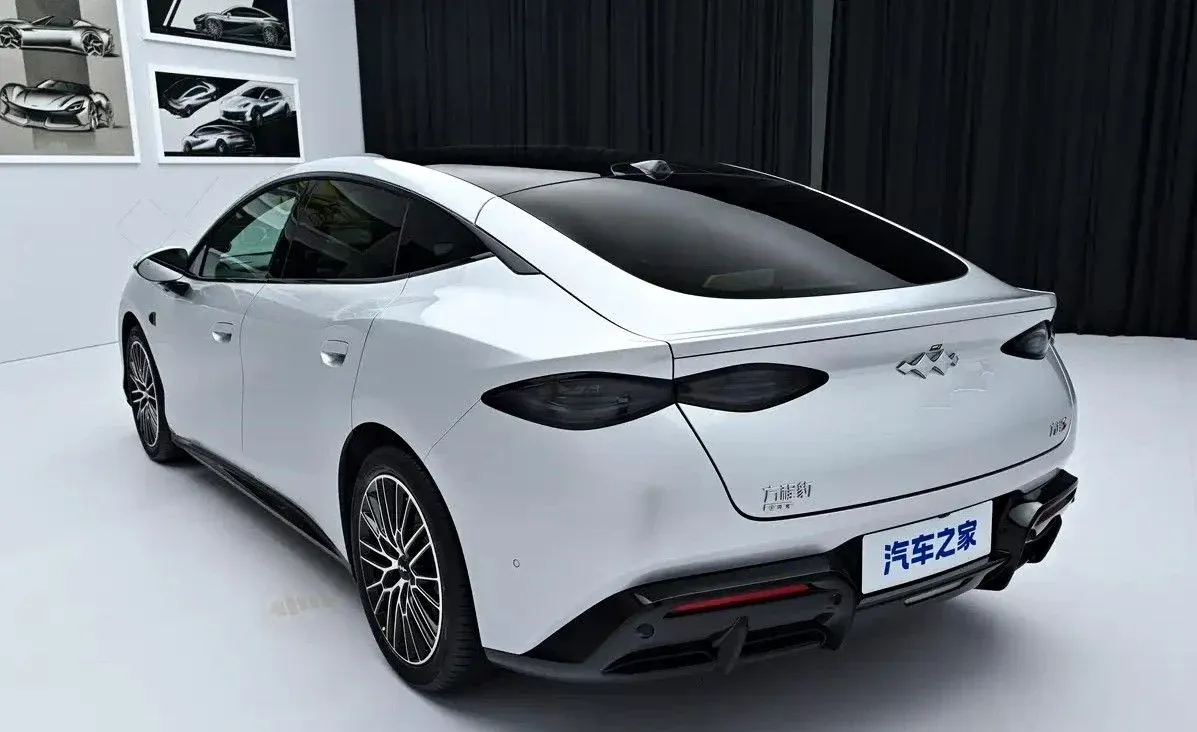
Aerodynamics played a significant role in its development. The Fangcheng S has an aerodynamic coefficient of 0.22, while the Fangcheng S GT is at 0.25. The main differences between the two lie in the rear section: the S model features a three-box silhouette with a sharply sloping roof and a small spoiler, whereas the S GT uses a sporty family-style body design with a rear hatch.
In both cases we find large tires, red brake calipers, and rear lights called “Infinite Ring,” whose glowing logo forms four geometric shapes when turned on. The exterior range offers six colors, and it’s also possible to add a paint finish that can be removed later to change the car’s appearance.
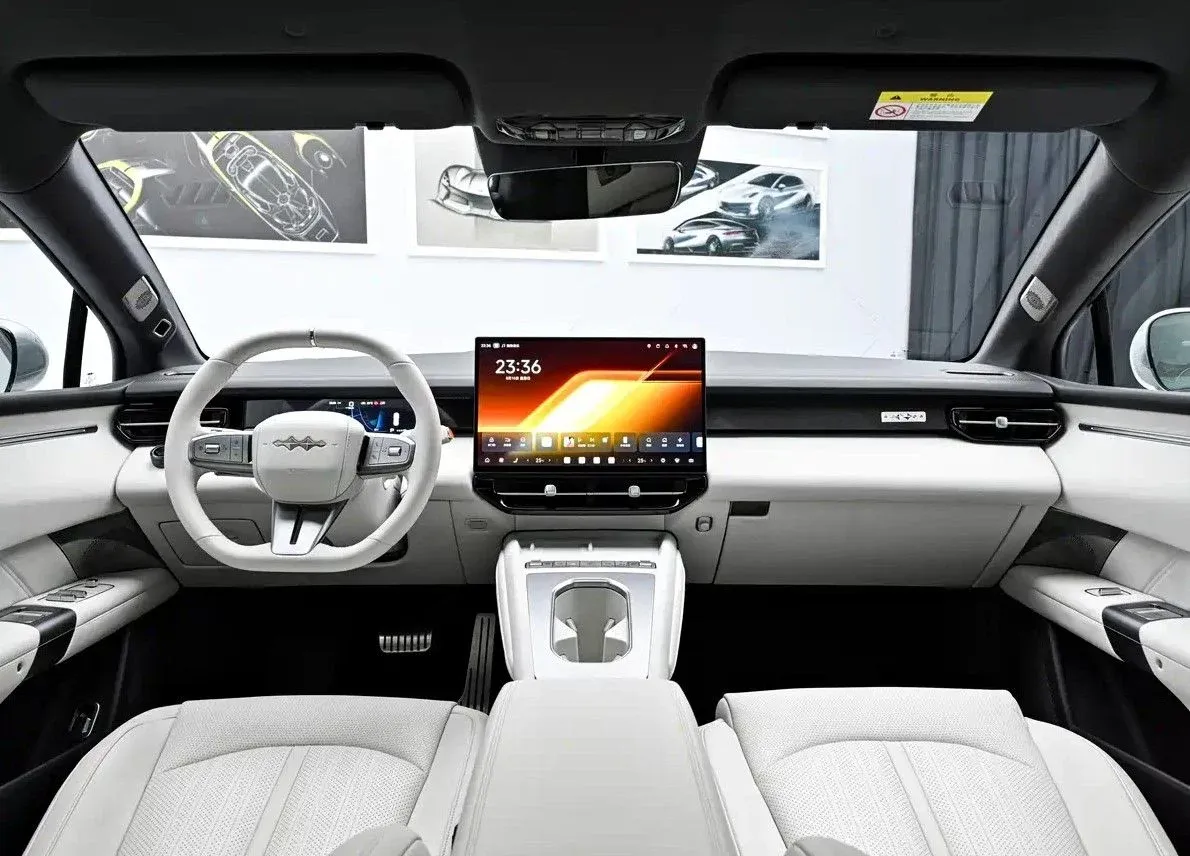
The interior follows a slightly different philosophy. Contrasting with the aggressive exterior design, Fangchengbao has opted for an interior that combines technology with a more comfortable atmosphere. There are three interior color combinations, 128-color ambient lighting, a floating central screen, and an integrated instrument panel.
The storage capacity hasn’t been neglected either. The Fangcheng S features a 151-liter electric front trunk, a 600-liter rear trunk, and up to 40 different storage spaces throughout the cabin.
Fangchengbao also presents the interior as a kind of customizable space. The next-generation Smart Ecology 2.0 system allows adding various accessories through magnetic connections, screw attachments, and other mounting points. Among the announced options are additional physical controls, ambient lighting, customizable buttons, and even accessories designed to turn the cabin into a small entertainment area.
Regarding driving assistance, the Fangcheng S and S GT come equipped with BYD’s DiPilot/Tianshen Eye B system, paired with a laser radar. Its functions include highway assist, urban navigation aid, and automatic parking. In any case, these are assistance systems rather than fully autonomous driving capabilities.
The lineup includes both rear-wheel drive and all-wheel drive versions. The Fangcheng S offers two power levels in its rear-wheel drive variants, at 245 and 300 kW, while the all-wheel drive versions achieve a combined power of 490 kW. The Fangcheng S GT uses 300 kW in its rear-wheel drive versions and also reaches 490 kW when equipped with two motors.
With 490 kW, the all-wheel drive system enables the Fangcheng S to reach 100 km/h from a standstill in 3.6 seconds, a figure that places this over-five-meter-long sedan in a clearly performance-oriented category.
The most interesting part, however, is likely in the suspension system. The Fangcheng S introduces the Yunian-M, an intelligent magnetorheological suspension that utilizes the properties of a magnetorheological fluid to modify its behavior within milliseconds.
The system can adjust the suspension’s response and also use data from sensors to anticipate irregularities in the road surface. Fangchengbao also plans for future OTA updates to improve the algorithms that control the chassis.
The versions with Yunian-A use a combination of dual-chamber air suspension and variable-damping shock absorbers, while the entry-level model relies on Yunian-C. The range also includes a specific driving mode for slippery conditions and an assistance function for such driving scenarios.

To power this entire system, the Fangcheng S uses BYD’s second-generation Blade batteries and an 800-volt electrical architecture. The range offers different capacities and configurations to achieve the various range figures announced by the manufacturer.
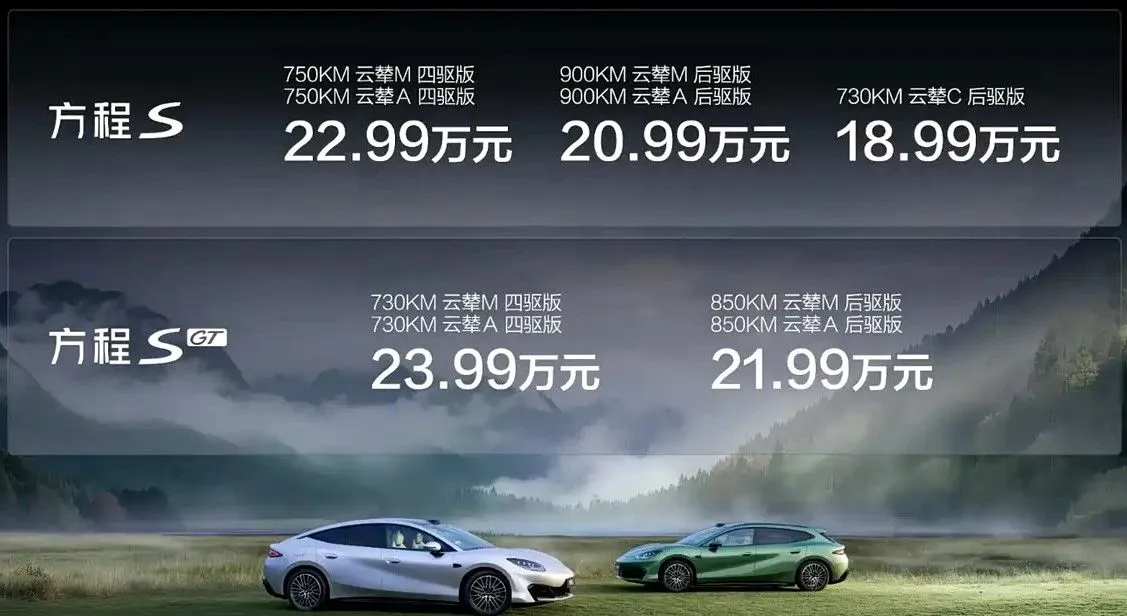
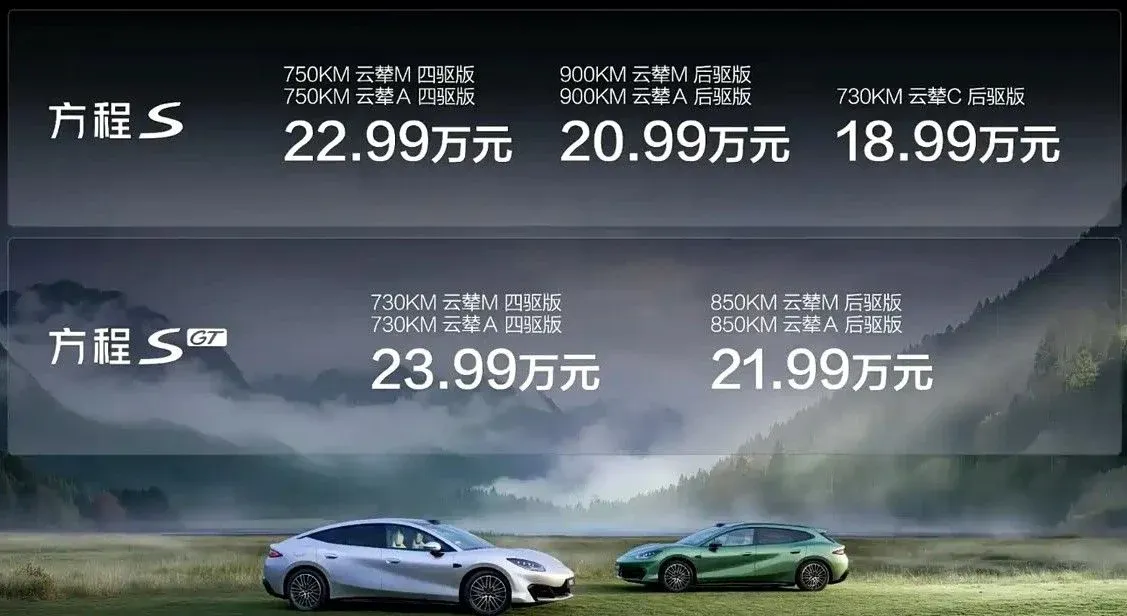
The Fangcheng S offers 730 kilometers CLTC in its base version, 900 kilometers CLTC in the higher-range rear-wheel-drive versions, and 750 kilometers CLTC in the all-wheel-drive variants. Applying a 13% reduction estimate compared to the Chinese cycle, this translates to approximately 635, 783, and 653 kilometers respectively, on a WLTP-equivalent basis.
The Fangcheng S GT provides 850 kilometers CLTC in its rear-wheel-drive versions, which is roughly equivalent to an estimated 740 kilometers, while the all-wheel-drive variants claim 730 kilometers CLTC, corresponding to about 635 kilometers estimated.
But if there’s one feature that stands out particularly in this range, it’s the charging time. The fast charging system allows the battery to go from 10% to 70% in just 5 minutes, while it takes about 9 minutes to reach 10% to 97%, according to official data. This is one of the most impressive figures of the new model and a demonstration of how far BYD has taken its high-power charging systems.
As for prices, the Fangcheng S starts at 18.99 million yuan, while the Fangcheng S GT begins at 21.99 million yuan. The range is structured as follows:
Model
Version
CLTC Range
Estimated Range
Drive Type
Power Output
Fangcheng S
Yunian-C
730 km
~635 km
Rear-wheel drive
245 kW
Fangcheng S
Yunian-A
900 km
~783 km
Rear-wheel drive
300 kW
Fangcheng S
Yunian-M
900 km
~783 km
Rear
300 kW
Fangcheng S
Yunian-A
750 km
~653 km
Total
490 kW
Fangcheng S
Yunian-M
750 km
~653 km
Total
490 kW
Fangcheng S GT
Yunian-A
850 km
~740 km
Rear
300 kW
Fangcheng S GT
Yunian-M
850 km
~740 km
Rear
300 kW
Fangcheng S GT
Yunian-A
730 km
~635 km
Total
490 kW
Fangcheng S GT
Yunian-M
730 km
~635 km
Total
490 kW
With these two models, Fangchengbao enters the market for electric sports sedans for the first time, moving beyond the SUV and off-road vehicle segment. The Fangcheng S aims to combine a five-meter long body with long range, extremely fast charging, and a chassis designed for a more sporty driving experience, while the S GT adds a family-oriented body style that also emphasizes versatility.
The arrival in Europe is not yet mentioned in the announcement made in China, so we will have to wait to find out whether Fangchengbao plans to export these models and, more importantly, with what specifications and prices.