
634 GWh installed and only 24 failures in a year: the giant battery industry has found a formula that cuts failures in half
30/10/2026 15:00
Updated to
30/10/2026 15:00
Energy storage systems using batteries are seeing significant advancements in terms of safety. A new study by the Electric Power Research Institute (EPRI) shows that despite the increase in installed capacity worldwide, the frequency of serious incidents has decreased substantially over the past seven years. The analysis also identifies which installations pose the greatest risks and what aspects still need improvement.
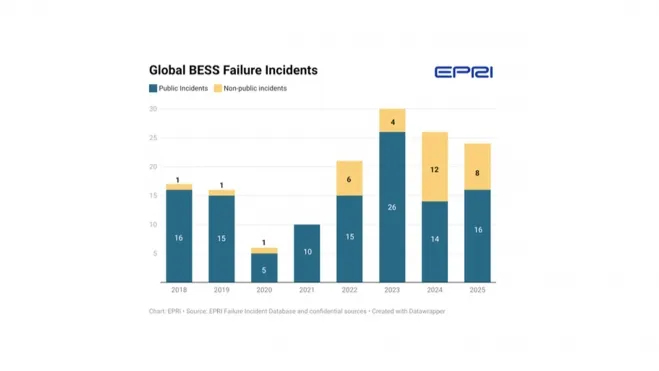
One of the most significant findings comes from comparing the last two periods. In 2024, there were 26 incidents with a cumulative global capacity of 343 GWh, while in 2025 the figure dropped to 24 despite the deployed storage capacity increasing to 634 GWh. This trend represents a nearly 50% reduction in the annual failure rate per unit of installed capacity.
Fire incidents in large batteries have decreased by 98% since 2018
The report Risk Factors and Failure Statistics of Lithium Ion BESS, published on October 5, 2026, shows an accumulated 98% reduction in the failure rate per GWh between 2018 and 2025. To conduct this study, EPRI used a database containing 150 international incidents from that period, including 33 cases that were not made public but were confirmed by industry experts.
The research covers only incidents of significant severity, such as fires, explosions, or electrical arcing, and therefore does not include minor malfunctions or operational disruptions. According to the institute, improvements in battery management systems, operating procedures, and safety standards account for much of this improvement, especially during the early years of the analyzed period.
Old systems and indoor installations pose the greatest risks
The location and age of equipment are two key factors. The study finds a higher prevalence of indoor installations among recorded incidents, along with generally more severe damage when failures occur. For this reason, it recommends installing protective barriers and compartmentalization systems to limit the consequences of potential fires, especially in installations within buildings.
Regarding human safety, 93% of the documented incidents reported no victims or injuries. There were also no reports of acute injuries among the general public or cases of fire spreading outside the facility in the network-scale storage incidents included in the records. In the United States, the institute has not identified any new injuries since the accident that occurred in Surprise, Arizona, in 2019.
The research also indicates that first-generation units require special attention, as newer systems have lower failure rates. EPRI advises evaluating older installations and examining their suitability for current safety requirements. Regarding the various chemicals in batteries, the available data do not allow it to be concluded that a specific composition alone implies a higher risk, due to the influence of other technical and operational factors.
Despite these results, the agency warns that the sector still lacks sufficient experience regarding the behavior of these facilities at the end of their useful life. It also acknowledges the possible existence of undocumented incidents. Therefore, it considers it necessary to enhance information sharing and establish data-driven preventive measures in a market where new facilities generated over 300 GWh in 2025.