
621 kWh, 500 km of range and 24 tons of payload: Mercedes unveils its new heavy-duty electric truck
15/09/2026 11:00
Updated to
15/09/2026 11:00
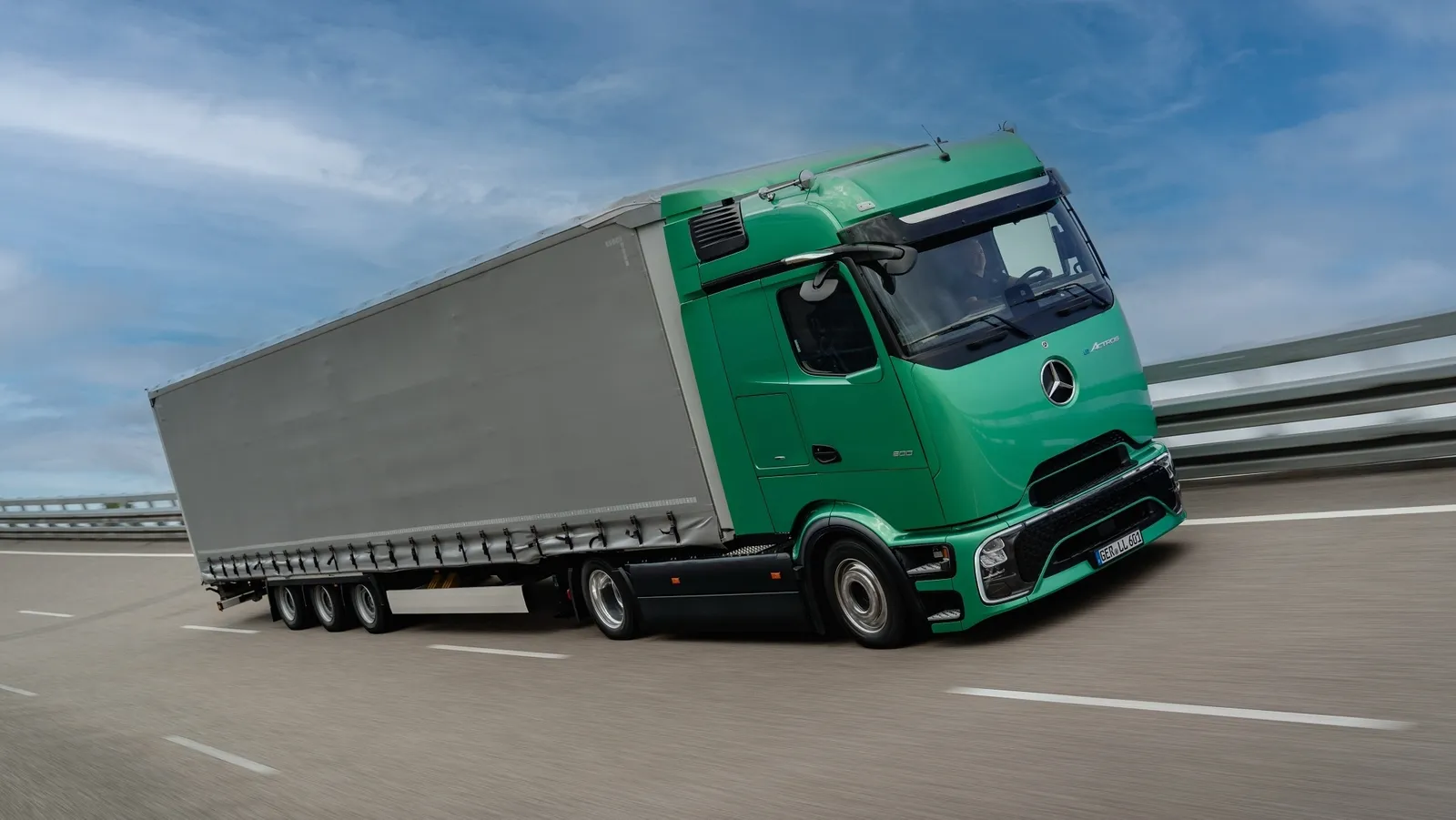
Heavy haul transportation has a particular obsession: achieving every possible centimeter of internal height without exceeding legal limits. This is precisely the problem that Mercedes-Benz Trucks has just solved with the eActros Lowliner, unveiled to the public at the IAA Transportation exhibition in Hannover. It represents the latest addition to their range of electric trucks, coming with a very specific goal: making electrification profitable in a segment where the numbers haven’t always added up until now.
The new model does not start from scratch. It uses the same technological concept as the eActros 600, which has been in production and operation since late 2024, but its architecture is adapted to fit the typical lowliner chassis — those trucks with a lowered platform that allow trailers to meet legal height limits while still retaining loading space. Orders will be accepted in the EU30 markets and other countries starting in the third quarter of 2026, while mass production at the Wörth plant will begin in the second quarter of 2027.
The batteries are tilted to gain height
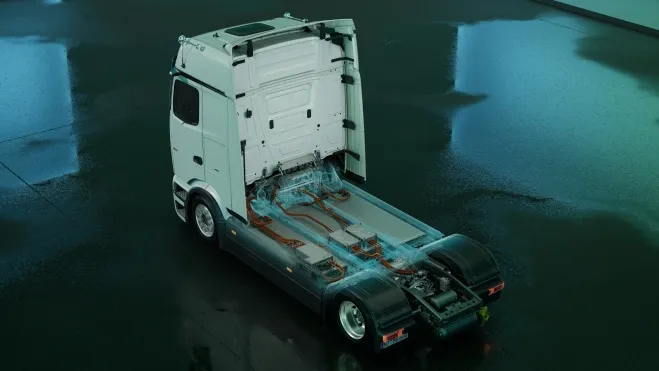
The technical key to the new eActros Lowliner family lies in how the batteries are arranged. In the conventional eActros 600, the battery packs are installed horizontally beneath the chassis. In the Lowliner, however, they are mounted longitudinally along the frame, which reduces the space required under the vehicle and allows the height of the fifth wheel to be lowered to match that of a comparable diesel truck. The result is an interior height of up to three meters for the trailer, while maintaining the same overall height and ground clearance as its combustion engine counterparts, making it easier to integrate into existing fleets.
The eActros Lowliner is available with two or three battery packs made of lithium iron phosphate (LFP), each with 207 kWh. With two packs, the eActros 400 Lowliner has a total installed capacity of 414 kWh; with three, the eActros 600 Lowliner reaches 621 kWh. The version with the most batteries offers a range of around 500 kilometers on a full charge, although in heavy-duty applications, the tires and the trailer itself have a greater impact on fuel consumption compared to a conventional electric truck. The two-battery configuration, despite being lighter, compensates with a higher payload: about 24 tons compared to 21 tons in the version with three packs.
A tractor unit designed for everyday use
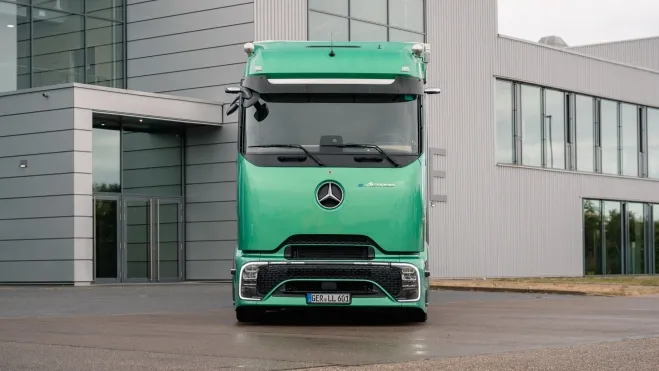
The vehicle is a 4x2 tractor with an axle spacing of 4,000 mm and a cab that is 2.50 meters wide. It features an electric drive axle developed internally by Mercedes-Benz Trucks, equipped with two electric motors and a four-speed transmission. These motors deliver a continuous power output of 400 kW, equivalent to 544 horsepower, and a maximum power output of 600 kW, around 816 horsepower, available practically continuously with minimal interruption in torque delivery.
All versions of the Lowliner can deliver up to 400 kW through the standard CCS2 connector, located on the left side of the vehicle. With two battery packs, it takes about 46 minutes to charge from 10% to 80%; with three, it takes around 70 minutes. Starting in the second half of 2027, both versions will be able to optionally adopt the megawatt charging standard (MCS), which will reduce these times to less than 30 minutes: 27 minutes for the two-battery version charging at up to 700 kW, and 29 minutes for the three-battery version with a charging power of up to 1,000 kW.
Self-managing efficiency
The Predictive Powertrain Control system, already available in the rest of the eActros range, predicts road topography, geometry, and traffic signals to optimize fuel consumption on each stretch. This is supplemented by energy recovery during braking, which not only charges the battery but also reduces brake system wear. According to the manufacturer’s calculations, the eActros Lowliner with three batteries offsets its initial carbon footprint from battery cell production after approximately 77,000 kilometers traveled on renewable electricity, or around 177,000 kilometers if the current average European electric mix is used.