
5000 km with an electric BMW. Did the iX3 pass the tests on range and charging?
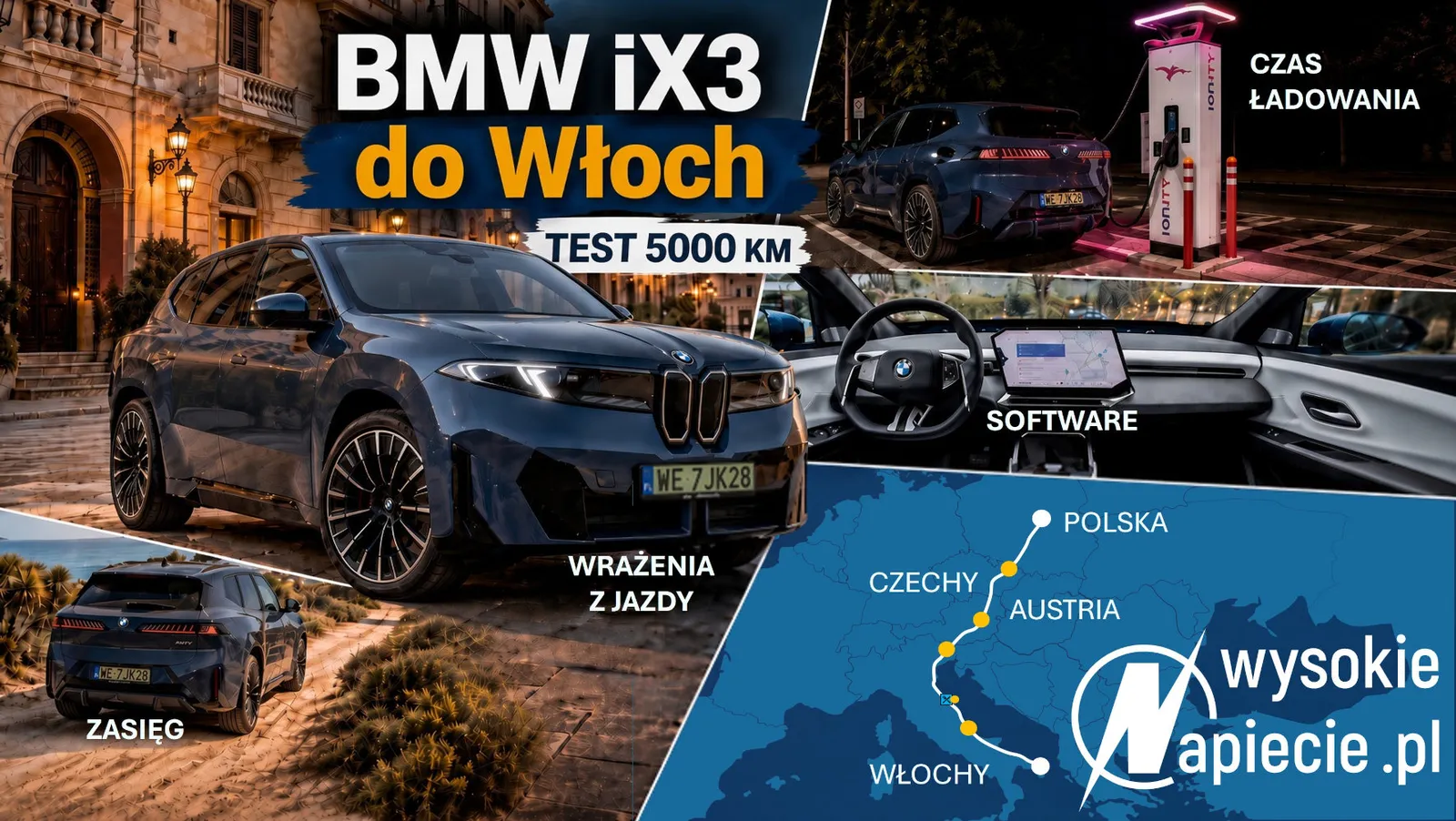
On long trips, does one still need to look for chargers, plan stops, and worry about electricity queues when driving an electric car? How long does charging actually take, and what is the real range on a next-generation electric car from Europe? We drove the BMW iX3 over 5,000 km across Europe to find out without any preferential tariffs.
Table of Contents
The electric three-seater has completely changed over 13 years
In 2017, when we received a test BMW i3 and announced that we planned to drive it — nothing less than — 360 km from Warsaw to Gdańsk, a BMW colleague asked if we knew what we were doing. To prove we weren’t joking, we packed a tent in the trunk and… on the first day of the trip, we managed to cover an astonishing 250 km, after which we stopped in Wąbrzeźno for the night to charge the battery (with a net capacity of 28 kWh) for the second part of this historic journey, which we described here: Vacation by electric car? It worked, but… The return from Gdańsk to Warsaw went smoothly and took just under 13 hours: 7 hours of efficient driving on local roads and over 5 hours of charging the i3 along the way.
Four years later, we went as far as the Czech Republic to test the first generation of the iX3. With a 74 kWh net battery and a charging capacity of 150 kW, it was already suitable for long domestic trips (BMW iX3 – will electric drive convince BMW customers?), but not necessarily for long European journeys (the i4 was much better suited for that: 1200 km in 12 hours behind the wheel of the electric BMW i4).
This year, when we received the new BMW iX3 50, with all-wheel drive, nearly 470 horsepower, a battery capacity of around 109 kWh, and charging at up to 400 kW, our claim that we wanted to drive it from Warsaw to the southernmost tip of Italy (a total of 5000 km round trip) no longer impressed anyone.
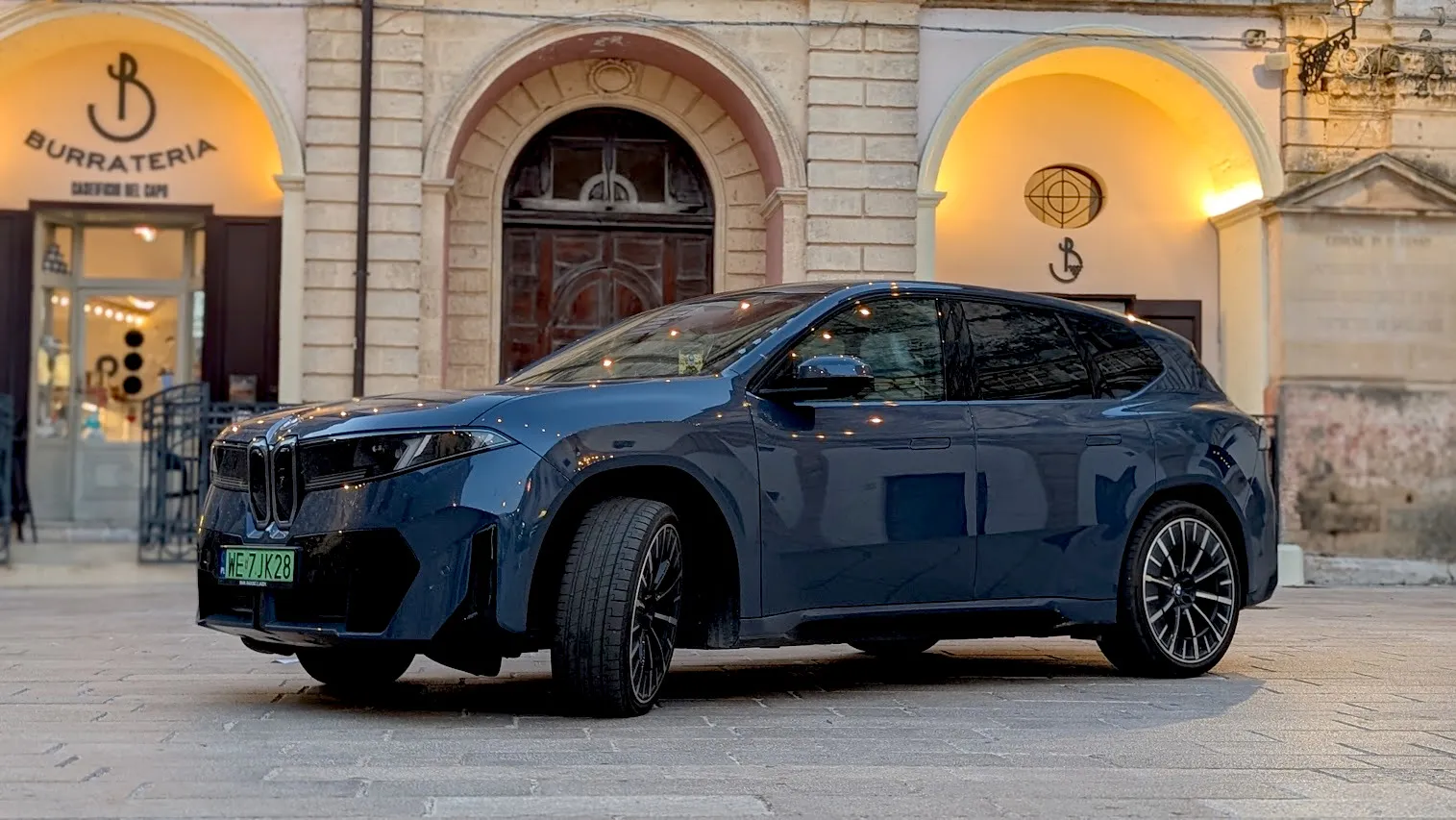
The Bavarian electric trio has transformed over 13 years from a futuristic urban concept car that somehow made it into production and succeeded, into a full-fledged family vehicle where drivers no longer have to worry about range or charging time. It’s likely not the end of this brand’s journey (the BMW iX5 already features a battery with a capacity of over 140 kWh), but it seems we’re approaching an optimal point in terms of range and charging time.
Actual range on the road
In our test, the new iX3 consumed just under 20 kWh per 100 km while maintaining a constant speed of 120 km/h. This means its actual range on highways is around 500-550 km. For comparison, the less powerful gasoline-powered X3 M50 has an actual range of only about 700 km.
Over 5,000 km of our testing, we didn’t find a single highway section over 100 km long (including Germany’s famous “no limit” zones) where traffic conditions would allow us to measure fuel consumption at a constant speed of 140 km/h, but we estimate it to be around 24 kWh/100 km.
What does this mean in practice? Without recharging, we can drive from Wrocław to Świnoujście, Gdańsk, or Olsztyn. When traveling from Kraków to the Tricity area or from Szczecin to Rzeszow, we’ll need one stop of about 15 minutes.

On our route, departing from Warsaw to Italy (taking S8 and A1), we plugged in the car to a charger for the first time in the Czech Republic after about 390 km, with 75 km (13%) of battery remaining. On the return trip, from Jelenia Góra to Warsaw and then driving around the capital a bit more, we covered 513 km, leaving us with 7% of battery range to cover another 40 km (and we suspect an additional equal distance before reaching 0%, but we didn’t want to check that). In both cases, as well as throughout the entire test, we were obviously driving at the maximum speeds allowed (or achievable due to traffic) according to GPS indications. Our model was equipped with 22-inch wheels, which increased its energy consumption compared to the base version with 20-inch tires.
On local roads, the BMW iX3 managed to achieve fuel consumption of 14-16 kWh/100 km (giving it around 700 km of real-world range). Interestingly, this consumption was only slightly higher than that of the small BMW i3 with a carbon fiber body, very narrow tires, and a battery four times smaller. This was made possible by the Neue Klasse’s use of two different engines: at the rear, a main synchronous EESM motor with an electrically excited rotor serves as the primary drive (with 326 HP), as it is efficient across a wide range of loads, while a simpler, smaller, and lighter asynchronous ASM motor at the front (167 HP) comes online mainly when additional torque or better traction is needed. Meanwhile, with the interior temperature set at 40°C over short distances, air conditioning relentlessly increased local fuel consumption to around 20 kWh/100 km, with one-third of that going toward cooling the cabin.
The average consumption after traveling 5,000 km to southern Italy and back gave us an average usage of 19.9 kWh/100 km. Interestingly, we achieved the same average speed both when driving to Italy at a fast (legal) pace and when returning via a scenic route with stops for sightseeing.
Charging issues
Our European test of the iX3 got off to a rather unfortunate start. In Ostrava, after connecting to a 350 kW Ionity charger (with the battery at 13% SOC), the BMW gradually and intermittently accelerated to the maximum 350 kW offered by the station, after which the charging power began to decrease linearly until it started fluctuating again with very large amplitude (between 40 and 130 kW).
It seemed as though the car had issues with effectively cooling the cells, which caused the BMS to limit the charging power. The pack heated from 40°C to 52°C. This is higher than the temperature allowed by previous generations of cells (45°C in the BMW i7) and slightly above what the Koreans allow (50°C in the Hyundai Ioniq 5 or Kia EV6), but — as subsequent charges showed — this was likely not the root of the problem.
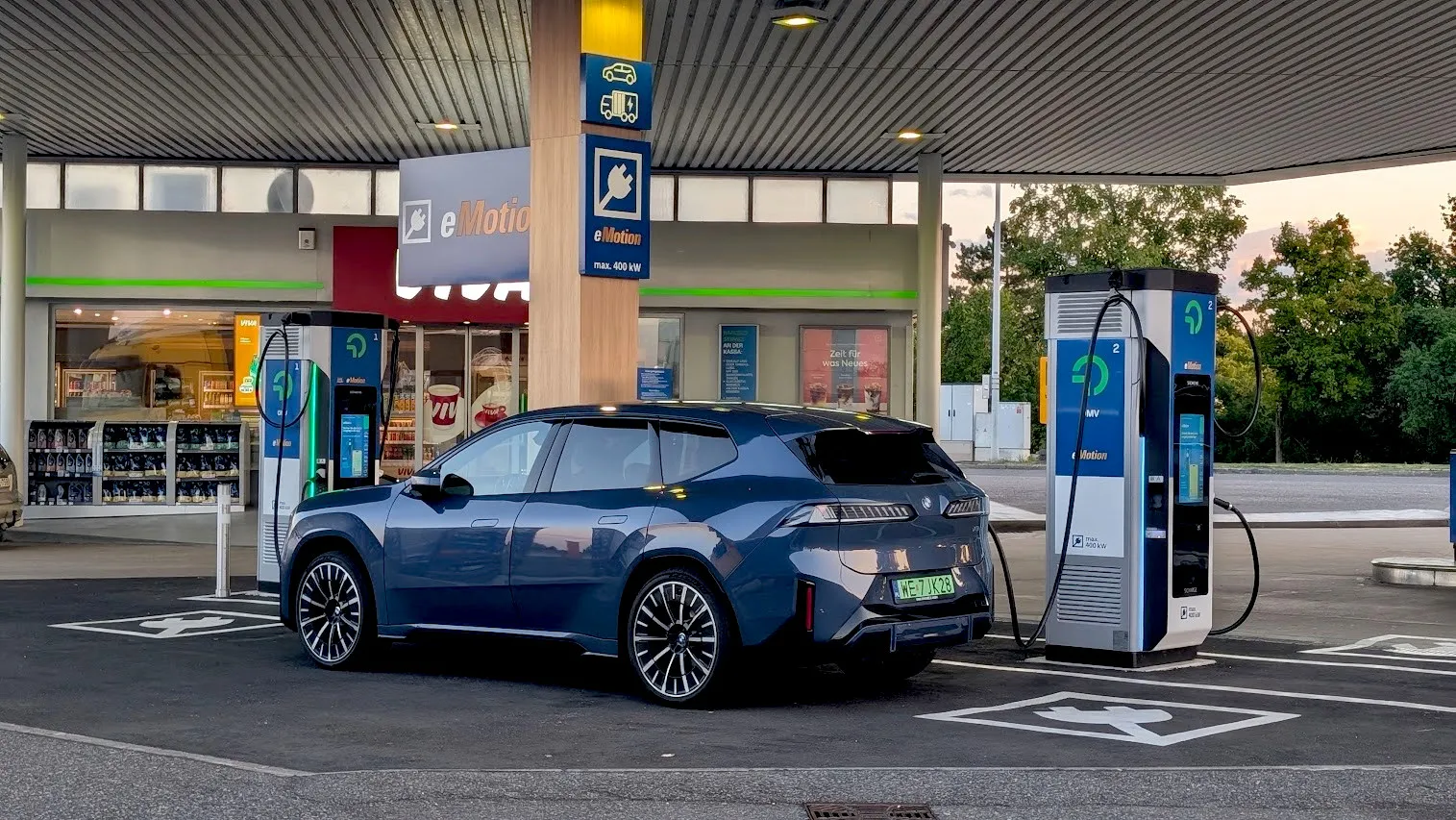
It happens that new electrician platforms have worse compatibility with certain charger manufacturers (for example, it refused to charge on the new satellite chargers from Ekoenergetyka iX3 in Zielona Góra, while charging worked without issues on their older 350 kW chargers placed nearby). It’s possible the same was true in Ostrava. Charger manufacturers address such problems with new cars within the first few months after the car’s launch.
Despite these issues, the iX3 absorbed 76 kWh in 24 minutes of charging, increasing its battery level from 13% to 77%, which is still a decent result. As a precaution, for the next three charges, we enabled the “battery protection” feature, which reduced the car’s maximum charging power to 186 kW. As a result, charging an additional 76 kWh took 38 minutes at the next station instead of 24 minutes.
At the fourth stop in a row, already in southern Italy, we turned off “battery protection” to see how the car would perform. The issue of charging voltage spikes did not occur again. The vehicle drew the maximum 300 kW offered by the charger without any difficulties. Interestingly, the battery temperature rose to as high as 61°C. However, the cooling system worked flawlessly—cooling the cells to 40°C shortly after charging (30–40°C is the optimal temperature for their rapid recharging).
Upon returning to Warsaw after over 5,000 km, we conducted a charging test at the Ekoen station there to charge the car from 7% to 98%. This time, to draw the same 76 kWh, the iX3 needed only 21 minutes (compared to 24 minutes earlier in Ostrowiec and 38 minutes with “battery protection” enabled).
Actual charging time
When charging the iX3 at 350 kW stations (which are currently more common than 400 kW chargers), we actually needed just under 4 minutes to cover 100 km on the highway, 9 minutes for 200 km, and 15 minutes for 300 km at a constant speed of 120 km/h. Within 30 minutes, the car absorbed 95 kWh of energy, which would be sufficient for, for example, 550 km of driving on local roads or 350–400 km on the highway.
In the cottage in southern Italy, however, the owner installed solar collectors, photovoltaic panels, even an energy storage system (10 kWh) and an electric vehicle charger. We could use it freely without restrictions, except for one thing—the building’s electrical system. It was single-phase and designed to power 6 air conditioners, an induction cooktop, an oven, and a car. Even charging at the lowest current (6 A) could overload the system, so the car was mainly charged at night. But we didn’t question the setup since we got more than a full battery for free. This is hard to imagine with a gasoline car—having it parked under the house at night while someone pours fuel into it for a few hundred zlotys.

The charging time? 1% per hour. It’s easy to calculate that it would take many days to fully charge the battery. However, this wasn’t a problem — we charged more every day than we could drive locally across the entire peninsula. As a result, by the end of our stay, we had a fully charged battery for the return trip. It cost us as much as plugging in the charger at home every day after returning.
Availability of chargers
After driving across Italy, we felt that Italians, especially along the A1 highway, are better prepared for electric cars today (which are almost nonexistent in the south) than Germans. At nearly every service station, we encountered stations with several charging points ranging from 150 to 400 kW, among which 300-350 kW connectors were the most common. Practically all of these charging points were empty.
The only major issue with charging occurred at an Ionity station in Battipaglia, south of Naples. The BMW travel planner warned us that this station had low ratings among drivers. It also indicated that all chargers were operational, with half of them available. However, the ratings for nearby restaurants on Google were quite high, and since we were looking for dinner, we decided to combine pleasure with practicality by stopping at this station. It turned out that none of the three available chargers would turn on, even though they lit up as if they were functional. Ionity’s customer service line (in Polish, despite the late hour) also couldn’t assist us. After 10 minutes, one of the working chargers slowed down, and after repositioning the car, everything started working as it should.
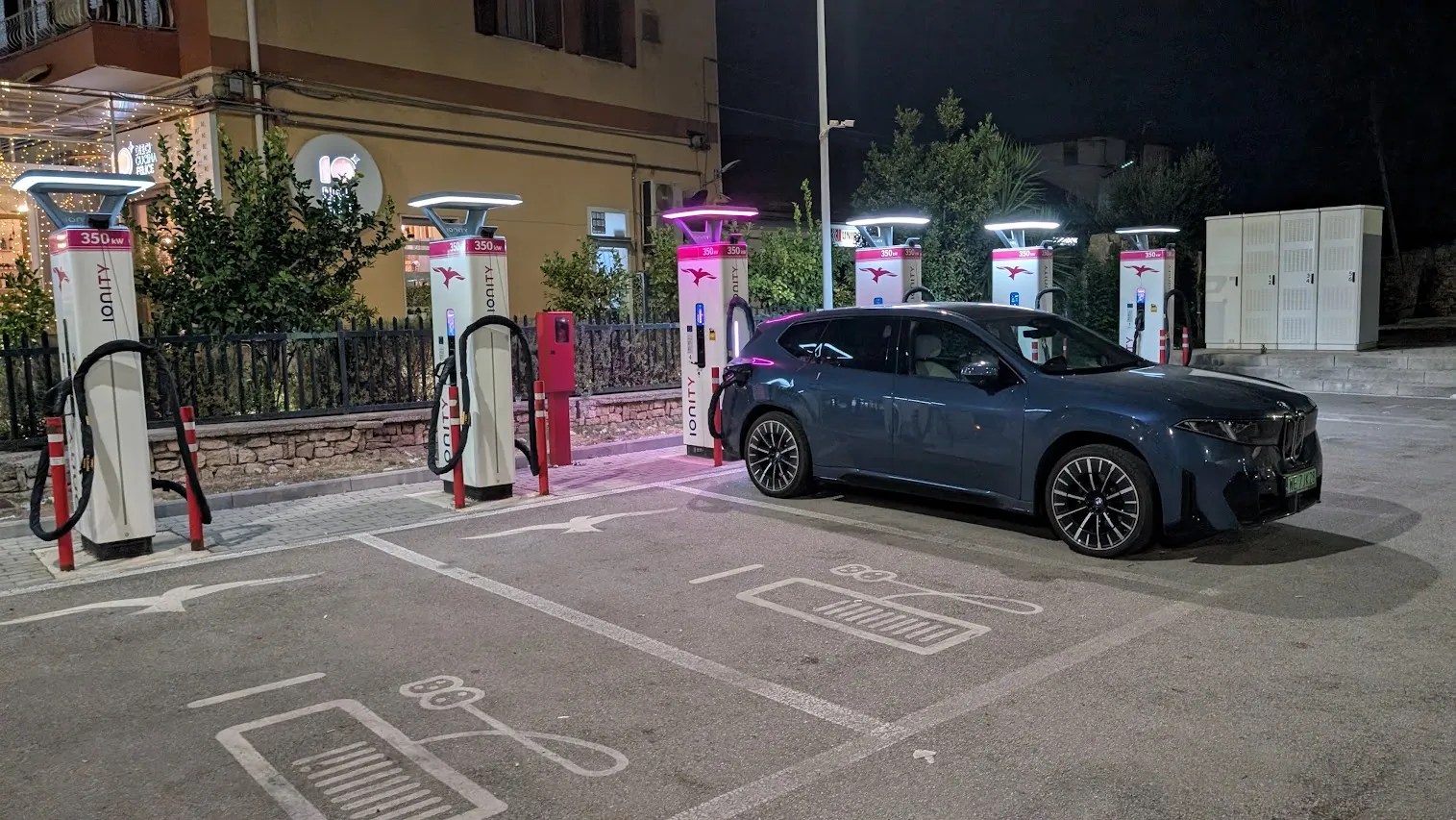
We also didn’t encounter any other fast chargers with queues or damage. Instead, we used the chargers that were located at the only parking spaces available in the area, right next to the tourist attractions.
Itinerary planning and navigation
The BMW in the Neue Klasse has, in my opinion, become the leader in this area. First, the planner predicts the car’s energy consumption and range with great accuracy, taking into account factors such as expected speed and terrain conditions. It also accounts for the extensive charging network offered by BMW Charging (DCS), including rates at ad-hoc chargers as well as those associated with the subscription we have purchased.
We can easily select there the power range of chargers we’re looking for or preferred charging networks. We’ll also see how many minutes we’ll lose traveling to the charger and back on the road, how that charger is rated by drivers, what services are available in the area, and most importantly, what power the connectors offer and how many are currently available. All of this with very high reliability. It’s also easy to add any point to the route, for example, to avoid traffic jams. The planner guides the driver step by step, ensuring that a route of around 2000 km shouldn’t be a challenge for someone without experience with electric vehicles.
The car’s built-in navigation was a pleasant surprise. BMW detected a section of highway at the Austrian-Italian border that was temporarily closed, even though Google still indicated it was open. The navigation works very well, aside from one annoying flaw — it has a slight delay of about 1 second, so on roundabouts or busy intersections we missed exits several times. This is something the manufacturer should improve or something drivers need to get used to. Of course, if we wish, we can also use Google Maps or Apple Maps, as the car wirelessly connects to both phone operating systems and displays their screens.
Charging Costs
The cost of traveling (including local transportation, totaling almost exactly 5400 km) covered charging the car at prices ranging from 0 to over 3 PLN/kWh. The largest portion was spent on fast DC charging stations, with an average cost of 2.84 PLN/kWh (including Ionity at 2.30 PLN and other fast chargers, usually around 3 PLN). Prices at slower AC charging stations varied significantly. We charged the car’s battery to full for 500 km in a cottage in Italy at 0 PLN, then topped it up at home in Jelenia Góra using a dynamic tariff at around 20 groszy/kWh. In contrast, we paid 2.58 PLN/kWh at a hotel in Bologna, and an average of 2.37 PLN at city charging stations in Italy. In total, all charging costs amounted to 2658 PLN (an average of 2.22 PLN/kWh).
According to the car’s onboard computer, we used 1075 kWh, but in reality we consumed 1200 kWh (the difference is due to charging losses of 10%). This results in a travel cost of 49 zł per 100 km. For comparison, a gasoline-powered X3 with the same engine would average 8-9 liters per 100 km, with fuel prices ranging from 8 zł in Poland to 9 zł per liter in Italy and Germany. This would mean a cost of 72 zł per 100 km, for a total cost of 3900 zł—over 1200 zł more than the electric version (plus two toll tickets for Czechia, where electric vehicles are exempt, and two stops in paid parking zones in Italy, where the electric vehicle didn’t have to pay, saving another 100 zł).
Driving and Impressions
The new class behaves more like a raised hatchback with a sporty flair than a heavy (2285 kg without the driver) electric SUV. The body leans little, the steering is precise, and torque vectoring and regenerative braking work exceptionally smoothly. BMW achieved this without pneumatic systems or adaptive dampers, but it comes at a cost: on uneven surfaces, the suspension is noticeably stiff, especially with the 22-inch wheels featured in the model tested.
The Bavarian SUV is also well-insulated, although—naturally—at speeds over 130 km/h or on hard concrete surfaces, noise begins to become noticeable. However, ADAC measurements at this speed show only 63.6 dB(A), which is a better result than, for example, the Porsche Macan.
Interior
Inside, the new iX3 offers comfortable space for a smaller family, although we’ve driven it around Italy with three children seated in the back using seat bases. The only thing missing is an acoustic glass partition between the driver’s and passenger cabin.
Interestingly, the total trunk capacity (520 liters in the back and 58 liters under the hood) is greater than that of the gasoline-powered BMW X3. The trunk is quite versatile, featuring a 40:20:40 split sofa and hooks for nets or straps, so it can also be used to transport skis in the middle.
The materials inside the cabin are decent. The Bavarians, to put it mildly, hinted that they have two more segments above the three-tier setup, but aside from the door armrest, which feels as hard as a cutting board after 10 hours of driving, I had nothing to complain about. The cockpit is simultaneously “clean,” spacious, and modern.
The seats, which in the test model also come equipped with adjustable side and lumbar supports, massage functions, and heating, are very comfortable. In the heat of southern Italy, we missed ventilation in them, a feature that is only now being added to the configurators.
Displays Instead of Clocks
BMW’s innovative (among European brands) solution called Panoramic Vision performs excellently. It consists of a set of displays arranged along a strip that runs across the entire width of the windshield. Right in front of the driver, we find key information such as speed, navigation cues, cruise control settings, and range. In the middle and right sections, we can customize six additional displays, such as outside temperature, battery temperature, elevation above sea level, compass, outdoor air quality, and more accurate navigation indicators.
The model we tested was also equipped with a HUD, which are semi-transparent indicators displayed on the windshield at road level. Honestly, since Panoramic Vision is already standard in all Neue Klasse models, I don’t see any need to pay extra for it.
BMW also eliminated the traditional screen behind the steering wheel, but unlike Tesla, which provides the driver only with a tablet in the center, we get critical information here in a very clear manner, even better than with traditional setups, because it’s right within the driver’s line of sight without having to look down or to the side.
We also have the climate control bar on the central screen. We can access it by sliding our finger from the bottom of the screen upward in one motion. The air vents at the front are electronically controlled, but it’s done intuitively with just a single swipe of the hand.
Virtual Key and Software
In addition to the key (physical, but also a phone or watch if we store our car key in it), it personalizes all our settings – the preferred position of the seats, mirrors, radio, as well as the climate control, including air vent directions and temperature.
The car key is stored, along with our gas cards or flight tickets, in the virtual wallet of an iPhone or Android. We can also easily share it with other car users. Door opening always works reliably (via Bluetooth). Controlling car functions from an app while nearby the vehicle, such as remote parking or driving out of a garage, also works quickly. Functions through cellular networks have greater latency, but the response time is still decent.
The new class can continuously track the route, and we can record footage of any traffic incident with a single button that stays permanently at the top of the main screen — easier than in Tesla.
Overall impressions on the road
The new BMW iX3 was a very useful car for a long trip across Europe. Its real-world range of over 500 km meant we could stop to charge every 400 km, but on crowded European highways this translates to 4-5 hours of driving, sometimes even 6 hours. Thus, the number of stops was significantly higher than the number of times we needed to charge the car. Meanwhile, charging times of 10-25 minutes, even on slower chargers, were almost always more than sufficient.
The enormous power, low center of gravity, and nearly perfect 50/50 weight distribution meant the iX3 handled with great confidence on Alpine roads, even in the tightest turns, delivering pure driving pleasure. Things might get even more interesting with the new BMW i3, which is likely to also receive an M version.
The Bavarians wanted to boost sales and restore the company’s profit margins through the Neue Klasse. That’s why the car isn’t cheap, although still—compared to the gasoline-powered X3 M50 with similar power—the iX3 50 is significantly cheaper. Given this trajectory, I see them having good chances of achieving that goal.
The test also showed how rapidly electromobility is evolving. Thirteen years ago, covering 360 km with the electric BMW i3 required an overnight stop for charging. Today, we drove over 5000 km from Warsaw to southern Italy and back with the new iX3 50 xDrive, achieving an average consumption of 19.9 kWh/100 km. This gives a real range of over 500 km, and charging at powers of hundreds of kilowatts meant we stopped more often on the road because of passenger requests rather than because the car required it.