
489 horsepower, a range of up to 743 km, and 325 km of driving distance after just 10 minutes of charging: we tested the new Mercedes-Benz Class C electric vehicle.
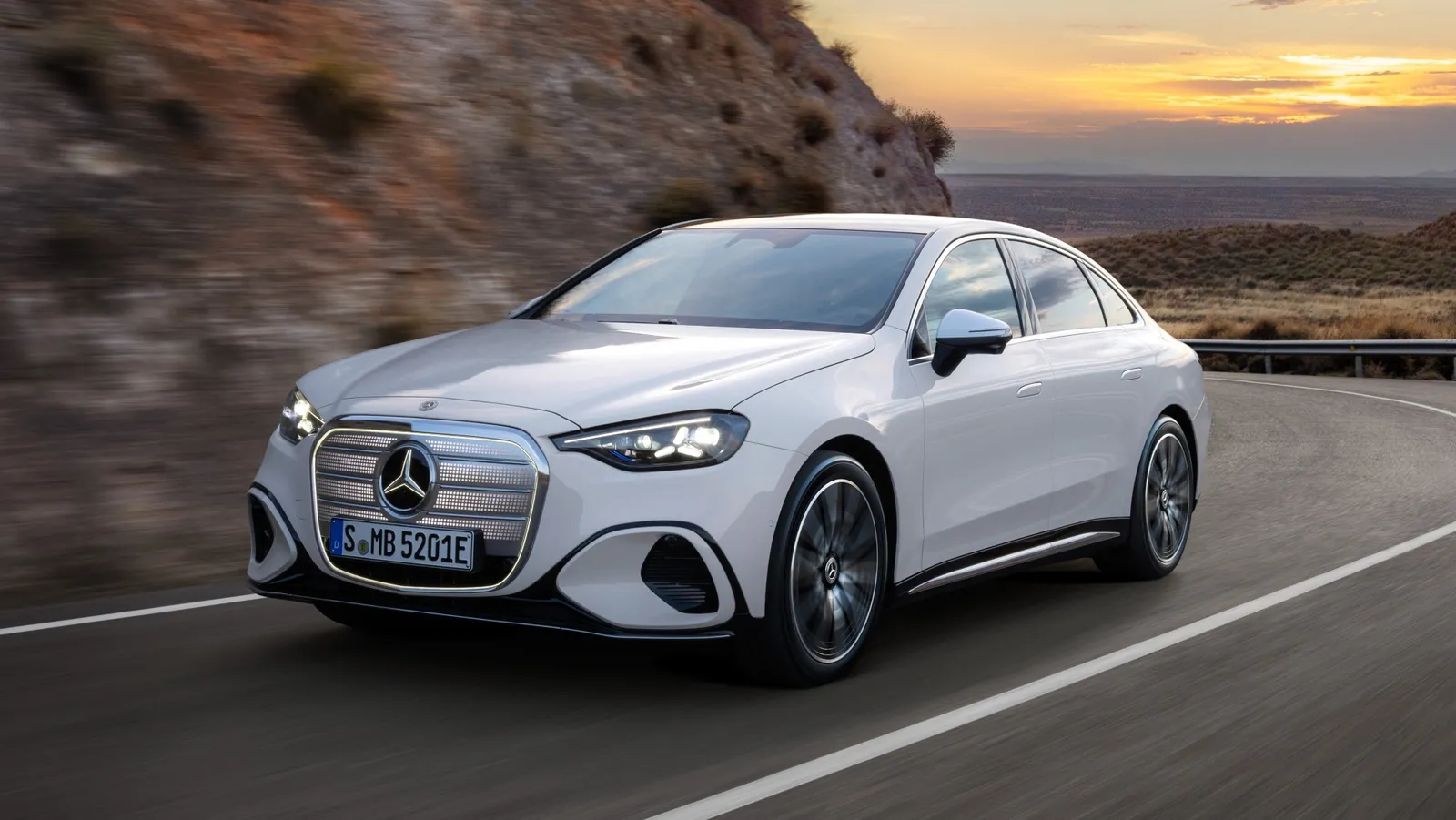
Some cars require many miles to convince you of their merits, while others succeed in doing so almost from the very first moment. The new Mercedes-Benz Class C electric belongs to this second group. The German brand already sells the fully electric version of one of its most iconic models in Spain, but it does so without sacrificing the qualities that have historically defined its vehicles: exceptional driving comfort, outstanding build quality, and a driving experience that is hard to surpass.
And indeed, after getting behind the wheel of this new sedan, our first impressions couldn’t be better. It’s a very comfortable car that exudes a high level of quality as soon as we step inside, and it boasts impressive performance. Additionally, despite its size and weight, it surprises with how easily it drives and offers a handling style that perfectly balances comfort and dynamism.
All of this is accompanied by a particularly interesting figure: during our test drive, the fuel consumption was around 16 kWh/100 km. An impressive figure for an electric sedan that’s nearly five meters long, has all-wheel drive, and boasts a whopping 489 horsepower. But let’s take it step by step.
Almost 4.9 meters long with an interior that exudes high quality
Mercedes-Benz has chosen to develop this electric Class C based on a dedicated electric vehicle architecture, rather than simply adapting its gasoline sedan platform. This approach has enabled significant advancements in design, interior space, and technology, while still maintaining a body style that is easily recognizable as a Class C.
Visually, one of the first things that catches the eye is its front end. The traditional Mercedes-Benz grille transforms into a large, enclosed surface that can feature up to 1,050 lighting elements. It is one of the most distinctive elements of the brand’s new design language, which we have already seen in other of its recent electric models.
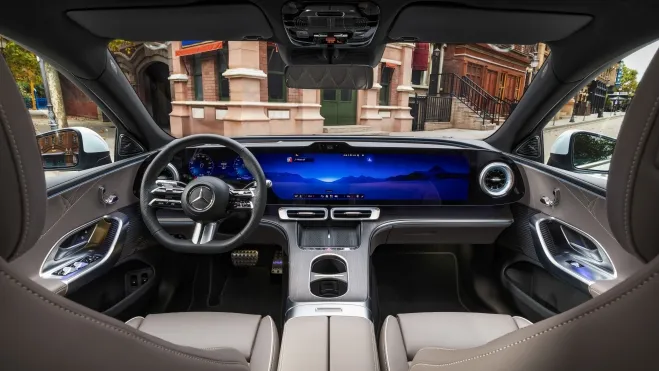
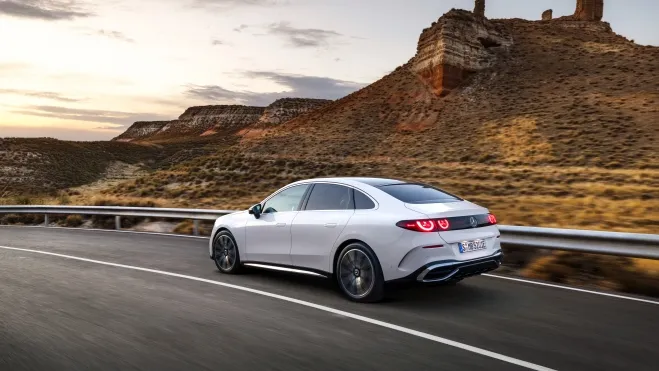
On the side, we find a stylized silhouette with a roof line that gradually slopes downward toward the rear, giving it a coupe-like appearance. At the back, the headlights also feature a distinctive lighting design with Mercedes-Benz stars as the focal point. Overall, the design retains the elegance of a traditional sedan, though with aerodynamic solutions typical of a modern electric vehicle.
If we examine its dimensions, the new electric Classe C is 4.88 meters long, 1.89 meters wide, and 1.50 meters high, with a wheelbase of 2.96 meters. Thus, it is a vehicle with substantial size, positioned in the premium sedan segment, aiming to combine ample interior space with top-tier dynamic performance.
The rear trunk offers 470 liters of capacity, which is a reasonable figure for this type of vehicle. However, Mercedes-Benz has also utilized the space under the front hood to include a second compartment of 101 liters, particularly useful for storing charging cables or certain items that we want to keep separate from the luggage.
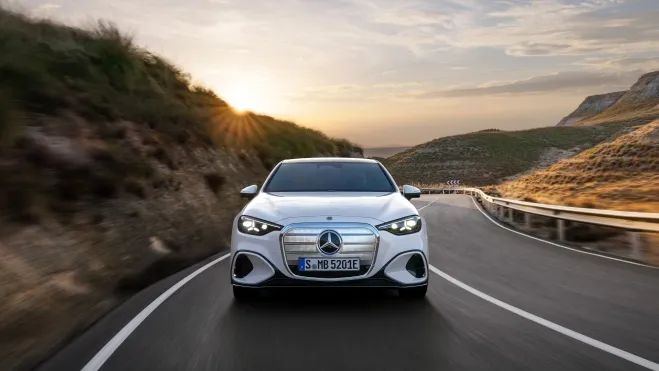
Once inside, the technological leap is evident. The dashboard can feature the optional MBUX Hyperscreen system, which consists of a massive 39.1-inch display spanning the width of the cabin. This is complemented by the latest generation of MB.OS operating system, designed to manage various vehicle functions and receive wireless updates.
Beyond the screens, however, there is something that seems even more important: the sense of quality conveyed by the interior. From the very first moment, we realize we are in a high-end Mercedes-Benz, with an cabin designed to offer comfort and a pleasant atmosphere for both the driver and passengers.
The German brand has aimed to turn the new electric Class C into a particularly comfortable space. Among the available features are seats with massage and ventilation functions, ambient lighting, and an optional panoramic roof that can feature 162 small illuminated stars.
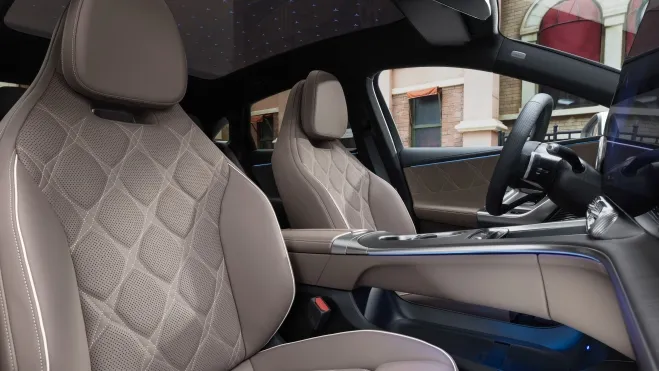
The result is an interior where technology plays a major role, but comfort remains one of the top priorities. This initial impression holds true, and even improves, when it’s time to get behind the wheel.
489 HP, strong acceleration, and excellent driving comfort
The version that marks the launch of the new Mercedes-Benz Class C electric vehicle is the C 400 4MATIC, equipped with two electric motors, one on each axle, and an all-wheel-drive system. The combined power reaches 489 HP, equivalent to 360 kW, while the maximum torque is 800 Nm.
These figures enable acceleration from 0 to 100 km/h in just four seconds, with a top speed electronically limited to 210 km/h. These performance traits are more typical of a sports sedan than of a model whose primary goal is to offer comfort for daily commutes and long trips.
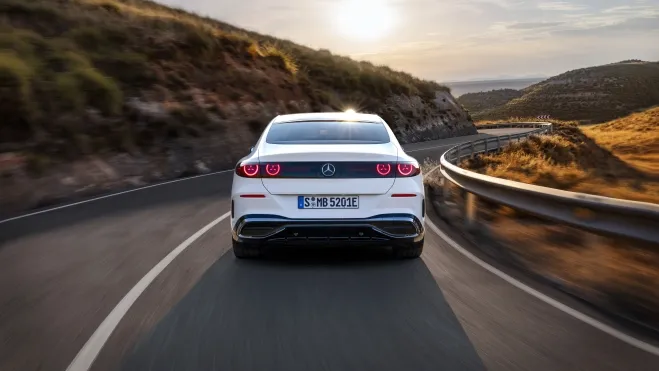
However, one of the things we liked most is exactly how it manages to combine these two aspects. Because once you accelerate decisively, you’ll see that the car performs very well, truly very well. The response to the accelerator is immediate, and the available thrust allows for speed gains with surprising ease.
But the electric Clase C isn’t just a powerful car. What’s truly interesting is that this acceleration comes alongside refined, very comfortable, and pleasant handling. In fact, it’s hard to find any significant drawbacks even after just a few kilometers.
At the wheel, it delivers a sense of extremely high quality. It’s one of those cars where everything seems designed to ensure the driver travels comfortably, without sacrificing performance that brings a smile when the accelerator is pressed firmly.
Another aspect that surprised us is its dynamic handling. After all, it’s important to remember that the new electric C 400 4MATIC weighs approximately 2,460 kilograms—a considerable figure that yet doesn’t match the driving sensations it provides on the road.
At no point did it seem to us to be a particularly heavy or clumsy car. On the contrary, it moves with great ease and offers a agility that is surprising given its size. It’s easy to get used to driving it, and although its performance is very high, the overall experience gives a sense of confidence.
The German manufacturer has turned to various technological solutions to achieve this. Among them is the option to equip it with the AIRMATIC air suspension, which allows its function to be adjusted according to driving conditions and different driving programs. This system can include predictive damping control, using information about road conditions to anticipate certain surface irregularities. In Sport mode, the suspension can also lower the vehicle’s height to enhance stability.
Another available technology is rear-wheel steering, which allows the rear wheels to turn up to 4.5 degrees. As a result, the turning radius can be reduced to as low as 11.2 meters, a feature particularly useful for a car that is nearly five meters long.
All of this demonstrates the effort Mercedes-Benz has put into creating a car that doesn’t just stand out for its power. In our opinion, the greatest strength of the new electric Class C lies in its balance. It’s fast when we want it to be, but also very comfortable when we simply seek a relaxed driving experience.
In fact, after this first test, comfort is perhaps one of the aspects we would highlight the most. There’s no need to drive it in a sporty manner to appreciate its qualities. Its smoothness, overall driving pleasure, and ease of movement are sufficient reasons to understand the approach behind this new sedan.
Up to 743 kilometers of range and a real-world fuel consumption of 16 kWh/100 km
We come to one of the most important aspects of any electric car: the battery, range, and energy consumption. After all, having nearly 500 horsepower and a luxury interior is of little use if the energy cost is too high or if we constantly need to stop to recharge.
The new Mercedes-Benz C 400 4MATIC features a lithium-ion battery with a useful capacity of 94 kWh, a substantial figure that allows it to achieve up to 743 kilometers of range in WLTP testing for the model sold in Spain.
Its official combined energy consumption is 14.6 kWh/100 km, though these figures can vary depending on the equipment, tires, and other vehicle components. As with any electric car, we should not confuse the tested range with the actual range we will achieve in real-world conditions.
Exactly, one of the main aspects we wanted to verify during our testing was its efficiency. The results were very satisfactory. The recorded fuel consumption was around 16 kWh/100 km, a figure we consider especially good for a car of this size, weight, and power. Additionally, during the test we drove in various conditions, such as on highways, in urban areas, and on secondary roads. In the latter case, combined with a more sporty driving style, fuel consumption increases, but it’s by no means excessive. Far from it.
If we perform a purely theoretical calculation, maintaining an average of 16 kWh/100 km throughout the discharge of its 94 kWh of usable energy would allow it to travel around 590 kilometers. Obviously, this is not an actual range verified through a full test, but rather a mathematical estimate based on the observed consumption.
Its charging system also deserves special attention. The electric Class C uses an 800-volt architecture and supports a maximum power of 330 kW in direct current, as long as the battery and charging station conditions permit reaching this figure. According to Mercedes-Benz, it can recover up to 325 kilometers of certified range in just ten minutes, while charging from 10% to 80% of the battery takes approximately 22 minutes under optimal conditions.
These are official figures that still need to be verified through a specific charging session, but they place the new Clase C among the electric sedans with the fastest charging capabilities in its class. For alternating current, it is equipped with a 11 kW charger, with the option to use one that offers 22 kW. Additionally, the navigation system can manage charging stops during trips, taking into account the battery status and the requirements of the route.
There is another interesting technical detail. The model features a two-speed transmission in the rear axle, a solution that allows it to combine strong acceleration response with improved efficiency at highway speeds. The all-wheel-drive version can also disconnect the front engine when unnecessary, reducing energy losses and enhancing range. These features help explain how a car with nearly 500 horsepower can achieve low fuel consumption under certain conditions.
How much does the new electric Class C cost?
Regarding price, the new Mercedes-Benz Class C electric vehicle is available in Spain starting at 69,800 euros for the C 400 4MATIC version, though the cost can increase significantly depending on the optional equipment chosen. The brand plans to expand the range with new powertrains, including rear-wheel-drive versions and different battery configurations. This will allow for alternatives with varying ratios of price, performance, and range, although its final specifications and pricing will still need to be determined.
Therefore, after driving it, we reiterate that our impressions were very positive. The new electric Class C seemed like an exceptionally well-executed sedan, with high-quality interior finishes, outstanding ride comfort, and performance that can surprise even those accustomed to driving powerful cars.
But perhaps the most interesting aspect is that it doesn’t need to rely on its 489 CV to convince you. Its true strength lies in making driving comfortable, pleasant, and simple, without giving the impression of operating a heavy or overly large vehicle. And if we add to these qualities a fuel consumption of around 16 kWh/100 km in our tests, a 94 kWh battery, and a charging capacity of up to 330 kW, we have sufficient reasons to rank it among the most interesting premium electric sedans available today.
That said, its price places it in a premium segment, and it will be necessary to see how it performs during a longer test drive, especially to assess its true range on the highway. But from this initial encounter, one thing is quite clear: Mercedes-Benz has created an electric car that stands out both for its speed and the comfort of driving it.