
30 Countries in 30 Days: How 15,000 Kilometers on a BEV Busted the Last Myths About Electrified Vehicles
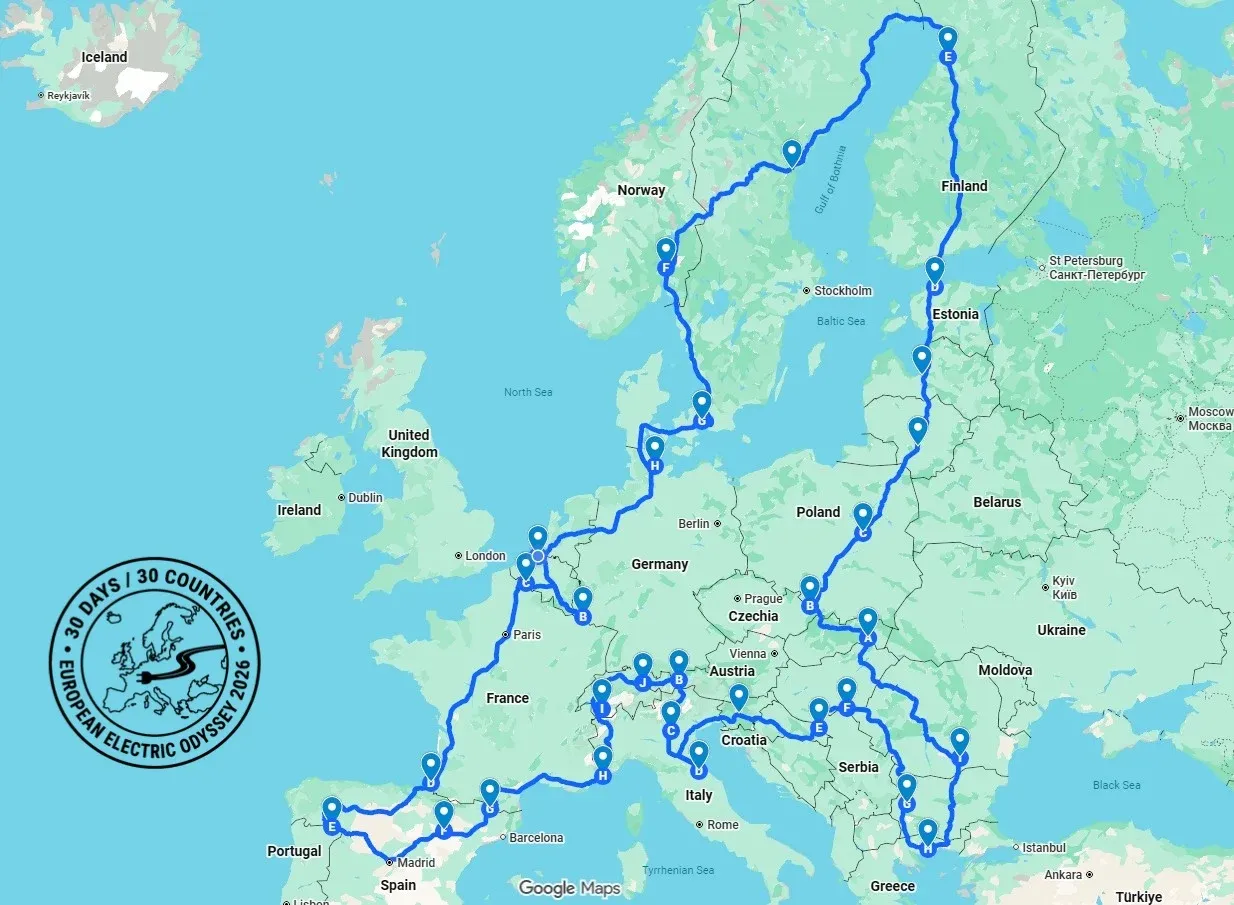
30 countries united the family
The idea had several origins. First, there was no vacation plan that could accommodate all family members. Second, I grew frustrated by the sensational descriptions of electric vehicle trips, some of which resembled hunting for charging stations more than a normal car journey. Social media is filled with accounts of several-hour trips to Masuria, which self-proclaimed electric vehicle celebrities loudly label as epic expeditions or adventures.
Thirdly, there was simple curiosity at play. I had already covered nearly two million electric kilometers on Europe’s roads, but those routes were mostly in countries that adopted electrified transportation years ago. This time, I wanted a broader perspective. More and more electric cars are on the roads across Europe, and as the number of those committed to electrified mobility grows, old questions resurface like boomerangs: Is it really possible to drive an electric car to Croatia? To Italy? To Spain? Or even further?
Somone had to answer them in a far more practical way than yet another test over a few hundred kilometers. Because discussions about electrified mobility can go on endlessly. You can also simply get into an electric car and drive across the entire continent back and forth.
No test of the car. A test of Europe
The car choice was easy. The Hyundai IONIQ 9, proven during several test drives, was perfect for the task. It’s hard to find a car of comparable quality on the market.
The route was uncompromising
First, a fast and easy cross-country trip westward to the Atlantic coast. From there, a calm and scenic journey along the Mediterranean Sea. Then some challenging driving through the Alps. Next was what was theoretically the most demanding section, crossing the Balkans to Greece and heading north—through the Carpathians, Central Europe, and the Baltic coast all the way to Lapland. Finally, Scandinavia and a return to the base in the Netherlands.
It all took a month
This marathon was an excellent opportunity for the most intensive test of Europe’s charging infrastructure that could be organized without renting a mobile lab. However, it wasn’t about checking things that can be found in any app. Charging power? Number of stations? Maximum charging speed? Those are dry facts. Much more interesting are the questions that apps usually don’t answer:
What does the signage at charging stations look like in thirty countries?
How easy is it to get to from the main road?
Is it easy to find a charger when visiting a place for the first time?
How does this highly touted European roaming work?
What is usually found in the immediate vicinity of chargers?
Is there lighting everywhere?
Is a canopy standard?
Is there always access to toilets?
Is there a place to throw away trash?
And finally: does the charging station look like part of modern infrastructure, or like a pole placed somewhere behind a warehouse and left to its own devices?
Because it is these things that determine whether traveling in an electric car is pleasant and convenient, or merely possible.
Europe from behind the wheel, or thirty answers to the same questions
The first days of the trip brought temperatures exceeding 40 degrees. The heat quickly tested some of the initial assumptions.
The plan to rely heavily on V2L and prepare meals during stops had to be scaled back. It was unbearable outside, and the heated kitchen equipment wouldn’t cool down. It was difficult to put a red-hot toaster into the trunk.
The trip through Schengen served as a symbolic reminder of how much Europe has changed. Not so long ago, such a route would have involved dozens of border controls. Today, it’s possible to cross the continent with almost no stops at borders.
France meant navigating between forest fires and the Tour de France route. Spain and Portugal added another layer of unbearable heat. Andorra and Monaco allowed a break from endless kilometers and reminded us that driving is meant to help us see something new.
Traveling through the Alps provided relief from the heat and gave us a chance to test the Hyundai IONIQ 9 on winding mountain passes. Here, the car had to prove it could not only cover long distances comfortably but also handle sharp turns.
Italy and the Balkans offer a culinary festival combined with drivers’ rather relaxed attitude toward traffic rules. Bulgaria and Greece, on the other hand, showed that European-level infrastructure has not yet reached every corner.
Central Europe—from Romania to Poland—provided a cozy atmosphere, new roads, hospitality, and a relaxed vacation vibe. The Baltic countries surprised with their diversity. Finland and Scandinavia, meanwhile, confirmed their status as travel paradises.
Germany and the Netherlands delighted drivers with their culture, roads, and well-developed EV infrastructure.
Logistics: the part of the trip you don’t see on Instagram
The idea for the 30/30 EV Challenge came two months before the trip. There was no time for promotional campaigns. We had to finalize details, plan the route, book accommodations, find partners, engage the media, set a budget... or ignore it all and improvise.
We didn’t waste time planning. The family embraced complete spontaneity. Partners appeared almost on their own when the first expedition of this kind gained attention in the EV community. The impossible became a little less impossible. The insurance company estimated the chances of success at 2%. For the family, that was a clear green light. The decision was made.
A month-long trip with no prior preparation required daily logistics management. Different currencies, languages, regulations, road conditions, national holidays, shopping days off, sports and entertainment events, construction work, and the unpredictable situation along the route through thirty countries.
The ongoing planning was thorough, but reality, as usual, had its own plan...
Tropical heat, storms, hotel changes, or routes closed due to forest fires forced constant improvisation. Even the start date of the journey had to account for events that could paralyze certain sections of the route.
With thirty countries involved, every small mistake triggers a cascade of consequences. It’s a domino effect. A closed road means changing the route. Changing the route means using a different charger. A different charger means altering travel time. And changing travel time can throw off the entire daily schedule.
In the end, three key factors determined success: highly flexible logistical preparation, the crew’s experience, and the technical maturity of modern electric vehicles.
The charger is not everything
The most interesting aspect of the entire endeavor turned out to be the infrastructure.
After 15,000 kilometers, it can be said that the mere presence of a charger is no longer a problem. What remains an issue are its quality and ease of use.
In some places, drivers find well-marked stations with an adequate number of charging points, a roof, lighting, a restaurant, a shop, and toilets.
In others, they get just a pole, asphalt, and a little hope.
For this reason, the team ruled out Tesla’s Superchargers.
The differences between chargers from various providers can be enormous, and even within the same network, there are vastly different stations.
It’s incredibly interesting to see how quickly the European market is changing. In more and more places, the charger is no longer a standalone device sitting somewhere by the road. It has become part of a larger ecosystem of services.
This also applies to hotels and restaurants. The ability to charge a car while staying overnight or having a meal is increasingly just another service, rather than a feature highlighted in big letters. Mateusz and his family really appreciated this. Charging while doing other things has become the standard for this trip.
This is precisely the direction that will be of tremendous importance for the further development of electromobility. Drivers don’t want to “stop to charge their car.” That’s a habit from the internal combustion engine era. Today, they want to get to their destination, have lunch, do some shopping, or spend the night—while the car charges along the way. Time savings are significant in this case, and on a 30-day trip, that difference can be enormous. If each of the 50 charges took 10 minutes, like refueling, Mateusz and his family would lose almost an entire day in total...
Roaming is no longer a novelty
One of the biggest advantages of this trip was interoperability.
Just a few years ago, traveling across Europe by electric vehicle often meant having a phone full of apps and having to remember which operator worked and which didn’t in a given country. Or else, it required being tied to just one operator, which was very inconvenient.
Today, the situation looks significantly better. Roaming and universal access systems have greatly simplified drivers’ lives. From the user’s perspective, it matters less and less who physically owns a particular charger. What’s much more important is whether it can be used simply with one card.
This might seem like a truism, but it is precisely such things that determine whether technology moves beyond enthusiasts and starts serving ordinary users. Of course, this also brings immense joy to the enthusiasts.
The best part of electric mobility turns out to be the community
The European EV community also contributed to the success of the expedition.
GEVA (Global EV Alliance) sponsored the project, with local electric vehicle clubs and driver groups joining to support the expedition in various countries.
From the beginning, during the early planning stage of the challenge, the response from the electric mobility community was very positive. The project fascinated almost everyone, although many thought 30 days in an electric car with family was impossible. Enthusiasts of electric mobility from across Europe invited Mateusz and his family for coffee, meals, or casual gatherings. Sometimes they also helped in the most practical way by providing their own chargers. This was the positive side of popularity.
One of the biggest fans of the expedition provided the travelers with accommodation and a full day of entertainment.
The EV driver community has once again shown it can integrate faster than many official roaming systems.
And perhaps this is also an important part of transportation transformation. New technology isn’t built solely on hardware. It’s also built on people who want to use it, promote it, and help others.
30-Day Summary
Distance: nearly 15,000 km
Average: about 500 km per day
Time behind the wheel: over 200 hours
Average: about 7 hours per day
Energy used: close to 3,000 kWh
Charging sessions: 55
Average consumption: 20–22 kWh/100 km
Average travel speed: about 70 km/h
These aren’t values from the manufacturer’s catalog.
This is the result of a family trip by electric car through thirty countries, under normal road conditions, with luggage, passengers, heat, rain, mountains, detours, and everything else that typically happens during a month-long journey.
Can you really go far with an electric car?
After 15,000 kilometers, the answer is obvious: Yes. But the family trip revealed something more important.
The biggest change didn’t happen in the cars themselves. The entire ecosystem around them changed.
The infrastructure is becoming more extensive. Roaming makes it easier to find charging stations. Hotels and restaurants are starting to treat charging as a standard part of their offerings. Smaller, local charging stations are increasingly able to compete with large ones along highways.
Of course, there are still huge differences between various countries. It’s pointless to pretend that the comfort of traveling in the Netherlands and Southern Europe is identical. It isn’t.
There are places where the infrastructure works excellently, but there are also ones where you start wondering if the charger was put there for drivers or just because someone happened to have some extra cable.
How quickly will less developed regions catch up with the best? That’s a completely different discussion.
But the difference is fundamental.
A few years ago, the question was: Can you drive across Europe in an electric car? Today, the questioner asks, “Why haven’t you done it yet?”
30 countries later
30 countries, 30 days, and almost 15,000 kilometers were enough to stop treating a long-distance trip in an electric car as an experiment.
It’s not perfect. It’s not comfortable everywhere. Not every parking lot looks like one from a catalog, and not every road leads exactly where the navigation suggests.
Travelers found that even with imperfections in the infrastructure, charging wasn’t a problem, and almost all trips were covered by a single Polish GreenWay card.
The electric car simply did what it was supposed to do.
With a four-person family aboard, it crossed Europe.
Without special treatment. Without an tow truck escort. Without carrying a generator in the tow truck, and without having to spend half of the vacation searching for a charger.
And one of the oldest myths about electromobility now sounds particularly archaic:
"You can’t really go far as an electrician."
You can. And quite far at that.
Mateusz Maćkowski, EV Klub Polska
We will soon publish an interview with Mr. Mateusz, in which he will share more in detail with our readers his experiences from his vacation trip to 30 European countries.