
2,934 solar panels generating 1,780,000,000 kWh: this is the way China has found to avoid taking 1,200 hectares of land.
30/09/2026 17:30
Updated to
30/09/2026 17:30
China has led the global deployment of renewable energy for years, but its rapid industrial and urban growth has created an unexpected problem: space. In many of its most populous regions, land available for new energy infrastructure is scarce and expensive.
Faced with this limitation, the country has chosen an ambitious and unconventional solution: taking power generation to the sea.
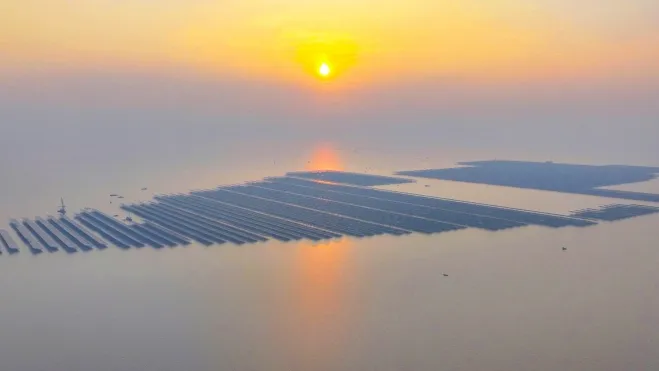
The Dongying Solar Plant
The result is a new generation of offshore solar plants designed to generate electricity on a large scale without competing for land with cities, agriculture, or industry. Among them stands a colossal project that symbolizes the Asian giant’s strategic shift toward harnessing energy from marine environments.
The facility, located off the coast of Shandong province in the city of Dongying, is part of a growing trend: floating photovoltaic power plants in open seas. Unlike systems installed in reservoirs or lakes, these infrastructures must withstand much more demanding conditions such as waves, salinity, and strong winds.
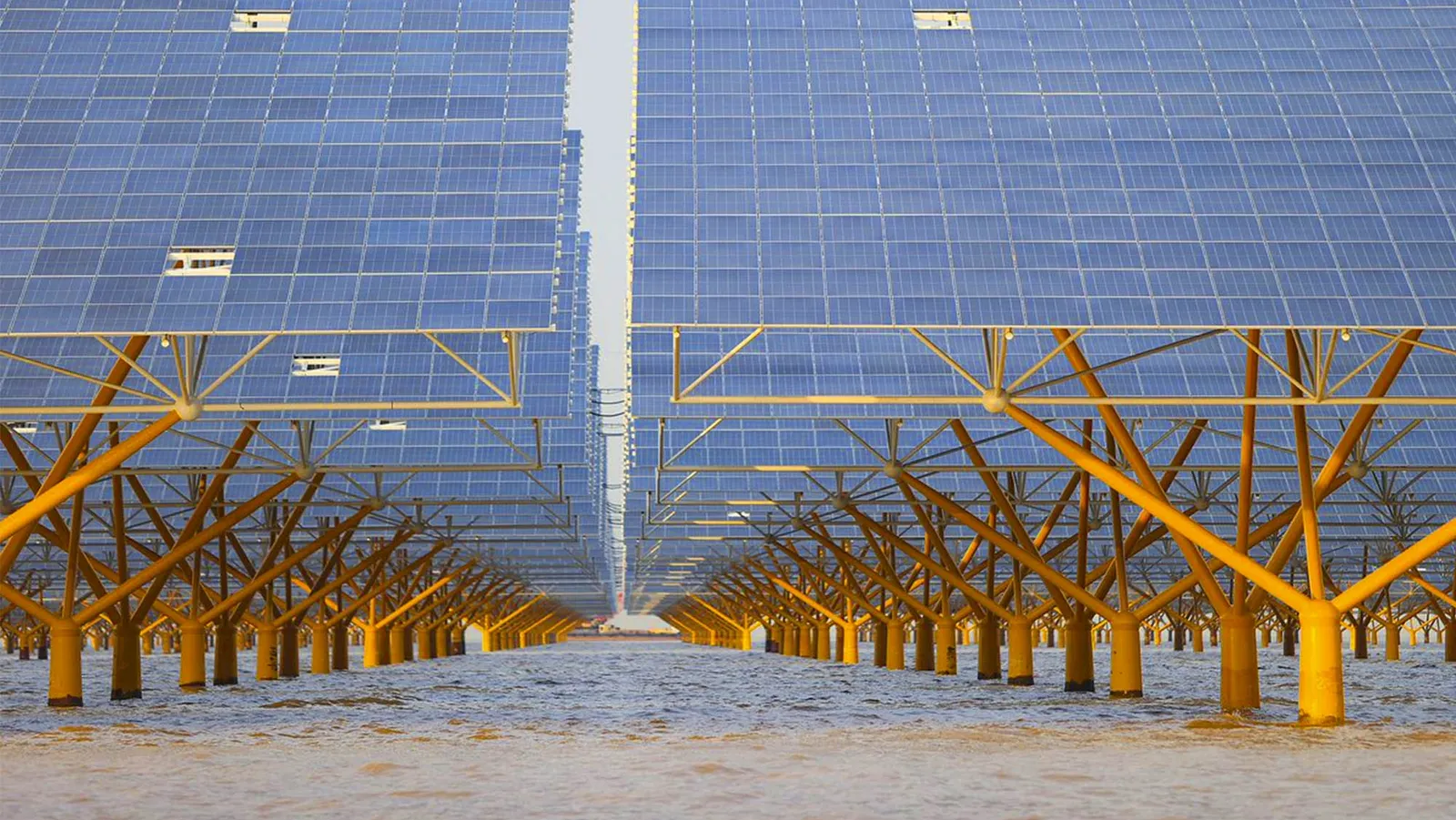
The complex covers 1,200 hectares of ocean surface, equipped with 2,934 solar panels that are 60 meters long and 35 meters wide, mounted on floating platforms. These structures are anchored to the seabed to maintain stability and connected to land via underwater cables that transmit electricity to the continental power grid.
The marine environment offers several advantages. The main one is the availability of large areas with no alternative uses, allowing projects to reach capacities that are difficult to achieve on land. Additionally, water helps cool the panels, improving their efficiency and reducing losses due to temperature. It also minimizes impact on terrestrial ecosystems and land use conflicts.
China is not starting from scratch in this field. Over the past few years, it has built numerous floating solar plants in former flooded mines and artificial reservoirs. However, moving to the open ocean poses a much greater technical challenge. These platforms must withstand corrosion, storms, and tidal changes over decades of operation.
This type of project aligns with the country’s energy strategy, which aims to reduce its reliance on coal without slowing economic growth. China is the world’s largest emitter of CO₂, but it is also the biggest investor in renewable energy and the global leader in installing solar and wind capacity.
The development of marine infrastructure also follows a territorial logic. Coastal regions house a large portion of the population and industrial activity, so generating electricity near consumption centers reduces transmission losses and improves electrical system stability.
The Shandong megaplant has a nominal capacity of 1 GW, capable of producing 1.780 million kWh—enough electricity to supply 2.6 million households, meeting 60% of their demand, while avoiding the emission of 1.3 million tons of CO2. The generated energy will be integrated into the regional grid, helping to meet the growing electricity demand in the eastern part of the country.
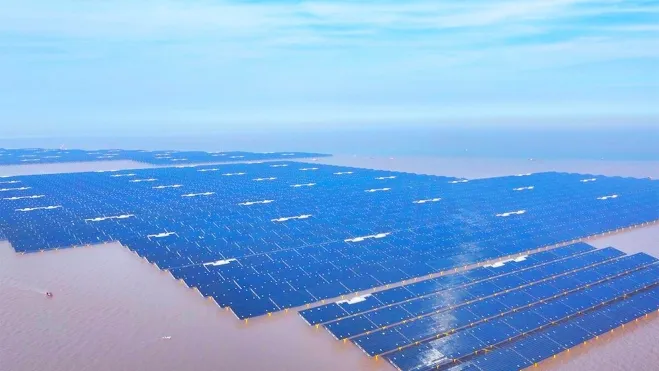
Another relevant aspect is the experimental and scalable nature of the project. If the model proves its technical and economic viability, it could be replicated on a large scale in other coastal areas of China and in other countries with high population density and soil limitations.
The deployment of solar energy at sea also opens the door to hybrid systems that combine photovoltaics with offshore wind power or even green hydrogen production. These combinations would allow for better utilization of space and stabilize renewable energy generation.
However, the development of these infrastructures is not free from questions. The costs of installation and maintenance are higher than on land, and their impact on marine ecosystems and navigation is still under study. It will also be crucial to assess their long-term resilience to extreme weather conditions.
