
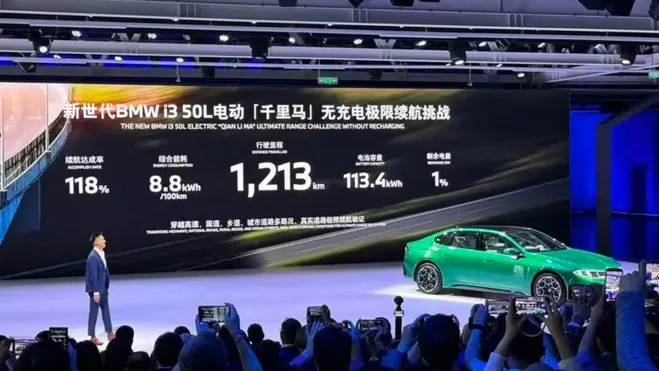
1,213 kilometers of range with 8.8 kWh per 100 kilometers: it reaches its destination with 1% of the battery remaining, breaking the record for electric BMWs.
17/10/2026 16:00
Updated to
17/10/2026 16:00
BMW has just achieved one of the most impressive results in recent months regarding electric range. The German company subjected its new i3 to a rigorous endurance test in China, where the vehicle managed to travel 1,213 kilometers on a single battery charge. What’s most surprising is that after completing the entire distance, the car still had 1% of its energy left, with an average consumption of just 8.8 kWh/100 km.
The star of this test was a unit of the new BMW i3 50L, an electric sedan developed specifically for the Chinese market on the Neue Klasse platform. According to data released by BMW China, the vehicle exceeded its official reference range by 18%, setting a new record for the brand’s longest-distance test. This result is significant because the journey wasn’t confined to a closed circuit but included various road types and driving conditions.
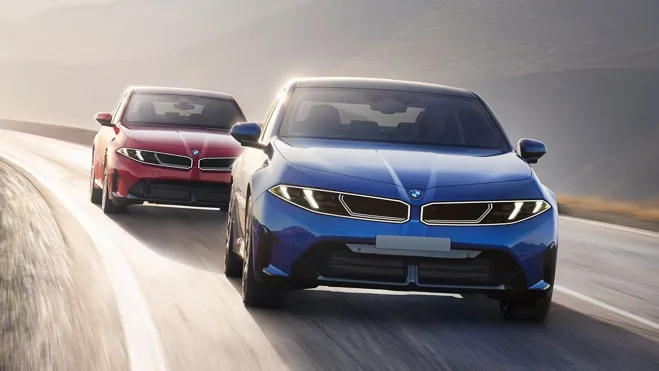
BMW i3 covers over 1,200 kilometers without stopping to recharge
During the challenge, the new BMW i3 50L traveled on highways, national roads, and urban streets, covering a total distance of 1,213 kilometers. The company has not detailed all the conditions of the test, such as average speed, outside temperature, or air conditioning use—factors that can significantly affect energy consumption. Therefore, while the result demonstrates the efficiency potential of the new platform, it should not be interpreted as a range that any driver can achieve under normal conditions.
The most notable figure is the consumption of 8.8 kWh per 100 km, an exceptionally low number for an electric sedan of these specifications. For reference, driving 1,213 kilometers at this energy consumption rate means using approximately 106.7 kWh of electricity. The test was completed with 1% of the battery remaining, demonstrating how effectively BMW utilized the available energy capacity throughout the journey.
The new i3 features a 113.4 kWh battery and an 800-volt electrical architecture, two of the key components of BMW’s sixth-generation eDrive technology. The system supports charging speeds of up to 400 kW in direct current, allowing the manufacturer to claim that enough energy can be recovered to cover 400 kilometers in just 10 minutes. In this way, BMW’s new electric generation aims to combine long range with significantly reduced charging times.
BMW’s new generation of batteries is already being produced in China
The range record coincides with another major announcement for BMW’s industrial strategy. On October 15, 2026, the company confirmed the start of mass production of its sixth-generation batteries at its industrial complex in Shenyang, China. The new facilities represent an investment of 10 billion yuan, approximately 1.2 billion euros, and cover an area of 240,000 square meters—five times larger than the space previously used for battery manufacturing in the region.
This technology will be used in the new electric models of the Neue Klasse series, starting with the BMW iX3 and i3. For the sedan model, the range will also include a four-wheel-drive version equipped with two electric motors, capable of producing up to 463 horsepower and 645 Nm of maximum torque. However, the unit used to set the range record had rear-wheel drive, a configuration that enhances energy efficiency.
Oliver Zipse, CEO of BMW Group, also used the announcement to reiterate China’s importance within the company’s international strategy. The manufacturer aims for over 95% of BMWs sold in that Asian market to be produced locally by 2030. The new iX3 has already opened for pre-orders in August with deliveries set to begin in November, while production and sales of the BMW i3 are scheduled for the final quarter of 2026.