
10 billion in savings: how electric vehicles can ease the strain on Poland’s energy grid
Electric vehicles are no longer just a means of transportation. With the development of vehicle-to-everything (V2X) technology, they can become an important component of the electrical system, enhancing its flexibility.
Table of Contents
Will electric cars be like PV?
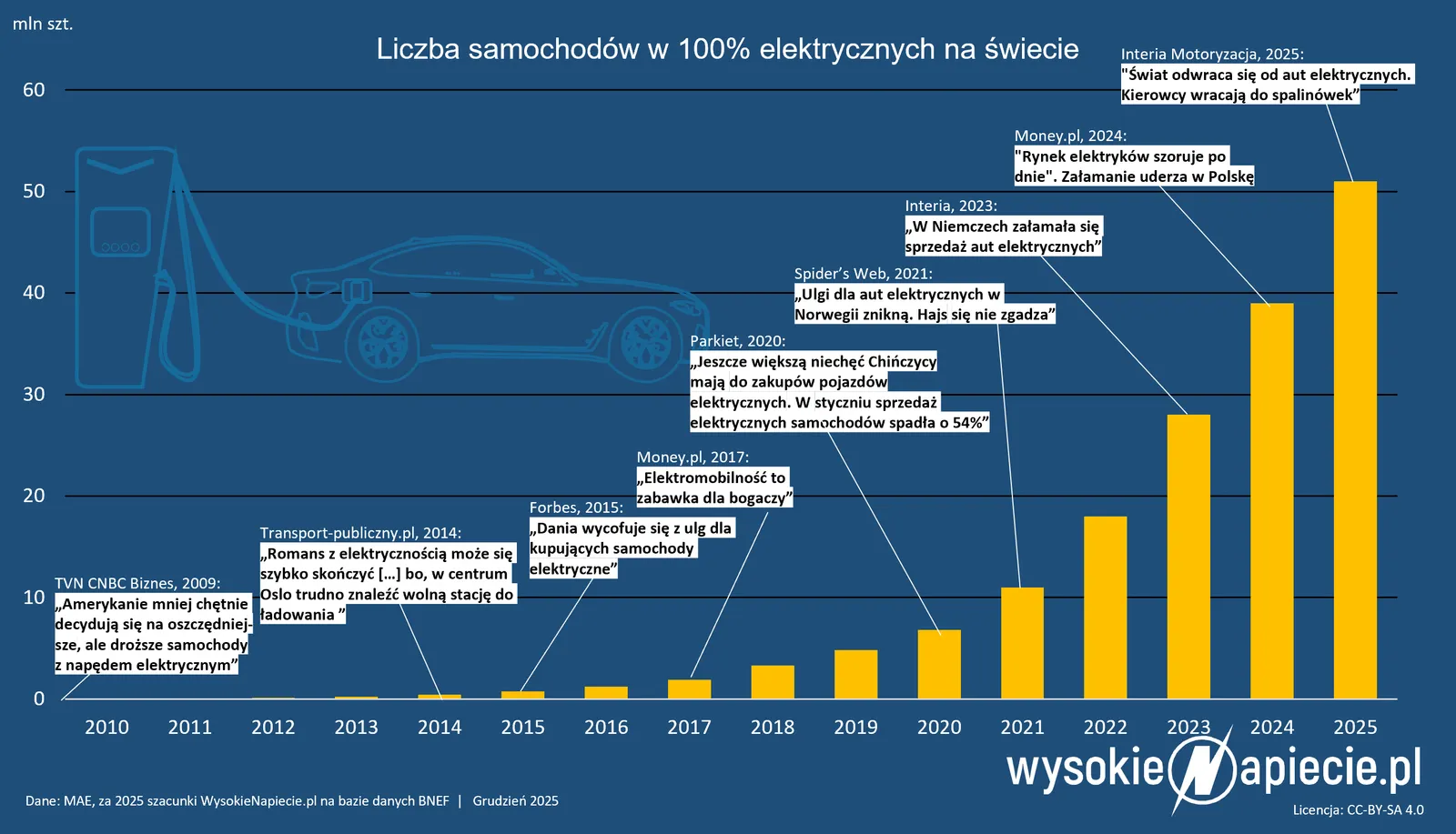
The electric vehicle (EV) market in Poland is currently in its early stages of development. By the end of 2025, there were approximately 122,000 electric vehicles (BEVs) and 116,000 hybrids (PHEVs) registered. This represents only about 1% of all vehicles on Polish roads.
At the same time, long-term prospects suggest dynamic growth. According to KPEiK, by 2040, over 4 million electric vehicles could be on Poland’s roads. This is an ambitious scenario, but still realistic. Its realization requires appropriate support measures and regulatory adjustments by the government.
The boom in the photovoltaic market could serve as a benchmark for transforming the transportation sector. Within a decade, Poland has seen 1.5 million prosumers emerge, with PV capacity increasing by more than 25 GW.
At the same time, in trying to repeat this success, it is necessary to avoid past mistakes. The rapid development of photovoltaics has exposed limitations in the electrical power system—including issues with overloading distribution networks and the need to reallocate large-scale renewable energy sources. This was largely due to a lack of flexibility in electricity production and consumption by prosumers. With the rapid electrification of transportation, we will have to confront similar risks.
Which path will we choose?
We face two scenarios for the development of the electric vehicle market—those for individual use and those for corporate fleets.
The first type of charging occurs in a rigid manner. The evening peak deepens, and power grids become increasingly overloaded. As a result, additional investment is needed in grid infrastructure and peak capacity sources, which incurs costs that are reflected in our bills.
In the second scenario, we promote the development of smart and two-way charging. Electric vehicles are charged primarily with green energy. Self-consumption from prosumer sources increases, while the scale of renewable energy reallocation decreases. The demand for peak capacity drops, and existing grid infrastructure is utilized much more effectively. As a result, the increase in distribution-related bills is partially curbed.
Elasticity, elasticity, and more elasticity
V2G (Vehicle-to-Grid), V2H (Vehicle-to-Home), V2L (Vehicle-to-Load), and V2X (Vehicle-to-Everything) involve electric vehicles acting as mobile energy storage units.
In practice, this means the vehicle is charged using a home solar installation or during off-peak hours when electricity prices are low. The stored energy can then be used to power the home during peak times or in case of grid failures. Such a “mobile storage unit” can provide Demand Side Response services in the energy market, generating additional income for the owner.
Smart charging is simply cost-effective
In the next decade, the combination of a solar power installation, heat pump, and electric vehicle will become standard in many single-family homes. This solution will be particularly popular among households looking to optimize their bills.
Smart control systems that manage the operation of heat pumps as well as the charging and discharging of electric vehicles allow for increased self-consumption of energy from rooftop panels, resulting in savings under dynamic pricing schemes. For prosumers, this means lower bills.
According to analyses by the Fraunhofer Institute, using V2H technology can reduce prosumers’ bills by 15-30% per year. Meanwhile, studies by Instatr indicate that two-way charging combined with dynamic pricing can save a household over 2,800 złoty per year.
How much can be saved
The systemic benefits of implementing V2X technology will emerge in the medium term. By then, the number of electric vehicles will be large enough that we will observe economies of scale.
As calculated by the Institute for Reforms, if 40% of electric vehicles were to charge intelligently by 2040, with 30% of them using V2X technology, the potential savings for the system could exceed 10 billion złoty. This amount consists of:
0.7 billion złoty in savings from reducing the need to reallocate renewable energy by 4.6 TWh, which will affect the quality tariff rate.
5.3 billion złoty in savings from reducing the production of expensive gas-powered energy by 5.5 TWh, which will be reflected in the active energy charge rate.
0.4 billion złoty in savings from reducing the demand for controllable peak capacity by 1 GW, which will result in a lower capacity fee.
A savings of 4 billion zł thanks to limiting the scale of expensive investments in network infrastructure, which will be reflected in lower network fees.
Poland has a unique opportunity...because it is at the beginning of this journey
To fully utilize the potential of V2X technology and the associated savings, specific decisions are needed, primarily at the government and regulatory levels.
The first step is to establish clear rules within the regulatory framework. It is necessary to define V2H and V2G and set forth rules for accounting of energy drawn from and returned to the grid. Without this, it will not be possible for prosumers to feed energy back into the grid.
The second element is the charging infrastructure. New and upgraded charging stations should support V2X technology and be based on open communication and management standards. Only then will vehicles, chargers, and computer systems from different manufacturers create one ecosystem rather than a collection of separate solutions.
The third pillar is the development of market instruments. Without appropriate economic incentives, flexible EV charging will not occur. Therefore, dynamic pricing and special rates for public chargers that reward charging during periods of lowest energy costs will be necessary.
We are at a particularly favorable moment. The EV market in Poland is just accelerating, which fosters the development of flexible electromobility. It is the cars purchased today and the chargers built now that will determine whether future systems will be rigid and costly or flexible and cheaper to maintain.
The faster we embrace flexibility, the less the electrification of transportation will strain the power grid.
There is no point in waiting. Western Europe is already testing and implementing solutions that demonstrate V2X works and brings savings. Examples can be found in Denmark, the United Kingdom, or France.
Denmark – Commercialization of V2G Potential
In 2016, the first fully commercial V2G project was launched in the Danish city of Frederiksberg. The project utilized a two-way charging management platform developed by the American company NUVVE. The water supply company Frederiksberg Forsyning became a user of this service. For the pilot project, the company purchased 10 Nissan e-NV200 electric vehicles along with 10 Enel V2G chargers, each with a capacity of 10 kW.
Spirii is another company operating in Denmark, having been an operator of an interactive electric vehicle charging platform since 2019.
In the Spirii Go app, users can view real-time data on selected charging stations, available charger capacities, and current electricity prices. With this information, they know where and when they can charge their car cheaply.
Chargers on the platform, on the other hand, monitor their entire infrastructure. They can see consumer behavior, charging process statistics, and network performance. Based on this data, companies adjust their offerings and decide where to install new chargers.
United Kingdom – V2G Becoming Profitable
The British SCIURUS V2G project (conducted from 2018 to 2021) showed something even more important – that owners of such mobile storage units can earn money from them.
In the pilot program, 300 electric vehicle owners received free access to two-way chargers and an interactive platform for managing energy consumption. Drivers were informed in advance about times when electricity prices were low. The system advised them when to charge their cars and when to feed energy back into the grid to earn money from its sale.
The result was savings of up to 725 pounds per owner per year. The project showed that on a nationwide scale, potential benefits could reach 3.5 billion pounds by 2030 (assuming half of Britain’s electric vehicle fleet uses V2G services).
Starting in 2025, British owners of electric vehicles can now take advantage of V2G services at market rates through Octopus Power Pack. Under this service, the operator (Octopus Energy) manages two-way charging of the electric vehicle. In return, the owner can save around 620 pounds per year compared to a standard tariff.
To benefit from this offer, the user must keep their car connected to a charging station for at least 12 hours per day, 20 days per month. The vehicle’s monthly charging demand cannot exceed 210 kWh.
The provider manages charging in such a way that the vehicle is ready to drive according to the schedule declared by the customer. The user also has the option to set a minimum battery charge level of 30%, ensuring the car is available in emergency situations.
France – V2G Enters System Services
In France, the potential of V2G technology is part of the planning for the electricity system. Developing infrastructure for flexible charging of electric vehicles is one of the key priorities in the French energy regulator’s strategy for 2025-2030.
The French transmission system operator RTE expects that by 2035, 2% of the country’s electric vehicle fleet will be capable of providing V2G services.
In 2022, RTE certified the first V2G-enabled aggregator for providing FCR (frequency control reserve) services. The certified aggregator is a consortium called DREEV, consisting of the French energy company EDF and the American aggregator service provider NUVVE. They used CHAdeMO two-way chargers intended for charging vehicles in corporate fleets for this aggregation purpose.
EDF is also developing a parallel project called EVVE, which aims to create a virtual electric energy storage facility with a capacity of over 8 MW, composed of 800 V2G two-way charging stations. A project of this scale will have a significant impact on balancing France’s electricity system.
V2X is a real tool — let’s not waste it
V2X is no longer a technological fantasy but a real solution — as demonstrated by countries such as Denmark, the United Kingdom, and France.
For Poland’s electricity system, V2X will be an important tool for enhancing flexibility. This means reducing the reallocation of renewable energy sources, decreasing reliance on expensive gas-powered electricity, limiting the need for controllable peak capacity, and expanding the grid.
In Poland, the stakes involve benefits worth around 10 billion zlotys by 2040. Decisions made now could determine whether these benefits can be achieved.
Klaudia Janik is an analyst for climate and energy policy at the Institute of Reforms.