
XPENG VLA 2.0 vs Tesla FSD in Amsterdam: Two different ways of driving a car
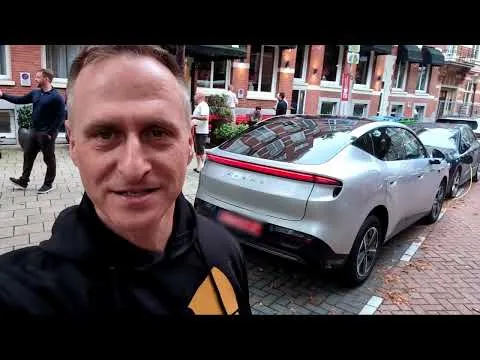
Amsterdam is not an easy place to test driving assistance systems. Narrow streets, trams, cyclists appearing from all directions, pedestrians, and frequent road construction create an environment that is much more complex than a typical American road. That’s why driving the XPENG L03 with VLA 2.0 and a Tesla Model 3 with FSD is more interesting than another highway driving demo.
Table of Contents
Show
Hide
The test took place on September 11, 2026. Larry Evans from CleanTechnica first drove the prototype XPENG L03 with VLA 2.0, and then a Tesla Model 3 with FSD. He did not drive the cars himself; an XPENG representative was behind the wheel of both vehicles. The cars drove on the same streets, though at different times and with varying traffic levels.
The most interesting question isn’t which car “won.” The test primarily showed how differently the two systems handle the same problems.
Amsterdam quickly reveals AI’s strengths and weaknesses
While driving the XPENG, the car had to navigate narrow streets, trams, cyclists, pedestrians, cars blocking the road, and uneven surfaces. Cyclists appeared from almost every direction, and some of them didn’t always follow traffic lights or rules.
The L03 was able to leave extra space for pedestrians and cyclists, and it adjusted its braking intensity based on the severity of the uneven surfaces. The author noted that the car did this smoothly, rather than reacting to each obstacle in the same way.
This is where the first impression arose that VLA 2.0 tries to anticipate situations rather than just reacting to threats.
It doesn’t mean, however, that XPENG completed the entire journey without driver assistance. In partially blocked roads or during road construction, the driver had to take control. At one point, it was difficult to determine whether a parked car was stationary or about to move.
This is still an L2 level system. The driver must monitor the road and be ready to act.
Tesla reacted faster, but more frequently
After switching to the Tesla Model 3, the difference in driving behavior became more apparent.
The author later described it very simply as “react and correct.” Tesla could quickly react to cyclists or pedestrians, but sometimes it did so when the situation didn’t yet require such a strong response.
In one instance, FSD stopped the car for a cyclist who was still some distance away. In another, it halted at a green light because a pedestrian was approaching the intersection. By the time the car decided it could move again, the light had turned red.
Problems also arose with lane selection while driving. Tesla ended up on the right-turn lane even though the navigation was directing it left. The driver had to assist the system to avoid taking an extra detour around the area.
Road construction proved even more challenging. Temporary traffic arrangements, trucks, and very limited space made it difficult for FSD to accurately assess the situation at times.
The most interesting difference: prediction versus reaction
This part of the test is, in my opinion, the most interesting.
According to the author, Tesla often reacted very quickly, but only when the situation became obvious. VLA 2.0, on the other hand, seemed like a system that interpreted the behavior of other road users in advance.
This was clearly evident with cyclists. Instead of waiting for the bicycle to enter the driving lane before braking, XPENG could reduce its speed earlier and leave a proper margin.
This does not automatically mean that one system is safer. In Amsterdam, Tesla’s caution often worked in its favor. FSD left a large margin for pedestrians and cyclists, even if this sometimes meant unnecessary stops for the passenger.
An XPENG representative also noted that driving style must depend on the location. What works in Beijing may not necessarily be suitable in Amsterdam. Bicycles hold a very strong position in traffic there, and a too-cautious car could simply hinder everyone else’s passage.
Tesla showed it has a response
The test was not one-sided, however. In one of the most challenging situations, Tesla had to drive through a very narrow space. The car made successive slight steering adjustments, approaching the obstacle and checking whether there was enough room. The maneuver took a long time and wasn’t particularly smooth, but ultimately FSD managed to get through. The author described this as impressive.
Tesla also performed well on the more open sections. There, differences in smoothness were less noticeable, and the system operated much more naturally.
Now I can finally show you the whole story from Amsterdam.
I was invited by Xinhua News Agency, one of the world’s largest news agencies, to experience XPENG NGP with VLA 2.0 and Tesla FSD Supervised on real roads in Amsterdam.
And importantly:… pic.twitter.com/3QS1kRT1z4
— EFIEBER (@EFIEBER_ANDRE) September 28, 2026
This wasn’t a head-to-head comparison of two identical cars
However, it is important to keep in mind the limitations of this comparison. The XPENG L03 was a pre-production prototype, while the Tesla Model 3 was a production vehicle equipped with HW4 and the latest version of FSD. The conditions were not identical either. The XPENG was driven in heavier traffic, while the Tesla was driven later when streets were quieter, and it was raining during its test. Additionally, the first attempt to drive the Tesla encountered technical issues, which is why the author conducted a second round.
This is not therefore a test based on which a winner can be fairly declared. It is, however, a good example of how the biggest differences between modern ADAS systems are now focusing not on whether a vehicle can drive itself, but on how it makes decisions.
Amsterdam showed this clearly. VLA 2.0 appeared more predictive and smoother. Tesla tended to be more cautious and could make sharper adjustments. At the same time, FSD handled extremely difficult situations that required precise maneuvering in tight spaces.
Both systems still require active driver supervision. And this is perhaps the most important takeaway from this test. We’re no longer just watching cars that learn to recognize obstacles. We’re increasingly seeing systems trying to predict what other road users will do next.
In the case of driving through Amsterdam, this difference was particularly evident.
Order your Tesla and take advantage of purchase bonuses using the referral link!