
Xpeng P7+ Long Range in Test: Top Features Meet Lightning-Fast Charging
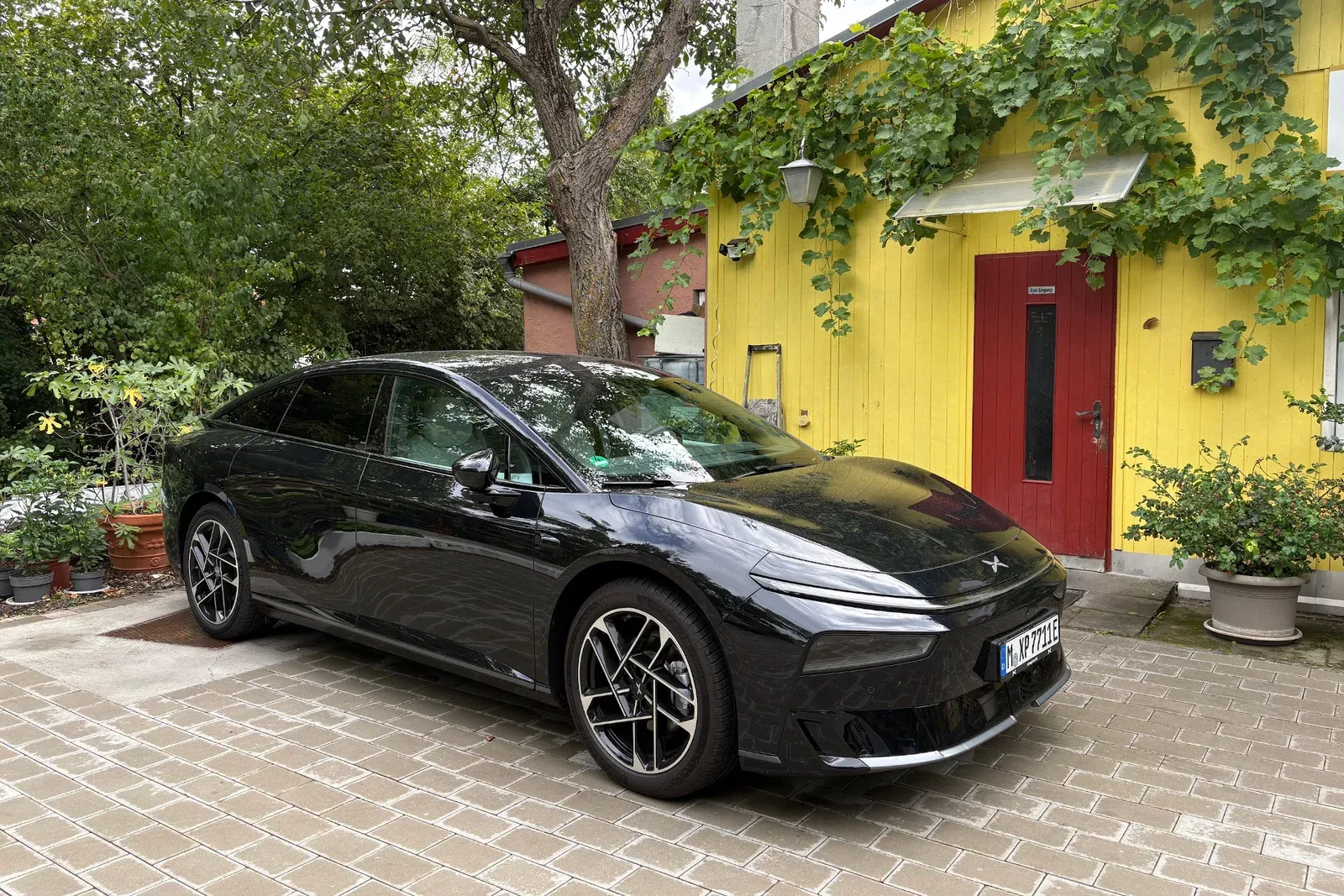
The previous Xpeng P7 already had some of the strongest specifications among its class. With the new P7+, which is essentially a separate model, the Chinese manufacturer doesn’t simply add a few extras or adapt its technology from the G6 and G9 models; instead, it surpasses their already impressive specification levels in several areas.
It features 800-volt technology instead of 400 volts, a large rear hatch replacing the less practical trunk lid, significantly more interior space — and for the first time in Xpeng’s lineup, it includes a head-up display. Most importantly, the P7+ charges so quickly that the traditional debate about the time advantage of refueling now seems completely outdated.
We were driving the Xpeng P7+ Long Range. This rear-wheel-drive vehicle delivers 230 kW (313 hp) and 450 Nm of torque, accelerates to 100 km/h in 6.2 seconds, and has a top speed of 200 km/h. Its large 74.9 kWh LFP battery is said to provide a range of 530 kilometers according to WLTP standards. The list price is 49,600 euros. At 5.07 meters in length and 1.94 meters in width, the P7+ is also a quite substantial electric car.
These were the things that stood out to us during the testing period:
The advantages of the Xpeng P7+
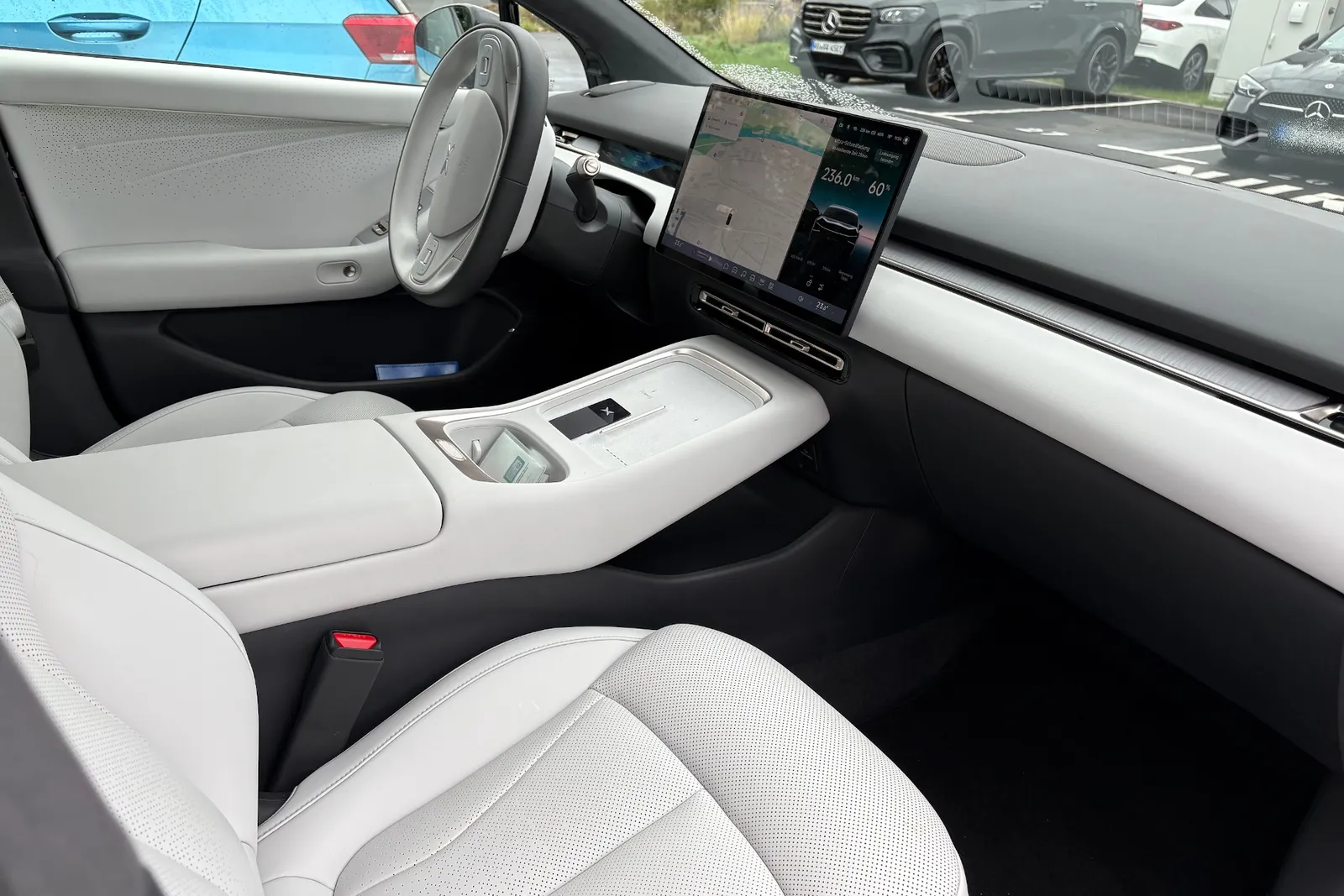
Features: “Full package” is typical of Xpeng. On the P7+, the list of features truly seems like no one stopped the assembly process at any point. It includes a head-up display, digital rearview mirror, panoramic glass roof, heated and ventilated seats with massage function, 20 speakers, surround-view cameras, along with a long list of driver assistance and parking systems. The Long Range version adds features such as Nappa leather, as well as massage and ventilation seats in the rear area.
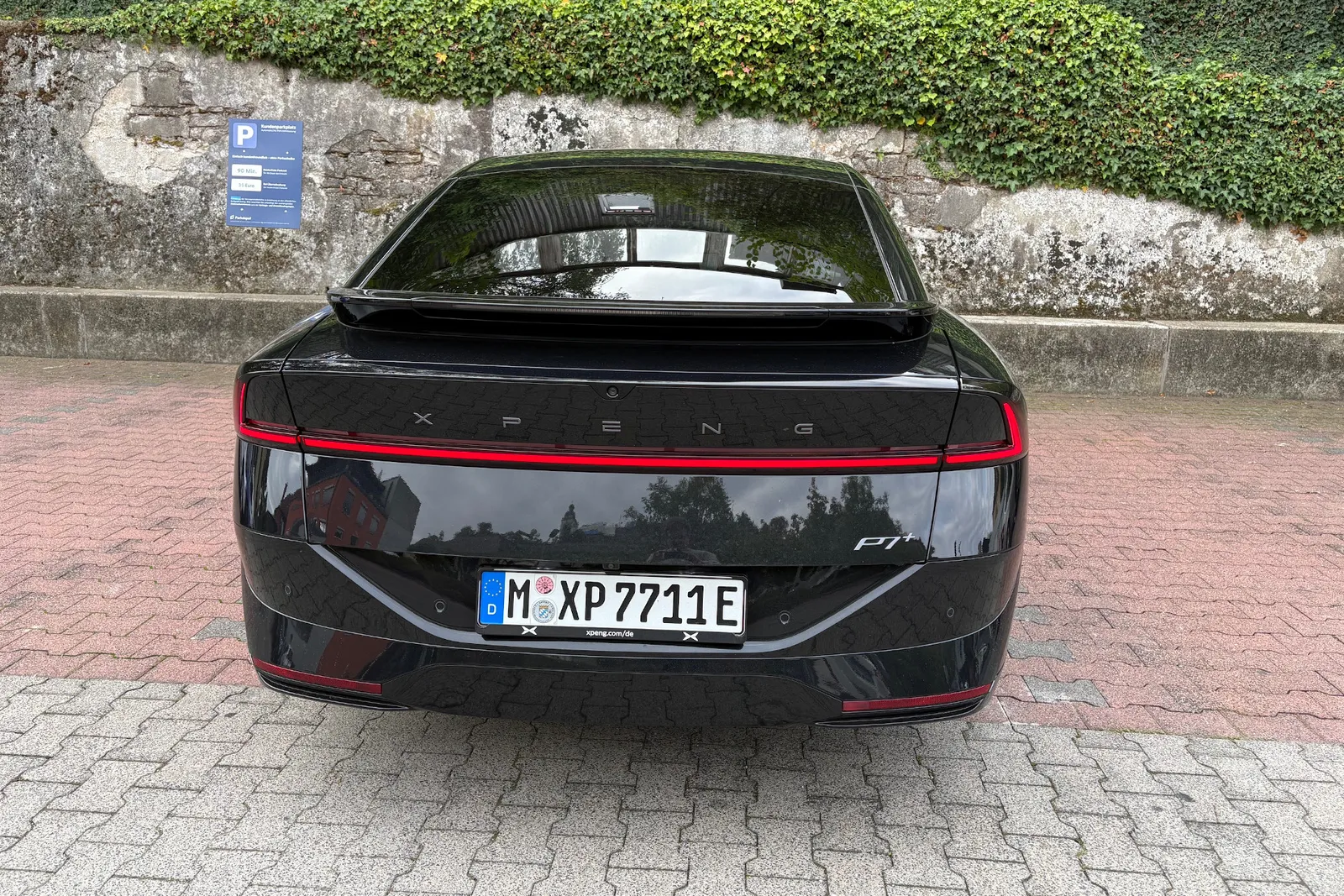
The head-up display, offered for the first time by Xpeng, is particularly impressive. It doesn’t just show speed and navigation information. When turning, it can also display camera footage from blind spots. This might seem a bit gimmicky at first, but in everyday use, especially when driving alongside cyclists, it proves to be extremely practical. The comprehensive camera system also helps when reversing. As the rear view is limited due to the flat trunk, the digital rearview mirror is almost more of a necessity than a novelty.
And then there’s the price. Xpeng lists the Long Range version at 49,600 euros. For comparison, a BMW i5 eDrive40 currently starts at around 70,900 euros, while the Mercedes EQE is priced at just over 65,000 euros — all before considering equipping them with the same level of features as the Xpeng. When it comes to size, technology, and equipment, established premium brands still have to answer some quite uncomfortable questions when compared to their competitors. Additionally, Xpeng does not pay import tariffs for the P7+, as it is manufactured in Graz by Magna under EU standards.
Charging speed: The perhaps most impressive feature of the P7+ becomes evident only when the car is parked. According to the specifications, the Long Range version can achieve up to 446 kW of DC charging power. Under ideal conditions, it claims to take only ten minutes to charge from 20 to 80 percent, and about twelve minutes for a 10 to 80 percent charge.
At first glance, this sounds like one of those promotional figures that should be taken with a grain of salt. Yet our test vehicle quickly made it clear that Xpeng isn’t bluffing here. At a charger with sufficient capacity, the display showed 400 kW charging power multiple times—exactly the limit of that charging station. The car itself could theoretically handle even more power.
But what’s even more impressive than the peak charging speed is how little time it now takes. For example, during a very short trip to the restroom, our car’s battery level increased from 48% to 70%. When you return to the car and find it’s actually ready to go again, it gives you an idea of just how much fast charging has changed in just a few years.
Thus, at least for the P7+, the argument that “refueling is faster” has become practically meaningless. Of course, gasoline fills the tank in two or three minutes. It’s just that the entire stop at a gas station—including driving up, refueling, paying, and possibly using the restroom—takes longer. Electric cars, on the other hand, can “refuel” while moving, and in the case of the P7+, at such high speeds that even the gas station attendant is amazed (“There aren’t any electric cars that can charge at 400 kW yet”).
Trunk space and comfort: Here, Xpeng addresses one of the P7’s biggest everyday weaknesses. Instead of a small, traditional sedan-style trunk opening, the P7+ features a fully upward-opening rear hatch. Behind it lies 573 liters of storage space, which increases to a maximum of 1931 liters when the rear seats are folded down.
A large child buggy could be comfortably stored on one side despite the sloping rear. There was still plenty of space left for suitcases and bags. This is remarkable even compared to the Xpeng G6, which has a trunk volume that’s almost exactly the same: with that buggy in it, so little space remains that only smaller pieces of luggage can fit next to it.
Driving experience: The P7+ Long Range isn’t a sports car, but fortunately it doesn’t desperately try to be one either. 313 horsepower is more than enough to keep the vehicle moving swiftly at all times. What’s far more important is how confidently this car weighing over two tons handles on the road. The Xpeng drives smoothly, quietly, and remains remarkably composed even at higher speeds.
On the highway, additional assistance systems come into play. Lane keeping, distance control, and automatic lane changing allow for long stretches with minimal driver intervention — still as an assistance system, not true fully autonomous driving. This works well with the car’s relaxed character, especially during longer highway trips. It’s also nice that the P7+ offers genuine one pedal driving, unlike Xpeng’s “older” models.
Consumption and range: An electric car that is five meters long and weighs over two tons, with more than 300 horsepower, doesn’t seem like a model designed for efficiency at first glance. However, the P7+ manages to keep its consumption in check thanks to its sleek design. In urban areas and on rural roads, with moderate driving on favorable routes, the onboard computer showed consumption levels of 11 to 12 kWh per 100 kilometers. This should not be interpreted as an annual average, but it does demonstrate what the car’s excellent aerodynamics can achieve when driven gently.
Even highway driving doesn’t ruin these figures. Despite a high proportion of time on the highway, many sections at around 150 km/h where possible, and extensive use of driving assistance features, the display showed 18.7 kWh per 100 kilometers at the end of our test—this included a few bursts to a top speed of just over 200 km/h shown on the speedometer.
Based on our 18.7 kWh, the calculated range is approximately 400 kilometers if the battery is used to its full capacity. If you leave 10 percent of charge remaining for peace of mind, you can roughly plan on a range of 360 kilometers between 100 and 10 percent charge. Although this is significantly lower than the 530 WLTP kilometers, with a charging stop of about twelve minutes, this difference loses much of its significance. At high speeds on the highway, however, recharging is needed every approximately 250 kilometers — enough time for a quick trip to the restroom or two espressos.
The downsides of the Xpeng P7+
Dimensions: Somewhere, the huge interior space and large trunk must come from. At 5.07 meters in length and just under 1.94 meters wide without mirrors, the P7+ isn’t a car you can drive confidently into the tightest old-town parking lots. Narrow streets, small parking spaces, and cramped garages require extra caution. However, Xpeng significantly mitigates this problem it created with very good cameras, 360-degree visibility, and automatic parking.
But even technology can’t do everything. Once, our parking assistant stopped a parking attempt because it seemed the space was too tight to it. Still, we were able to manually guide the car into the spot using the cameras. So there’s no need to give up at every tight parking space—though it still doesn’t turn the P7+ into a compact car.
Assistance and Operation: Our rating for this aspect is slightly more positive than in some other tests, though this may also be because our reviewer normally drives a leased Xpeng G6 and thus didn’t need to get used to the controls. One must be familiar with the minor quirks of the driving assistants in order to overcome them. The numerous warning sounds can be reduced to just one using a command generated in the app, which can be turned off with a “click” at the start of driving.
This mainly shows that further refinement is needed for the software to suit European roads. Fortunately, Xpeng is among those manufacturers that can improve such aspects relatively quickly through OTA updates. The strong emphasis on the large central screen is also a matter of personal preference; those who prefer real buttons will miss some of them. All the initial difficulties that less familiar Xpeng testers often encounter fade over time. However, it remains clear that the overall usability is not particularly intuitive.
Conclusion
The old P7 was a good electric car with some design-related weaknesses in everyday use. Its largely independent counterpart, the P7+, seems to reflect Xpeng’s careful attention to what customers want from a large electric sedan.
The trunk is suitable for families, with plenty of space in the back. The equipment level falls somewhere between “generous” and “excessive,” and the new head-up display, with its camera overlays, is more than just a nice feature. The suspension fits perfectly for a large touring sedan, and even in terms of fuel consumption, the P7+ doesn’t suffer from significant issues despite its size.
The real game-changer, however, is the charging technology. 400 kW in practice, with up to 446 kW possible, and just ten to twelve minutes needed for a typical fast charge to 80 percent battery level — these figures make the old debates about gas stations increasingly irrelevant. On top of that, the Long Range model costs 49,600 euros regularly. German premium sedans of similar size start at prices 15,000 to over 20,000 euros higher — and still don’t come equipped with such a comprehensive set of features.
The downside is quite straightforward: the P7+ is large. Extremely large, in fact. And in some aspects of its assistive software, it’s still evident that Xpeng hasn’t fully finalized the tuning for Europe. For those who can live with this, the P7+ Long Range offers one of the most compelling overall packages among large electric sedans today. It’s also likely one of the few cars where you really need to hurry up at the charging station to meet basic human needs.
Transparency note: The test vehicle was provided to us free of charge by Xpeng Deutschland. This does not affect our honest opinion, as stated here.