
VW ID. Buzz: Fully Equipped Electric Camper in Test
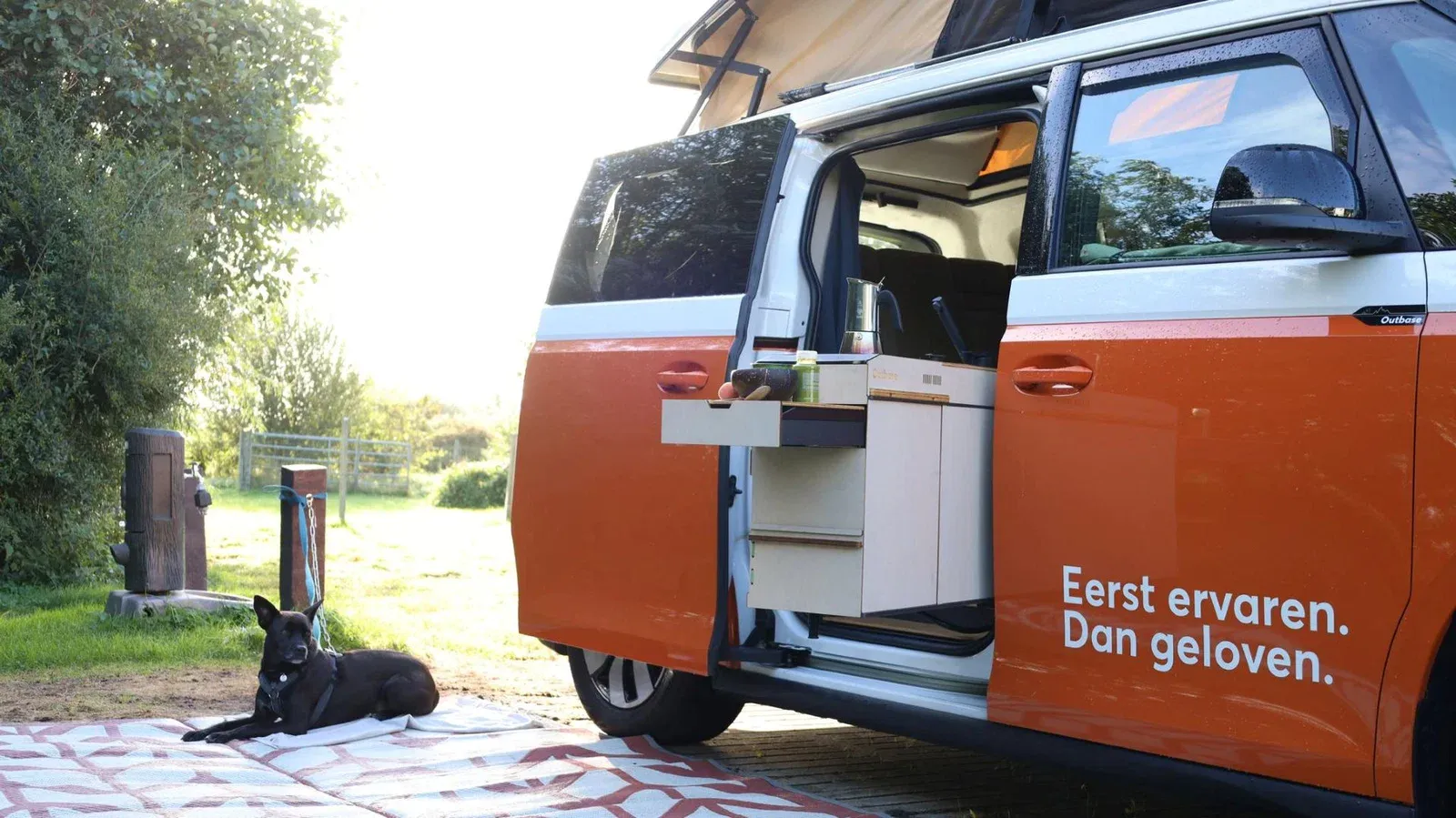
While sitting on the train to Utrecht, the sun slowly rises and shines through the misty clouds hanging over the fields. It almost seems as though this idyllic September scene is trying to prepare me for what’s ahead, as I’ll be spending the next few days among lighthouses and windmills in the Netherlands. There, I’ll get to test a fully equipped electric camper of the Volkswagen ID. Buzz type, provided to me by the Dutch company Outbase Campervans.
Together with my dog, I’ve set out for the northern part of the country and plan to drive to the sea from Utrecht. The weather forecast already suggests that I’ll have plenty of time to thoroughly test all the advantages of this fully equipped camper, as in addition to a mild 15 degrees Celsius temperature, there’s also expected to be heavy rain and wind.
In the past three years that I’ve lived in my own custom-built van, I’ve learned that the true quality of a camper conversion is revealed when the weather is bad. Features for good weather are part of a solid setup, but they’re useless if you feel cramped inside. So I’m curious to see how the ID. Buzz, as a relatively small model, performs in this regard and what the camping conversion from Outbase can offer.
Between One Pedal Driving and Fast Charging
At the Outbase headquarters in Utrecht, I am greeted by founder Tim van Broekhoven. The company has developed and standardized its own modifications, specifically for the ID. Buzz model. When we enter the production hall, I find myself in my personal paradise: numerous new ID. Buzz vehicles are parked at various ends of the hall, each at different stages of modification.
Step by step, the new electric campers are being built here. Some vehicles in this hall are currently being insulated, while others still don’t have any fabric stretched over their rooftop tents. Another ID. Buzz is even completely white, as all Outbase vehicles are purchased in this standard paint finish to be repainted according to customer preferences. The color palette includes 20 sample colors, though it’s also possible to choose a completely custom shade. One of the most popular paint finishes currently on display at the Outbase showroom is the Porsche color Frozen Berry – a metallic rose tone.
After a brief introduction, I drive my test model, painted in a vibrant orange shade, out of the yard. Just a few meters in, I notice how intuitively easy it is to operate the ID. Buzz. Switching from my diesel truck, which is over twenty years old and has been my companion on travels, proves surprisingly straightforward. Using a lever on the steering wheel, one can switch between automatic modes with slight tilting movements. I also discover the One Pedal Driving feature and immediately become curious to try it out. The idea behind it is that once you remove your foot from the accelerator, the electric car brakes itself quite strongly—enough to require only one pedal for driving. Of course, the brake pedal remains available for faster responses. Thanks to high-level regenerative braking, this mode helps conserve the car’s battery and range.
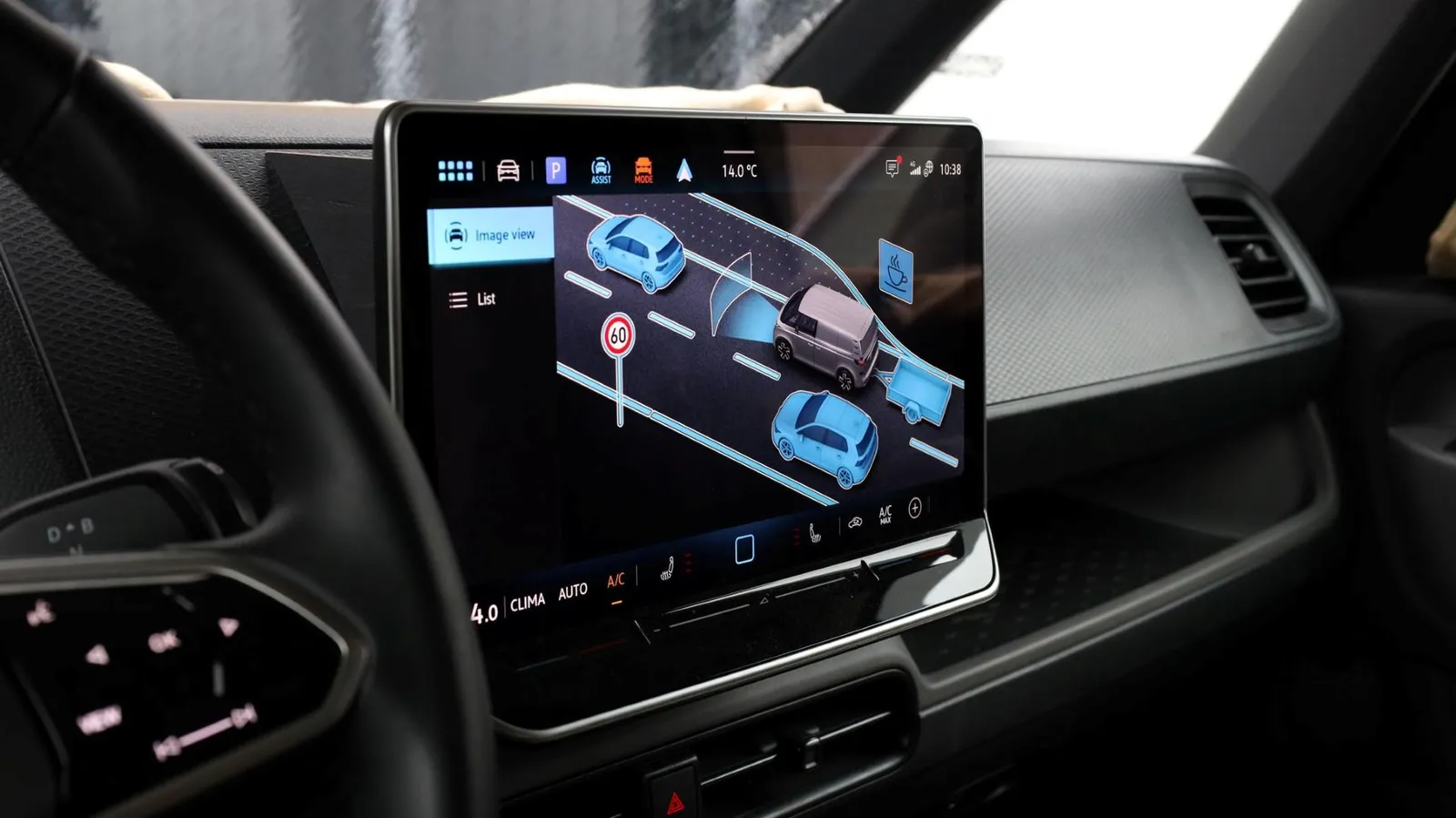
.The large central display with infotainment system is easy to use—especially after switching the language from Dutch. It allows control not only of the climate control, music, or navigation but also of the driving assistance systems. The ID. Buzz features a cruise control, distance monitoring, traffic sign recognition, and lane-keeping assist, with the latter requiring the longest adjustment time due to its gentle, externally controlled nudges of the steering wheel. The blind spot detection, which provides an optical warning in the side mirror, is very useful for campervans. The same applies to the cameras and sensors that offer a 360-degree view on the screen while parking.
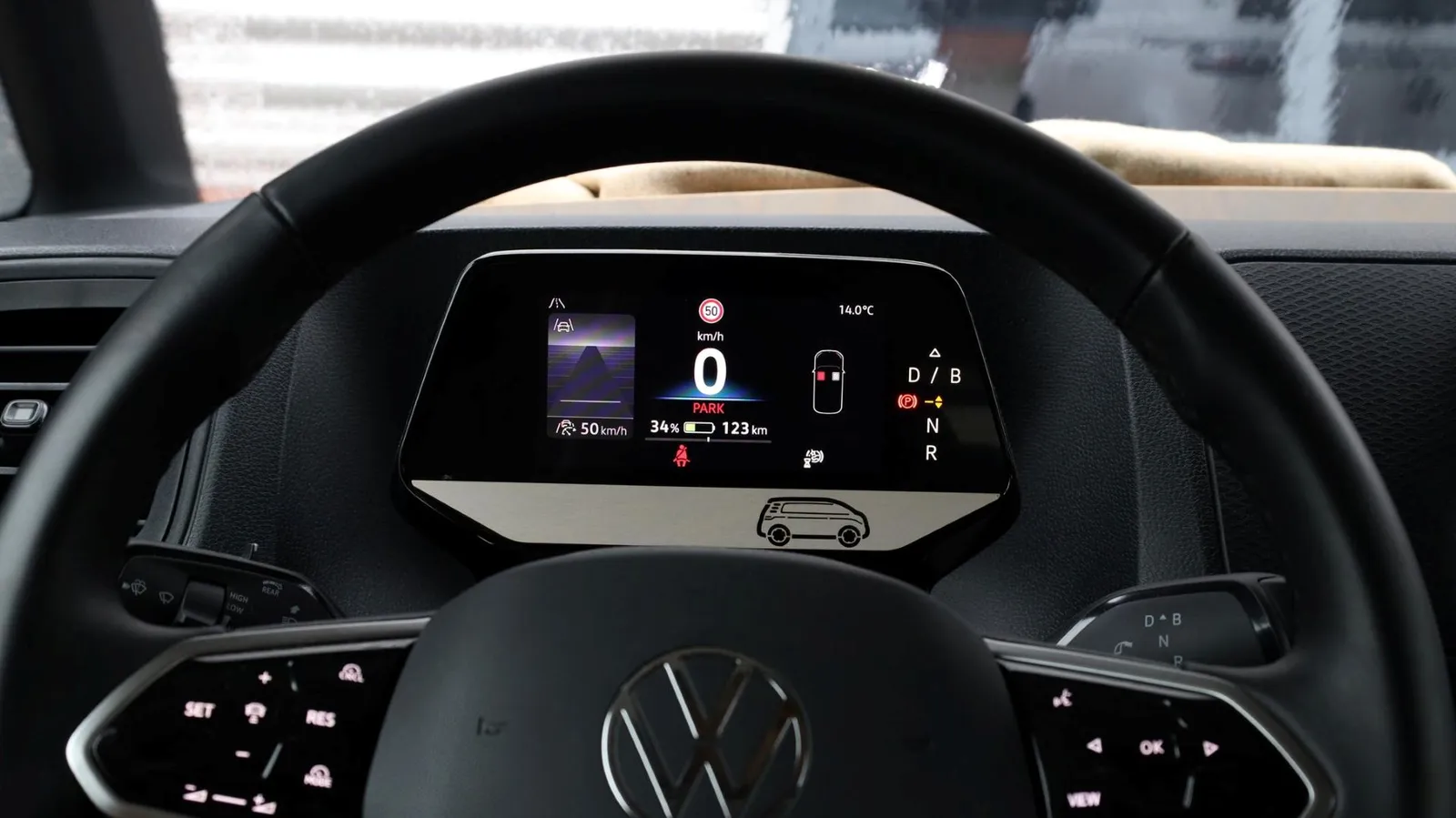
From Utrecht to the North Sea coast at the northwest tip of the Netherlands, I cover 110 kilometers in one direction, and with a total distance of 220 kilometers, I’m not even close to reaching the limits of its electric range. According to WLTP standards, this range is a maximum of 458 kilometers, while Outbase claims an actual range of up to 500 kilometers.
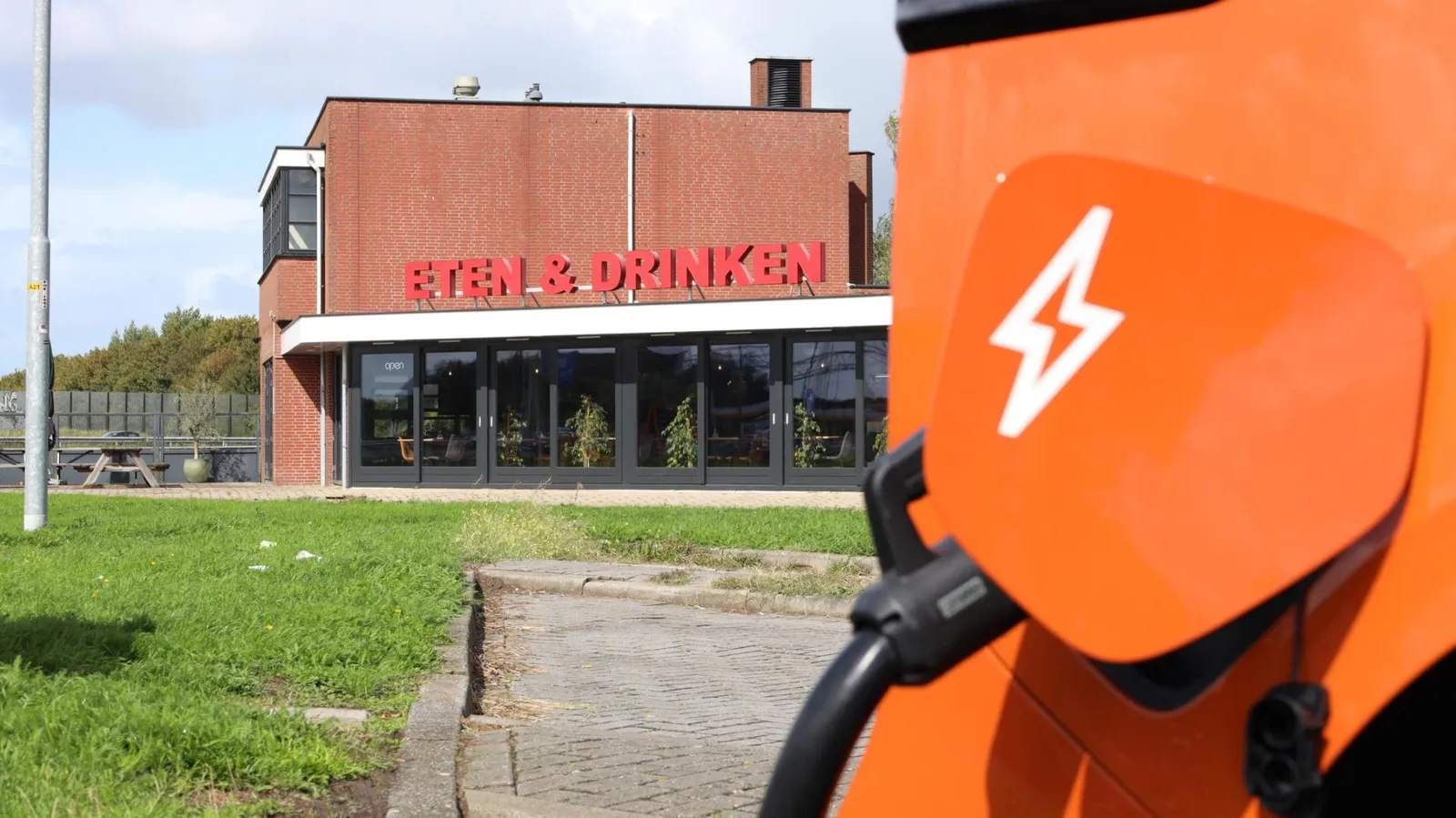
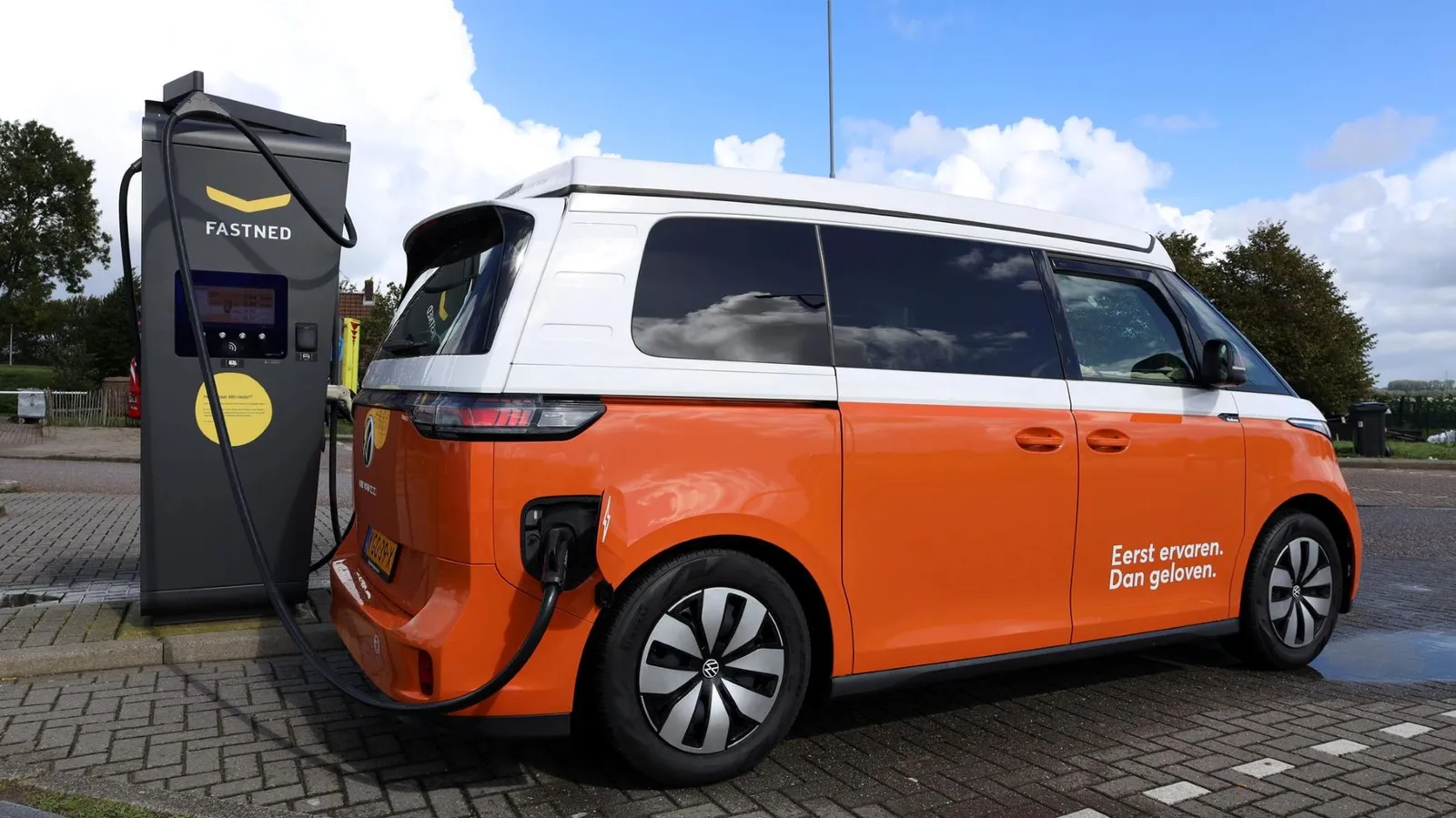
The manufacturer states that the fast charging time from 10 to 80 percent takes 26 minutes. Charging my 79-kilowatt-hour battery from 60 to 80 percent using the fast charger barely gives me enough time to grab a sandwich to go at a rest stop. The charging station can be unlocked easily with the charger card from the Dutch provider Tango. By the time I finally get to my croquette sandwich, the electric camper is already fully charged and the charging spot is free.
You can easily check and compare how far you can go with an electric camper using eCamperRadar’s range map. Besides the VW ID. Buzz, there are other electric models such as the Peugeot E-Boxer, Mercedes EQV, and Ford eTransit, which are pre-built and rented or sold by various companies. On eCamperRadar, all purchase and rental prices are also clearly displayed.
Folding, sliding, rotating: A detailed look at the interior setup
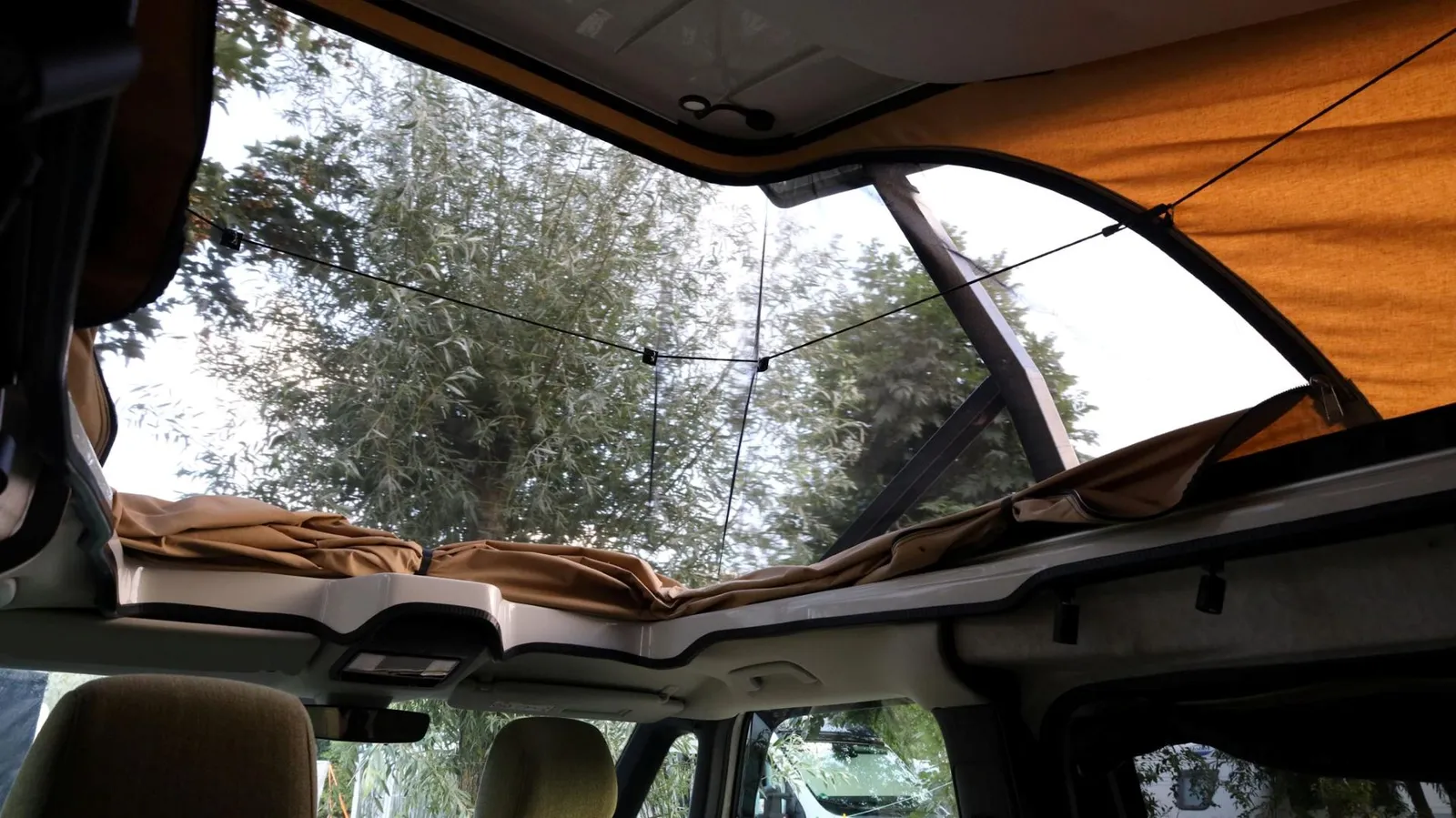
For my test drive, I received the Outbase version Delta, which is equipped with various conveniences. This includes an electric lift roof that allows one to stand comfortably upright in the otherwise low ID. Buzz. The sleeping area, which can be moved down to a height just below the roof, can also be used as a bed. Thus, this electric camper has two large sleeping areas for up to four people.
Before leaving, I was skeptical about the roof top in light of the weather forecast. Experience tells me that wind and a roof top are not a pleasant combination. Fortunately, I didn’t have to worry about this at the campgrounds where I could park the ID. Buzz in a wind-protected area. With extremely strong winds and no standing height at all, this trip would surely have been less comfortable. Instead, the roof top offers a feature that really impressed me: the opaque inner fabric of the rooftop tent can be opened, leaving only the semi-transparent mosquito net. This greatly improves the sense of space and light intake.
The front seats can be rotated 180 degrees, a feature that Outbase added to the ID. Buzz. This allows them to be used as seating facing inward toward the cabin. Conveniently stored between them is a simple partitioned toilet, which can also be used as a small step for climbing onto the upper bed.
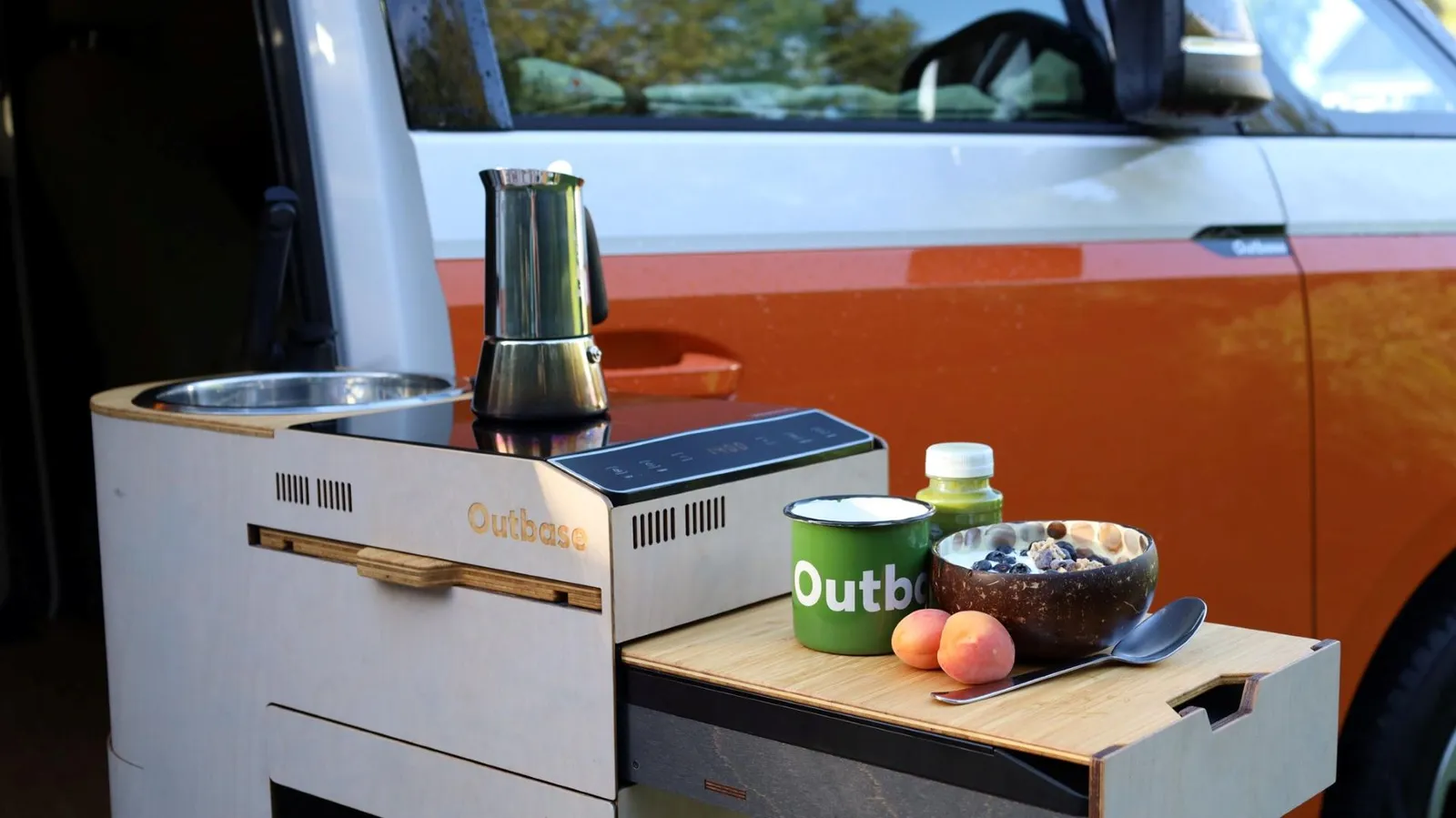
The kitchen island located in front of one of the two sliding doors is also movable and can be rotated outward through the open door. On the kitchen counter, there is a powerful induction cooktop and a sink, though the latter could definitely use to be larger. The same applies to the two water tanks beneath it. Although they can be easily removed, refilled, or emptied, with 10 liters for fresh water and 5 liters for wastewater, they would barely last a day unless one is constantly at campgrounds. The fact that there is more fresh water available than wastewater volume remained unclear to me until the end, as did the fact that the wastewater tank is not capped from above but only has a hose of the same width extending into it. When the 5-liter wastewater tank is full
If necessary, use the remaining 5 liters to fill the tank compartments with gray water. After all, it’s not easy to check the fill level.Other than that, the kitchen unit is excellently designed. Various compartments that can be pulled out from multiple sides hold cutting boards, a utensil tray, and a second induction cooktop. The kitchen attracts the most attention at the campsite among my temporary neighbors. No wonder, as it’s perfect for enjoying morning coffee there, and when the sun is replaced by rain again, everything can be quickly folded up.
The rear seat inside the vehicle, along with two additional approved seats, functions as a sofa and can be expanded into a dining area with a folding table or unfolded into a spacious bed. There is storage space between them and outside as well: Outbase claims a volume of 1000 liters.
What also catches my attention during these days I spend with the electric camper on the North Sea coast is the love for detail. Outbase has created an interior that is not only well-thought out but also high-quality and aesthetically pleasing. The light-colored wood of the floor, kitchen, and cabinet wall harmonizes with the green-streaked fabric covers on the seats and a light gray felt trim. All windows are covered with custom-made, light-colored, sand-toned fabrics that are secured using magnetic and click systems. During the day, they are rolled up and fastened, which is quick and easy to do.
The matte black LED spots and USB ports inside can be rotated to any position on the narrow 12-volt strips, casting a cozy, warm light throughout the interior when it’s dark. Numerous hooks and small baskets provide ample storage for daily items, while the open compartments are secured with elastic green straps to keep everything in place during driving.
It should be mentioned here that the entire Outbase setup is composed of movable components. Almost everything can be folded, rotated, pulled out, or pushed together—whether it’s seats, tables, a kitchen, beds, or storage space. While this ensures maximum flexibility and makes full use of the small space, it has two significant drawbacks in my opinion: first, one often gets in their own way, and second, the components wear out more quickly. Speaking of wear and tear, one must also stay in good physical condition for this setup, as pushing, lifting, bending, and climbing are simply inevitable tasks.
The Power Setup in an Electric Camper
All 12-volt consumers, such as LEDs and charging ports, the faucet, and the refrigerator, are powered by a regular auxiliary battery, whose charge level can be easily checked on a screen. This battery can be charged through the photovoltaic cells on the roof, while driving, or via mains electricity using a plug. All charging options can be simply activated or deactivated with a switch. Similarly, 230 volts, required for the Schuko outlet and the induction field, can be turned on with a button press. Although it was mostly cloudy during my trip, the PV energy is sufficient to fully charge the auxiliary battery.
What I keep using on these cold autumn evenings to maintain a cozy warmth inside is the ID. Buzz’s built-in climate control. To use it, I first have to download the Volkswagen app, which is a bit cumbersome, as only through this app can the seat heating be turned on or off. When heating is active, electricity is drawn from the vehicle’s battery, which reduces its range. With two overnight stays during which I turn on the heating intermittently, I lose about 10 kilometers of range at an outside temperature of 12 to 15 degrees. Overall, my average power consumption per 100 kilometers is 21.6 kilowatts, slightly above the normal level of 19 kilowatts. The practical aspect is that the heating can be scheduled to turn on at a specific time via the app. Additionally, the heating is almost completely silent.
What is the Outbase ID. Buzz good for?
For my trip to the North Sea in autumn, the Outbase camper was ideal. With just my dog, I had more than enough space, so I enjoyed staying inside no matter the weather. Whether it was for eating and cooking, working, or relaxing, the ID. Buzz eventually felt almost like home.
It certainly shouldn’t have been that cold, though. Aside from the electric car’s battery performing poorly in low temperatures, this E-camper has very little insulation. The metal sides are only covered with felt in some areas, and in many spots there’s no covering at all. The large windows on all sides aren’t adequately insulated even by the thick fabric curtains. When the interior heating has to run at full capacity, not much of the electric range is left.
For occasional road trips, however, the ID. Buzz in Outbase configuration is an excellent companion. For this purpose, in addition to charging stations, campsites should be available every 250 to 300 kilometers. Occasional off-road use certainly works as well, but it lacks important comforts such as a severely limited water supply and no shower. If one owns this electric camper and travels well-equipped, it can certainly be a lot of fun even on longer distances. Ultimately, as with any camper, the question arises: What is the plan?
The VW ID. Buzz in the Cargo version, based on Outbase’s short-wheelbase model, is available as a base model for less than 50,000 euros. The Delta version of Outbase’s campers, new and fully equipped, costs between 110,000 and 120,000 euros. The Flow version is already available at a lower price. Those who are curious can test Outbase’s pre-assembled E-campers not only directly through the company but also at rental fleets. In Germany, for example, this vehicle is available for testing at EV Camper’s location in Dortmund.
Disclaimer: Outbase provided the Delta camper in Utrecht, Netherlands, free of charge. This does not affect the honest opinion expressed here.