
Is your range a lie? We explain what the Tesla screen actually shows
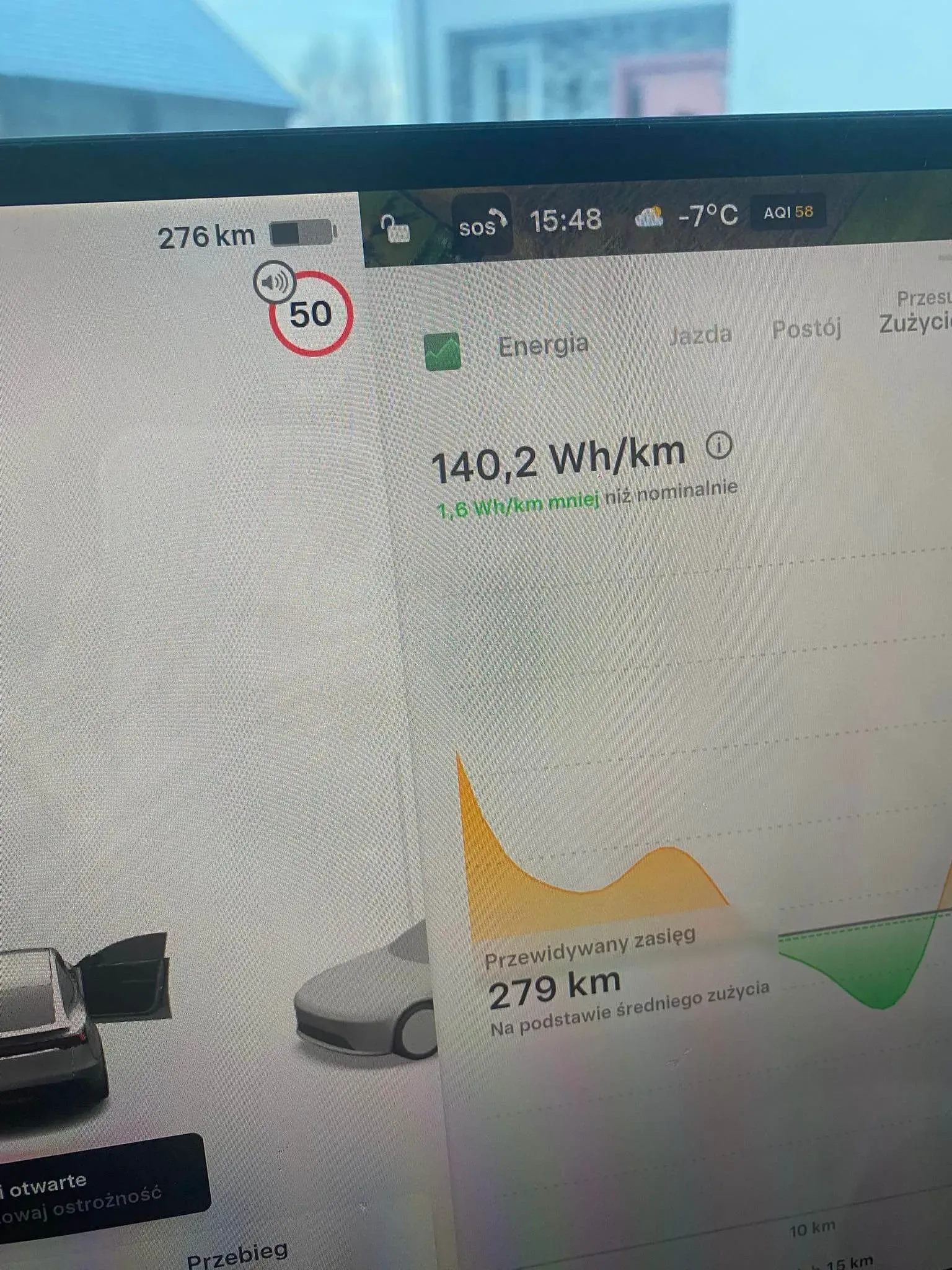
Internet forums and discussion groups are flooded with arguments among electric vehicle owners. One boasts about performance, another complains about battery degradation after just a month, and yet another claims their car “learns” driving habits and thus shows fewer miles. These disputes usually stem from one fundamental misunderstanding. Most drivers misinterpret the numbers displayed next to the battery icon on the main screen.
Table of Contents
Show
Hide
Tesla uses a specific and essentially simple logic that may seem illogical to laypeople. The manufacturer employs three different concepts related to range. If you don’t distinguish between them, you’ll never understand your car. We’ll clarify this once and for all by debunking myths about the “smart mileage meter.”
Paper Fiction vs. American Conservatism
Let’s start with what you see in the catalogs and configurator on the website. In Europe, Tesla, like any other manufacturer, must provide values in accordance with the WLTP procedure. This is a legal requirement. This procedure is a standardized test carried out under laboratory conditions.
The car drives onto a brake testing track, where the temperature is controlled, and there is no wind, rain, or traffic jams. The speed profile is strictly defined. WLTP is designed to be an optimistic procedure, often resulting in figures that are difficult to achieve during normal driving, especially on highways.
The situation is completely different in the United States. There, the EPA standard applies. These tests are more stringent and conservative. The same Tesla Model 3 or Tesla Model Y will show a significantly lower range on paper in the US (EPA) compared to Europe (WLTP), even though physically it’s almost the same car with the same battery.
Why am I writing about this? Because this is where we encounter the first cognitive shock. The number you see on your car’s screen in Europe has nothing to do with the European WLTP standard.
What the battery gauge actually displays
This is the most important point in this text. Many drivers believe that the mileage shown next to the battery icon is a prediction. That the car analyzes how they drove over the past week and calculates based on that how far they will go today. That’s nonsense.
Tesla uses an algorithm based on the EPA standard to display range on the main screen. It does this even in vehicles sold in the European market.
The mechanism behind this is painfully simple and static. The manufacturer assigns a single, fixed energy consumption value derived from EPA tests to each model variant (e.g., Model 3 Long Range with 19-inch wheels). The Battery Management System (BMS) checks how many kilowatt-hours (kWh) of energy are available in the cells. It then performs a simple division: available energy divided by a fixed consumption constant. The result appears on the screen as a distance in kilometers.
The table below illustrates the differences between the three types of data that Tesla users encounter:
Data Type
Source
Variability
Does it account for driving style?
Applications
WLTP Range
EU Tests
Fixed (catalog) value
No
Marketing, EU law
Screen range
EPA standard
Changes only when battery capacity changes
No
Rapid charging preview
Navigational range
Tesla algorithms
Dynamic (real-time)
Yes
Actual trip planning
The battery value is pure math with no artificial intelligence involved. Driving style, outside temperature, rain, or your speed have no impact on this figure. You can drive aggressively for a week, and after a full charge, you’ll see the same result as a driver who drives gently. The number changes only when the actual amount of energy available in the battery changes.
Tesla engineers’ decision was deliberate. They wanted to avoid “floating” numbers that would create chaos. The user gets one fixed reference point that serves as a fuel level indicator, scaled in units of distance rather than percentages.
Where the real intelligence lies
Since the gauge next to the battery lies (or rather, simplifies reality), how do we know how far we can actually drive? Tesla has advanced prediction algorithms, but they are hidden elsewhere—in the navigation system and in the Energy (Consumption) app.
It is only after entering a destination in navigation that the system begins analyzing reality. That’s where the magic happens. The computer takes into account the terrain (ups and downs), current temperature, wind direction and strength, traffic density, and your actual energy consumption from the previous kilometers.
In recent years, Tesla has added many variables to this equation. Wind and precipitation have a huge impact on energy consumption, often greater than speed or temperature alone. Navigation systems take this into account. The gauge on the steering wheel does not.
This leads to situations that confuse new users. The car shows “300 km range” based on the battery, yet a destination 250 km away is marked as unreachable without charging. Who is right? Always the navigation system. The number shown on the battery represents only theoretical potential under ideal, American testing conditions. In reality, at highway speeds of 120-140 km/h, EPA and WLTP standards become nothing more than literary fiction.
Why not WLTP on the screen?
Since we live in Europe, why doesn’t Tesla show us the WLTP figure? The answer is pragmatic. The WLTP standard is even more detached from reality than the EPA standard. At highway speeds, the numbers provided by WLTP are completely unattainable.
If Tesla displayed the WLTP range, customer disappointment would be enormous on any longer journey. Although still laboratory-based, the EPA standard is more reproducible and closer to reality (though still optimistic). It also makes it easier to compare battery conditions between different units of the same model, regardless of the market where they are sold.
Achieving the figure displayed on the screen is possible, but it requires specific conditions. Urban driving, low average speeds, frequent use of regenerative braking, and local roads with speed limits of 70-90 km/h. Under these circumstances, even the powerful Model X can consume minimal amounts of energy and deliver the figure shown on the screen. On highways, this is physically impossible.
What Does BMS Actually Do?
We need to delve deeper to understand the mechanics of this system. The basic principle is: An electric car doesn’t have range; it has energy. The concept of “range” is a secondary interpretation, a graphical representation for the user.
The battery management system (BMS) does not measure mileage. Its role is to monitor the voltage across the cell groups, current levels, and the temperature of the pack. Based on these physical parameters, the BMS estimates two key metrics: SOC (State of Charge) and usable energy.
Only at the end does the processor take the value of “usable energy” and divide it by a fixed consumption constant. This is how the number you see is generated. So, if the range on the screen decreases or increases, it means one of two things: either the estimate of available energy in the battery has changed, or the calculation algorithm has been altered (e.g., after an update).
Updates and disappearing mileage
This leads us to another myth: “Tesla reduced my range with an update.” After installing new software, users often notice that with 100% charge, the car shows, for example, 10 km less range than before the update. They panic thinking the battery has degraded.
Stay calm. Tesla did not remotely reduce the physical capacity of your battery. The update changed the mathematical model that the BMS uses to interpret cell voltages. The safety buffers were adjusted.
The BMS reserves a certain amount of energy as a “lower buffer” (to prevent cells from being completely discharged, which could damage them) and an “upper buffer.” Software changes can adjust the size of these buffers. Sometimes after an update, the system better recognizes the aging characteristics of the cells and adjusts the displayed range for greater accuracy. This is not a defect; it’s calibration.
How to Maintain Accuracy of Readings
The BMS is just an algorithm that can sometimes drift. If we keep the battery within a narrow charge range for extended periods (for example, only charging between 40% and 80%), the system loses its reference points. It cannot determine exactly where the true bottom and top of the battery’s capacity lie.
That’s why engineers recommend a procedure that can be called calibration. Periodically, it’s advisable to charge the car to 100% and—crucially—leave it connected to the charger for some time after charging is complete. For the Model 3 and Y, it’s even recommended to leave the plug in for 3 hours.
This isn’t about forcing electrons in. At this time, with low current, the cells are balanced. The voltages across each cell even out, giving the BMS a chance to record new, precise reference points for maximum charging. This makes the estimation of available energy more accurate. Don’t do this every day, but occasionally—for the health of the measurement system.
Remember that the numbers on the screen are just a rough indicator. The navigation system holds the real knowledge about where you’ll end up. Everything else is just an estimate based on laboratory assumptions, which rarely match the actual route.
What do you think of Tesla’s approach? Do you prefer the strict math from the EPA, or would you like to see a real-time forecast based on your driving style right next to the battery icon? Let us know in the comments.
Order your Tesla and take advantage of purchase bonuses using the referral link!