
A 400 kW station does not make a profit with 10 cars per day. BeReady2GO revealed the costs
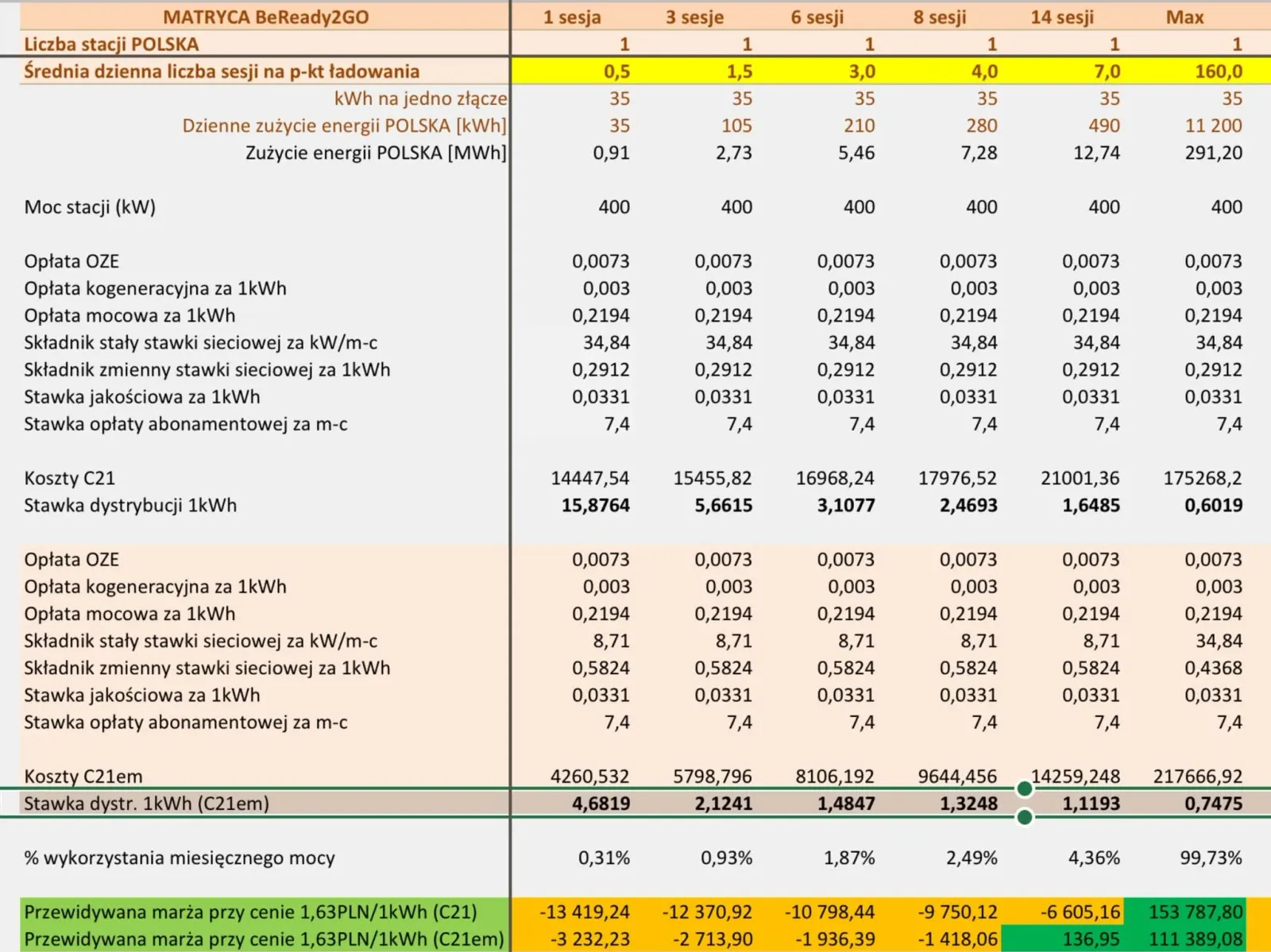
BeReady2GO has released cost calculations for energy distribution at a 400 kW charging station in Celbów. Based on Energi rates, at a gross price of 2.00 PLN per kWh, the operator could face losses even with 20 charging sessions per day if operating under standard low-voltage tariffs.
Table of Contents
Show
Hide
This is a good answer to why electricity at fast DC chargers doesn’t cost as much as at home. In the case of HPC, it’s not the energy itself that’s the issue, but rather the fixed fees for power and distribution.
Where the Problem Comes From
At a home outlet, we mainly pay for energy and distribution at a relatively low connection capacity. With a 400 kW DC station, the situation is reversed: before the operator sells even the first kilowatt-hour, they already have to cover a high cost for network readiness.
BeReady2GO calculated this for a single location, assuming that one charging session uses an average of 35 kWh. The less traffic there is, the more the fixed costs are spread across a small amount of energy used. That’s when figures emerge that seem absurd from the driver’s perspective, but are simply part of the bill from the operator’s point of view.
Tariffs C21 and C21em make a big difference
Under the standard C21 tariff, the network fee alone amounts to 34.84 PLN per 1 kW of contracted capacity per month. For a station with 400 kW, this results in nearly 14,000 PLN in fixed costs per month before any energy is sold.
The dedicated C21em tariff for electric mobility significantly reduces the fixed cost to 8.71 PLN/kW, but increases the variable cost for each kilowatt-hour used. This helps with low usage levels, but it doesn’t work miracles. If traffic is light, the math remains harsh.
What the numbers from Celbowa show
Parameter
1 session
6 sessions
10 sessions
20 sessions
Max (96 sessions)
Daily energy consumption (kWh)
35
210
350
700
6 720
C21 distribution costs (zł/month)
14 447,54
16 968,24
18 984,80
24 026,20
110 738,28
C21 distribution rate per 1 kWh (zł)
15,88
3,11
2,09
1,32
0,63
Margin at a price of 1,63 zł/kWh net C21 (zł/month)
-13 419,24
-10 798,44
-8 701,80
-3 460,20
86 695,32
C21em distribution costs (zł/month)
4 260,53
8 106,19
11 182,72
18 874,04
136 177,51
C21em distribution rate per 1 kWh (zł)
4,68
1,48
1,23
1,04
0,78
Margin at a price of 1,63 zł/kWh net C21em (zł/month)
-3,232.23
-1,936.39
-899.72
1,691.96
61,256.09
The most straightforward conclusion is that with 10 sessions per day, the operator ends up in the red under both C21 and C21em. With the latter tariff, the loss is smaller, but it still amounts to -899.72 zł per month just for the relationship between selling price and distribution costs.
With 20 sessions per day, the standard C21 still results in a negative figure: -3,460.20 zł per month. Only C21em allows a slight profit margin of 1,691.96 zł per month. However, this still only accounts for energy and distribution, not the entire operation of the station.
2.00 zł gross per kWh stops seeming like “theft”
BeReady2GO sells electricity at 2.00 PLN gross per kWh, which is approximately 1.63 PLN net. If the distribution cost alone amounts to 2.09 PLN/kWh in C21 or 1.23 PLN/kWh in C21em for 10 charging sessions per day, it’s easy to see that the operator doesn’t have much room for high margins. Thus, it’s not surprising that some operators, when pricing at such levels (or lower), rely on subscription fees—this provides them with an additional source of income while also encouraging customers to charge there.
Yet distribution isn’t the entire cost per kilowatt-hour. There are also the costs of purchasing energy, transaction fees, payment processing, the backend system, maintenance, customer service, a support line, and repair costs. When someone says that fast charging should cost as much as electricity at home, they’re simply mixing two different concepts together.
This isn’t included in the table yet
The BeReady2GO matrix shows the cost from the distribution system operator, but it does not show the cost of setting up the station. And that is where the other half of the problem lies.
A modern 400 kW charger, including installation, wiring, and construction work, usually costs hundreds of thousands of zlotys. On top of that are land leases, often with fixed rent and a share of profits if the location is attractive. There are also maintenance checks, spare parts, modem connectivity, a payment terminal, and 24/7 support for reports.
In practice, even a positive result just from energy costs does not mean the station is profitable. It may only indicate that it stops losing money at the initial cost level.
Where is the break-even point?
The calculations show that with the C21em tariff, the break-even point occurs around 14 sessions per day. This level can be achieved at good transit locations, but it is not necessarily the norm outside of peak seasons and on less popular routes.
This is exactly why operators do not compete today with prices close to home tariffs. With low usage, a reduction of just a few dozen groszy per kWh can wipe out any remaining margins or even increase losses. As a result, players like Tesla offer lower rates. But the situation is different here — Tesla has an enormous network of charging stations and also sells cars. They can thus manipulate charging prices in new markets (where one station loses, others profit) or even offer them at cost as a marketing tactic to encourage purchases of their cars.
These numbers are valuable because they reveal the issue without any marketing or talk about “cheaper electric mobility.” With fast chargers, does it bother you more the cost per kWh, or rather the fact that stations still have too little traffic to actually bring down those prices?