
Electric cars as energy storage: V2L, V2H, V2G in practice + TOP 10 cheapest EVs in Poland (2026)
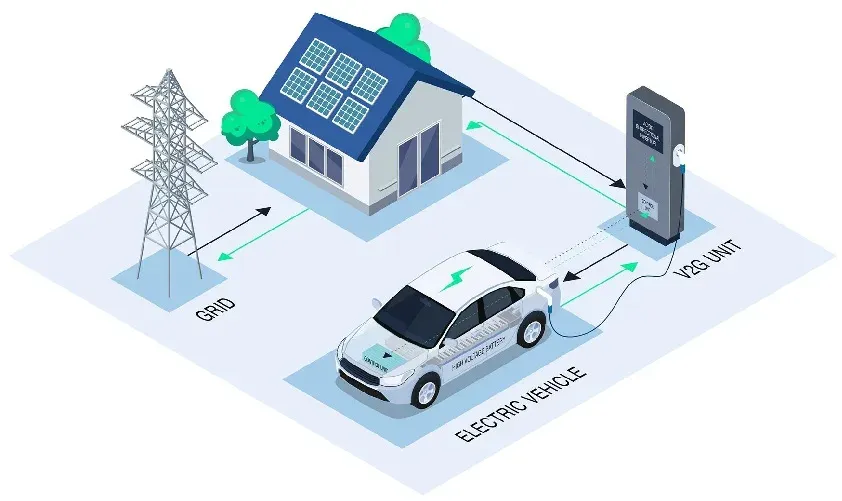
V2L, V2H, and V2G technologies show that electric vehicles are no longer just means of transportation but increasingly function as mobile energy storage units. V2L allows devices to be powered directly from the car, V2H enables support for home electrical systems, while V2G opens the way for interaction with the power grid and the provision of so-called flexibility services.
Table of Contents
Show
Hide
In the Polish market, as of March 2026, the prices of the cheapest new electric cars start at just over 73,000 złoty, with urban cars and city crossover models dominating the budget segment. At the same time, it is becoming increasingly clear that a car’s advantages are no longer determined solely by its range or price, but also by its ability to deliver energy externally and its integration into home and public charging ecosystems.
V2X in Practice: More Than Just Driving
V2L, V2H, and V2G are three different ways to utilize electricity stored in an electric vehicle’s battery, but they do not mean exactly the same thing. In short: V2L is used to power specific devices directly from the car, V2H allows charging an entire home, while V2G returns energy from the car to the public power grid.
The most important thing to remember is that V2L is often a very simple and fully local function, whereas V2H and V2G form the basis of the broader concept of two-way charging. This distinction is crucial because not every car equipped with basic V2L will be able to handle advanced V2H or V2G functions.
What Exactly Are the Differences Between These Technologies?
V2L (Vehicle-to-Load) is the simplest solution. The car has a built-in converter and can power standard devices through a regular AC outlet or an adapter connected to the charging port—without the need for an external, expensive two-way charger. This feature is useful for camping, construction sites, during power outages, or simply when you want to charge a laptop, plug in a portable fridge, or run power tools.
V2H (Vehicle-to-Home) works very similarly to a stationary home energy storage system. In this case, electricity from the car battery feeds into the building’s electrical system rather than an external grid. For this to work, a compatible two-way charger is required, along with deep integration with the home electrical system and energy metering setup.
V2G (Vehicle-to-Grid) is the most advanced and complex variant. The car not only draws energy from the grid but can also feed it back to the grid upon demand. In this way, EVs help balance the energy system and shift peak usage to more favorable times. This model requires a smart meter, software for managing energy flow, and strict compliance with the network operator’s technical requirements.
Technology
Where the energy goes
Hardware and complexity
Typical applications
V2L
For devices connected directly to the car.
The simplest solution; usually does not require a two-way charger.
Emergency power, camping, power tools, small household appliances.
V2H
For the electrical installation at home.
It requires a compatible two-way charger and integration with building energy consumption monitoring.
Self-consumption from solar power, reduced electricity bills, emergency power for the home.
V2G
To the public electricity grid.
Highest complexity; technical compatibility, a control system, and a smart meter are required.
Grid balancing, flexibility services, charging and supplying energy at the best rates.
What does this mean for drivers?
For the vast majority of users, V2L remains the easiest (and cheapest) way to enter the world of V2X. It offers tangible benefits right after purchase and does not require costly modifications to the home electrical system or signing complex contracts for network services. On the other hand, V2H is most economically sensible when a car spends a lot of time parked near a home and can effectively work alongside solar panels, acting as a free energy storage solution.
Although V2G has enormous potential from a macroeconomic and systemic perspective, it is the most difficult to implement commercially. It requires not only a suitable car and charger (wallbox) but also communication standards and clear legal regulations. As a result, in practice, it is much easier today to buy a car with a V2L port at a dealership than to start earning money by supplying power through the V2G system.
Be cautious of a common terminological trap: “two-way charging” is a broader concept than V2G alone. It also includes V2H, and it is sometimes used (not entirely accurately) by some manufacturers to describe advanced device power supply functions (V2L). The Nissan Leaf is often cited as a standard, historical example of a model designed for V2G (thanks to its CHAdeMO port), while popular cars on the Polish market with V2L functionality include the BYD Atto 3, Hyundai Ioniq 5, and Kia EV6.
9 Electric Vehicles in Poland with V2X (March 2026)
The list below provides a great overview of today’s market, focusing on what’s most important to us right now: the availability of battery energy return features. You’ll find both budget-friendly urban models and powerful family SUVs here. The prices listed are based on March 2026 pricing lists (most are list prices without government subsidies, unless the manufacturer specifies otherwise).
Model
V2X Feature
Price in Poland
Things to Know
Dacia Spring
V2L
starting from 73,500 PLN
The cheapest new EV in Poland. Keep in mind that the V2L feature with an adapter is available only on the higher trim level (Extreme 65).
BYD Dolphin Surf Boost
V2L
97,700 PLN
A budget-friendly compact vehicle with a safe LFP battery that standardly allows powering devices using the car’s electricity.
Hyundai Inster
V2L up to 3.6 kW
from 103,900 PLN
A small urban electric vehicle with a full and very practical function for powering devices directly from the car.
MG4 Standard
V2L
110,000 PLN
One of the more interesting market compromises in terms of price/range (year-end sale model); it supports energy output through a special adapter.
Nissan Leaf
V2G
from 157,100 PLN
An older design (CHAdeMO connector), but it is one of the most recognizable models associated worldwide with pioneering V2G implementations.
Kia EV6
V2L
from around 175,000 PLN
Based on an 800V system; it is regularly cited as a model example of efficient V2L (*price includes the “NaszEauto” subsidy in an official promotion).
BYD Atto 3 EVO
V2L
from 176,300 PLN
The upgraded EVO version that has just entered our market. A spacious family SUV equipped with reverse power supply.
Hyundai Ioniq 5
V2L
starting from 214,900 PLN
The tech-sibling of the Kia EV6 with a retro-futuristic design; it’s currently one of the most frequently mentioned in media as a car with practical V2L capabilities.
Kia EV9
V2L up to 3.68 kW
starting from 328,200 PLN
The powerful flagship SUV of the brand. It comes with full V2L support, allowing easy power supply for heavier equipment at campgrounds or tools.
What car options would you add? Let us know in the comments whether you’ve used these features in your daily life!