
Overcoming the challenges of bidirectional onboard charger V2L testing with programmable AC load simulation
Sponsored by Chroma.
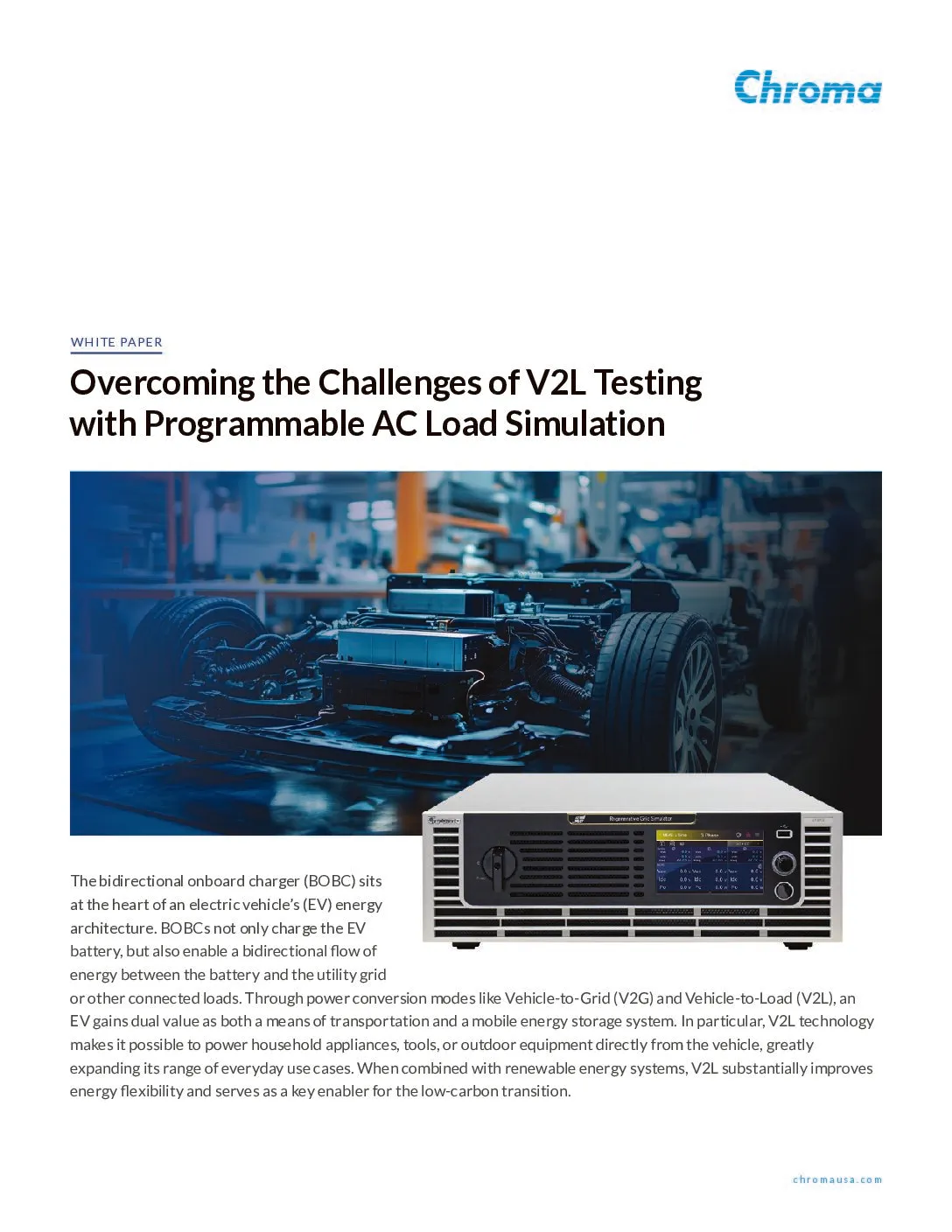
The bidirectional onboard charger (BOBC) sits at the heart of an electric vehicle’s energy architecture. BOBCs not only charge the EV battery but also enable bidirectional energy flow between the battery and the utility grid or other connected loads. Through power conversion modes like Vehicle-to-Grid (V2G) and Vehicle-to-Load (V2L), an EV gains dual value as both a means of transportation and a mobile energy storage system.
In particular, V2L technology enables powering household appliances, tools, or outdoor equipment directly from the vehicle, greatly expanding its everyday use cases. When combined with renewable energy systems, V2L substantially improves energy flexibility and serves as a key enabler for the low-carbon transition.
This whitepaper outlines V2L testing challenges and offers an efficient and comprehensive solutions based on the optional AC load capability.
Comment
Create Account. Already Registered? Log In
Virtual Conference on EV Engineering: Free to Attend
Don't miss our next Virtual Conference on September 14-17, 2026.
Register for the free webinar sessions below to reserve your spot and watch them live or on demand.
LOAD MORE SESSIONS