
An Amazing Journey as an Electrician to the French Riviera. Account of a Trip in a Kia e-SOUL
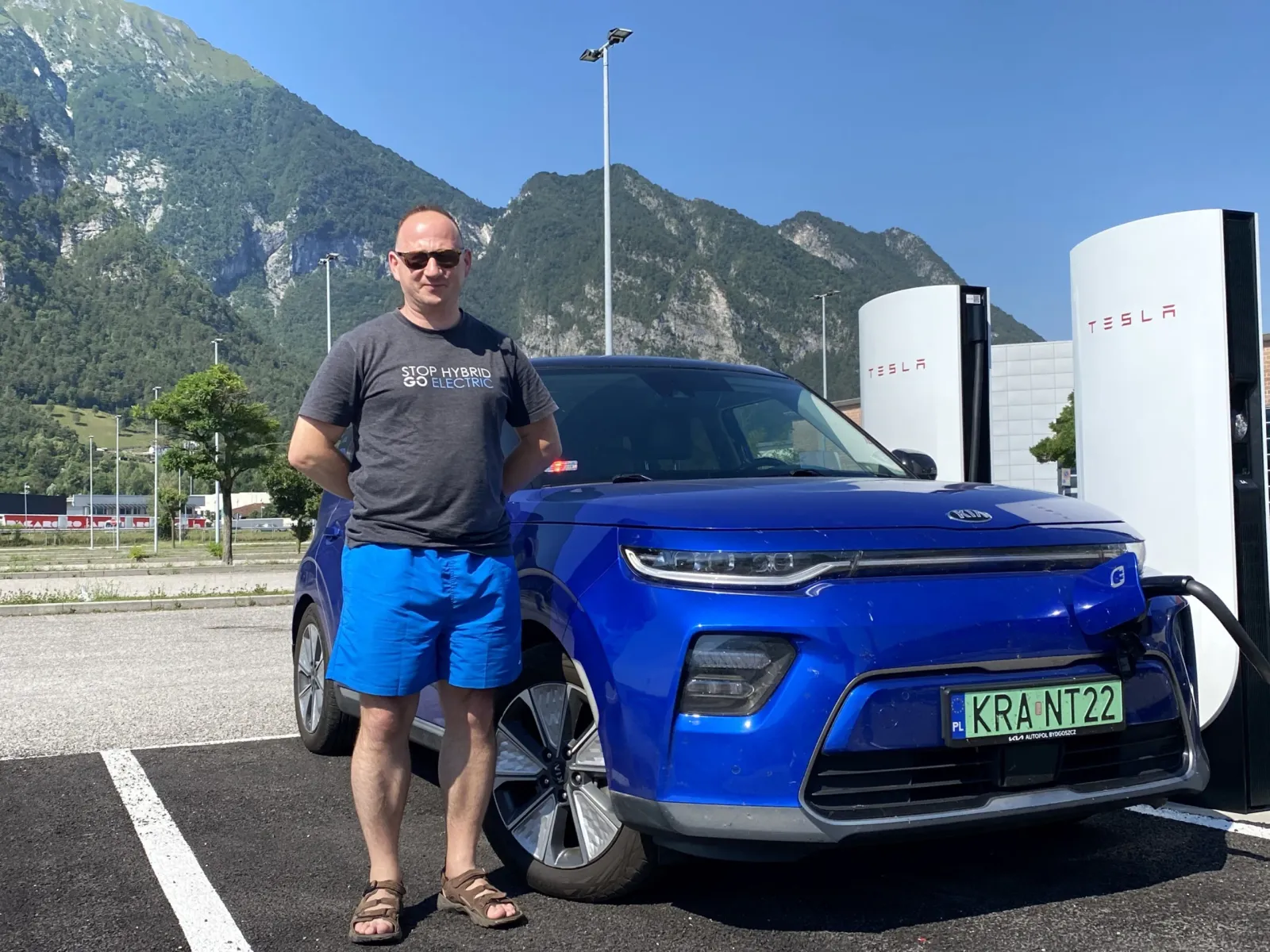
Three years ago it was the Croatian Nissan Leaf 62 kWh (the Zadar area); two years ago, the Hyundai Ioniq 28 kWh to a seaside campsite near Ravenna and San Marino. This year, we decided to head to the area patrolled by gendarmes in Saint-Tropez.
Table of Contents
Show
Hide
Four people filled with positive energy (plus the Kia eSOUL 64 kWh car), packed with essential vacation gear (about 250 kg total including passengers), we set off at dawn from a village near Kraków in the Skawina municipality for the longest “electric vehicle” trip yet—1700 km.
The author of this text is Marcin Hałat from the fanpage Electric Cars Kraków / Małopolska.
Stage I: The Road Through Slovakia and Italy
Just as before when going to Croatia or Italy, we decided this time to take the highways through Slovakia (necessary vignettes, such as 10-day ones, had to be purchased online). Since we try not to drive continuously day and night, we stopped for the first night after about 1000 kilometers of travel. We found this to be an optimal distance from home for our first longer rest stop.
The location near Verona, Italy, which we had arranged in advance, had an underground parking lot (somehow they don’t charge for electricity—Is this just a Polish invention?! ) with two charging stations for cars. We used a hotel app that allowed us to fully recharge our car during our stay.
After a night’s rest and a delicious breakfast, we set off on our further journey toward Piacenza, Genoa, and the Ligurian Sea. The route towards the French border, and then further on, ran along the Mediterranean coast on one side and at the foot of the Piedmont mountains (the name of the region literally means “land at the foot of the mountains”) on the other.
Travel destination: Saint-Tropez Bay
Next, we headed southwest, passing Menton, Monaco, Nice, Antibes, and Cannes on our left. Our camping site, with over 100 cottages (this was the third time we used the pan-European Homair.com network), was located in Saint-Tropez Bay, near the port of Grimaud.
We chose this location because of:
The proximity to the Mediterranean beach (about 9 minutes on foot),
Facilities on site (swimming pool with lifeguards, two slides, restaurant, bar, ice cream shops, supermarket, WiFi throughout, sports fields, etc.).
Two charging stations for electric cars were an added advantage, but since there are other stations in the city nearby, including Tesla Supercharger stations with electricity as cheap as beet soup, we didn’t worry about it at all. Incidentally, I should mention that all staff at the campsite used only electric vehicles. Unfortunately, the waste collection vehicles are now only diesel-powered.
Summer temperatures near 40 degrees persisted throughout half of our vacation, after which the heat eased slightly to only 32-35 degrees in the shade. There wasn’t a single drop of rain, so bringing spare jackets from home was completely unnecessary.
What did we see on site?
Locally – combining time at the pool or nearby beaches, and adding sightseeing, we covered about a thousand kilometers. We saw not only seaside resorts and cities, including:
Nice (Colline du Château hill, Masséna Square, the nearly seven-kilometer-long Promenade des Anglais, Garibaldi Square, the old town, Port, and Lympia Beach);
Saint-Tropez (of course, the port and surrounding streets, the citadel on a hill, as well as the Gendarmerie Museum and the Saint-Tropez Cinema located in a former authentic police station at 2 place Blanqui);
Port Grimaud (known as the “French Venice” – beautiful colorful houses on the water, canals instead of streets, small bridges, boats, and yachts side by side);
We also passed through picturesque seaside towns: Saint-Maxime, Saint-Raphael, Antibes;
Gassin, Ramatuelle – charming, flower-filled Provençal villages “hung” on hillsides, offering beautiful views of the Saint-Tropez Bay;
Monaco/Monte Carlo (it’s worth starting the tour with the breathtaking view of the city from Tete de Chien hill in La Turbie), then the Castle, the yacht port, streets where Formula 1 cars race during Grand Prix events, and of course the city streets lined with very expensive Ferraris, Bentleys, Rolls-Royces, or Maseratis;
Cannes (promenade and festival palace);
Eze (an old town located on a high cliff, along with a stunning exotic garden offering an incredible panorama of the entire French Riviera);
The Alps of Upper Provence, where we sailed through the Verdon Gorge deep into the land (turquoise waters visible from the water bikes and the chance to experience Europe’s deepest gorge), as well as visiting the nearby picturesque town of Moustiers-Sainte-Marie (a waterfall in the town, an old church, delicious ice cream, and the pervasive scent of lavender in the streets);
The streets of the mountain town of Gourdon.
My wife, on the other hand, took us to the largest in the world and probably most spectacular lavender fields located on the Provencal plateau of Valensole.
The return trip to Poland involved one night at a great Italian villa (with the option to charge the car at night), but there were fewer places to visit; we saw two amazing alpine glacial lakes in the Laghi di Fusine area, where it was pleasant to walk around among the forests and rocks.
Costs and charging: Numerical summary
In summary, the total distance traveled there and back plus local driving with the electric car was about 4500 km, of which:
A few hundred kilometers were covered from our home in Poland (charged using solar power and under the second tariff) as well as from Monaco (where public charging stations offer free electricity…), while we paid for the rest at DC and AC charging stations, mainly:
Tesla Superchargers (prices starting at 16 cents per kWh),
Ionity (1-month subscription with prices of around 1.6–1.86 zł per kWh),
Once using Greenway (the summer promotion did not apply to roaming stations).
Driving strategy: We drove in such a way as to arrive at the charging station with at least 5% battery remaining, but with a 64 kWh battery, it’s a completely different driving experience compared to last year’s Hyundai Ioniq with a 28 kWh battery (actually 24 kWh). We stopped along the way whenever we wanted, rather than when the car demanded it, which meant roughly every 2-3 hours (the car can drive continuously on a full charge for over 300 km at the maximum speed limits on highways in France, Italy, Austria, or Slovakia). There was practically no fear of running out of range and not reaching a charging station. This isn’t the era of the 24 kWh Leaf…. Apps like ABRP and Plugshare helped us during the trip, but only out of curiosity. After all, apps are one thing, and real life is another. Those who travel know what I mean.
All the stations started working without any problems. We didn’t end up in any “legendary” queues, even though it was the start of vacation season across Europe and there were schedule changes and such.
Cost comparison for the route:
Electric car (Kia e-SOUL): around 259 euros, which is 1111 zł (already including exchange rate of 4.3 zł per euro).
Gas-powered car (Diesel, fuel consumption of about 6l/100km): at least 2150 zł.
Advantages of driving an electric car: much greater comfort, silence, better performance, ability to control the air conditioning via an app, no need to deal with the clutch, handbrake, or gas pedal on steep climbs (though there are significant slopes of up to 18%), significantly lower travel costs, and no need to search for gas stations on the road.
A few statistics
TAM fuel consumption (to France): about 17.4 kWh/100 km at an average speed of around 70 km/h. It calculates the average even when the car is stationary (not moving, so the average speed drops), and that was indeed the case.
Total fuel consumption (TAM, local driving, and return trip): about 16.6 kWh/100 km with an average speed over 4420 km of around 54 km/h (including stops and cooling down the car).
Number of charging stops on the way to TAM: 4 stops (including for food and shopping).
Number of charging stops on the return trip: 5 stops.
Total energy used during the journey: over 700 kWh (including free energy).
It should be noted that we traveled on paid highways (with tolls and gates) in Slovakia, Austria, as well as in Italy and France. Slovenia had only local roads. We drove almost the entire time in NORMAL mode, sometimes in SPORT mode, and on slopes we mostly used full regenerative braking.
Disadvantages, or the challenges of traveling
Various apps, but manageable: We mainly focused on Tesla’s apps, IONITY, and 1 x Greenway – the car’s range and route length meant charging was only possible at Ionity or Superchargers, but to optimize the route, we used both networks (which is why we purchased a one-month subscription for 50 zł).
Inconvenient hotel systems: At one hotel on the way to an AC charger, we had to use a dedicated app for that hotel, which was unintuitive and clunky.
Duress deposits at DC stations: It was common to need to leave around several dozen euros per use, but fortunately, refunds to the bank account were processed consistently within 1-4 days (including weekends).
Infrastructure in Europe vs. Poland
Austria – it’s really very good there, and practically in every corner we had AC/DC stations to choose from, just like in Italy or France. In France, AC stations could be seen even in the most unexpected small towns. In Poland, sometimes even in the county town you can barely spot the only station available near a Lidl or Biedronka...
Overall, on our trips we saw the most Teslas (including French and Italian models), along with many VAGs, Stellantis vehicles, and “Korean” cars. There were extremely few Chinese cars, just a few BYDs here and there. And about ten Polestar 2s and 4s. It should be noted that the French strongly support their own automotive industry, as whether electric or gasoline-powered, French cars are very prominent on the roads. The Italians do the same.
Summa Summarum
It was absolutely worth it, and next time routes of even 1700 km with overnight stays can be easily covered using electric vehicles with batteries >60kWh. We want to emphasize that this time the larger battery (plus surprisingly low energy consumption!), the ability to charge at 11 kW (3F) via AC, and the app for remotely cooling the car are fantastic features and represent a significant improvement compared to driving a Hyundai Ioniq 28 kWh model a year ago (small battery, single-phase AC charging, no app)…
The Kia eSoul has a DC charging rate of about 1.1 kWh per minute, which may not be an impressive figure, but it’s offset by relatively low energy consumption. You can still top up the battery during breaks or stops every few hours on the road. There were times when charging took place near shopping malls or restaurants, and it was the car waiting for us rather than us waiting for it.
For those interested in details about the trip, feel free to contact me via comments, private message, or email: electriccarskrakow(małpa)gmail.com – I’d be happy to share my experience.
P.S. Observations from the trip (Austria/Italy/France):
Tunnels: There are many long tunnels, several kilometers in length, with speed limits of 80 / 90 / 100 km/h inside them, so I don’t understand why people in Poland complain about the tunnel on “Zakopiance” for having such speed restrictions...
Charging stations: An enormous number of charging stations along the roads, as well as in smaller towns and regions in France, Italy, and Austria.
Driving style: The Italians and French follow closely behind other cars, driving chaotically and illogically as if on huge doses of caffeine (?), often overtaking in continuous flow lanes and at pedestrian crossings, though the French seem slightly more civilized on the road. Italians like to avoid using turn signals.
Austrians: The safely driving Austrians (keep a distance from the vehicle ahead, no reckless behavior on public roads, etc.).
Radars: Numerous speed cameras and spot checks for speed (especially in Italy).
Gas stations in Italy: There are practically no gas stations like those in Poland – all of them are self-service. Italians might envy us for being able to buy almost anything at Orlen or BP that’s available in supermarkets, from plush toys and porcelain cups to various foods and drinks.
Laundromats in Italy: A poorly developed network of self-service laundromats, and when they do exist, they require tokens (forget about payment terminals).
Prices: Shop/supermarket prices are the same as in Poland (even though living costs in Poland relative to earnings are significantly higher).
People: Friendly, polite, and helpful citizens.
Weather: Air temperatures in France and Italy ranged from 30 to even 40°C in the shade during the day (late June/early July).
Beaches: Beautiful, gentle entrances to the sea, with water noticeably warmer than in the Baltic Sea during July/August.
Nature: Magnificently chirping cicadas (!).
Tastes: Very delicious ice cream (e.g., in the flavor Tropezienne, inspired by the iconic Tarta Tropézienne, reflecting Saint-Tropez’ signature treat that combines elements of fluffy buttery brioche, delicate vanilla cream, and orange zest).