
Kia PV5. Test of the electric bus that really surprised me
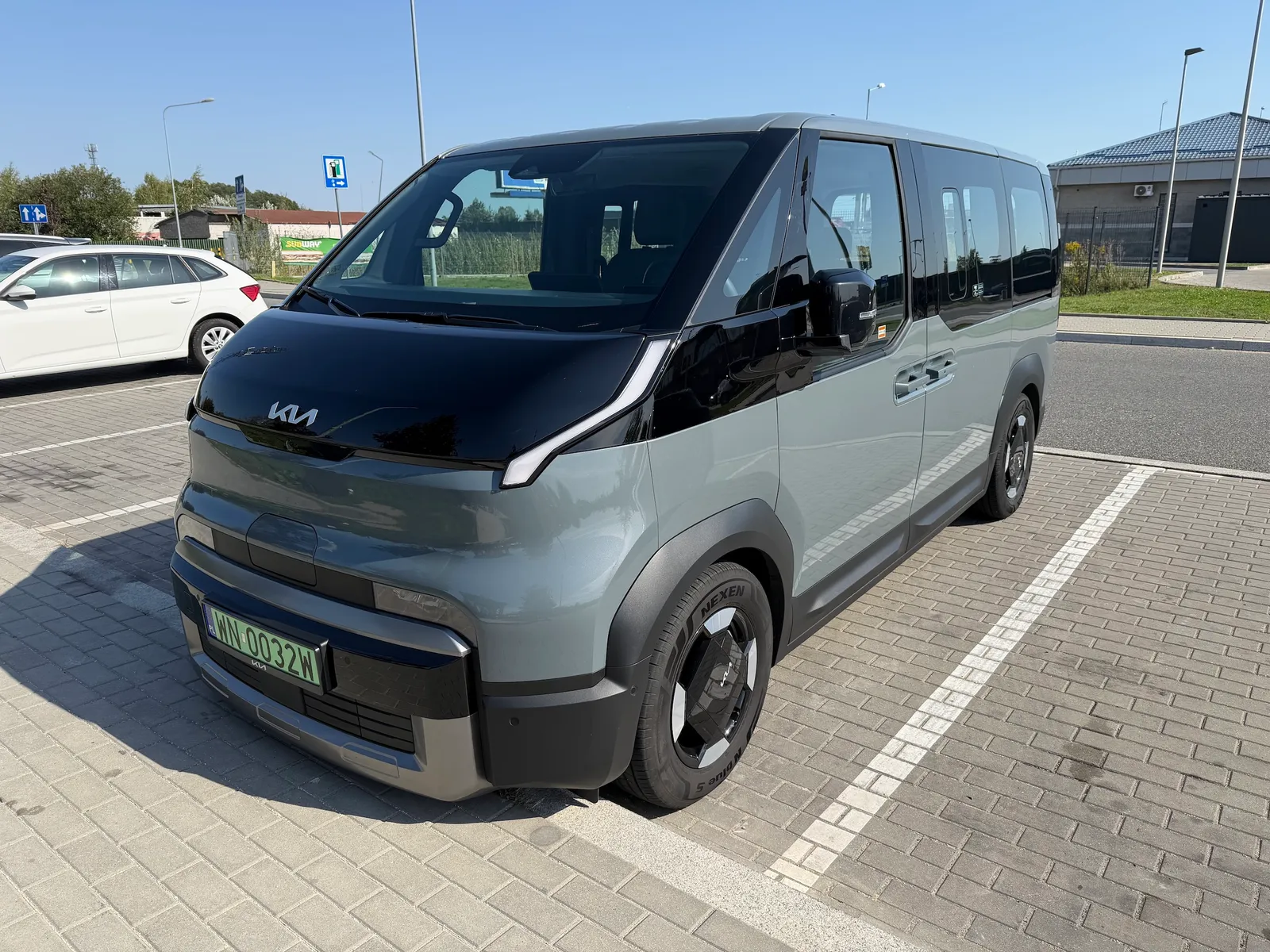
The Kia PV5 is a bus that Kia unveiled at the beginning of this year and which is the first vehicle built on its new utility platform. The model is available in several variants. There’s the Cargo version, a passenger version that I had the chance to test, and a variant designed for transporting people with disabilities. Production of the seven-seater version was also set to begin in August.
Table of Contents
Show
Hide
And I must admit that I simply fell in love with the PV5.
This was my first encounter with an electric bus, and before the test I didn’t expect it to impress me so much. When I watched videos about electric vans earlier, including the Volkswagen ID.Buzz—which I still haven’t had the chance to test yet (to VW’s team, this is a message that I’d like to start testing your vehicles)—the range didn’t always make a strong impression on me. Here, the Kia really surprised me in a very positive way. I’ll talk about range and energy consumption in a moment, as it’s in these aspects that the PV5 impressed me the most.
Kia PV5. Specifications
Test version: passenger, 5-seater
Battery: 71.2 kWh
Maximum DC charging power: 150 kW
Powertrain: electric
Seats: 5
Dimensions: 4695 x 1895 x 1899 mm
Wheelbase: 2995 mm
Weight: approximately 1890 kg
The maximum listed price with packages is 217,300 PLN, including a heat pump.
It’s really a large car.
The Kia PV5 is big. Truly huge. Yet while driving, it doesn’t give off the same sense of size as one might expect from a vehicle of such dimensions.
At the front, we have a charging port located in a distinctive spot, right at the very front of the car, essentially on top of the hood. The charging itself is relatively fast. The maximum power output is 150 kW, and the battery has a capacity of 71.2 kWh. However, during driving itself, something else turned out to be more important. This car can truly cover many kilometers without constantly searching for a charger.
I tested the five-seater version. There are two seats in the front, three in the back, and behind them lies an enormous trunk space.
This is where the first issue arises, because Kia gave us a huge trunk, but didn’t fully consider how to make use of it.
Huge Trunk, But Empty Like a Warehouse
The trunk itself is certainly fantastic in terms of capacity. We can fit an incredibly large amount of stuff inside it. The problem is that aside from the space itself, there’s not much else available here.
I miss even a simple light that would allow us to see what’s inside. Some lighting on the lid, hooks, shelves, or solutions to organize groceries and other items would also be useful. Right now, we just have a big, empty box into which we can stuff tons of things, but organizing them is much harder.
We find a bit more extra space under the floor, and here Kia has prepared some partitions and shelves. There are also elements in several places that suggest there might be or could appear dedicated accessories to make better use of the space. However, I didn’t use them during testing, so it’s hard for me to say exactly what their availability is like and what can be done with them.
And that’s exactly what was a bit lacking here. Since we have such a huge amount of space, it’s tempting to use it for more than just a large storage area.
Cockpit more like that of a passenger car
The driver’s area looks interesting in a similar way. On the left side behind the steering wheel, there’s a shelf, and behind that, additional space for documents. This is a solution reminiscent of other buses and commercial vehicles.
The cockpit itself is definitely more personal than that of a typical bus. Kia hasn’t used its signature long panel with two large screens, as seen in many of the brand’s passenger car models. Instead, there’s a small display in front of the driver showing the most important driving information, while the infotainment screen is located on the right side.
If I remember correctly, its diagonal size is about 12 inches. The most important thing though is that it works really well. Kia has used the Pleos system here, which is the brand’s new software, and during my test it was very responsive and intuitive. If someone has previously used Android, they should have no trouble navigating this system.
Of course, we also have wireless Apple CarPlay and wireless Android Auto. There’s space under the screen for an inductive charger.
There are plenty of storage compartments here
In terms of options for storing various items, the PV5 performs really well. There are several pockets in the doors, plenty of space under the center console, and another storage compartment under the armrests.
In addition, there’s a fairly large compartment in front of the passenger, with more hidden spaces under the driver and passenger feet. To access them, you need to lift the floor mat, but there’s quite a bit of space there.
Extra storage is also available near the driver and passenger seats. Overall, Kia has done a really good job with storage options here. The main issue with lack of organization is the huge rear trunk.
The rear doors are impressive
We also have sliding windows in both doors.
And despite all this mechanism, Kia still managed to provide a really spacious rear seat area.
In the five-seater version, we have three seats at the back, and I was truly surprised by this. Two child safety seats with ISOFIX systems, positioned facing the direction of travel, fit in without much trouble, and an adult could still sit between them.
I’m not talking about someone who is very small. I tried sitting between the seats myself, and although I had to squeeze in tightly, it was still possible.
In today’s cars, this is truly rare.
The First Few Kilometers and a Big Surprise
Driving itself is very pleasant. The PV5 might not be a small car, but I didn’t feel like I was behind the wheel of a large bus. In terms of size, I’d say it’s somewhat similar to my Tesla, only obviously larger and much more angular.
Still, I had no problems with wind gusts or driving the car. In total, I drove it about 1500 kilometers, most of which were on highways, and I must say it was really enjoyable to drive.
But the biggest surprise was the energy consumption.
An Electric Bus with Tesla-like Consumption?
In the city, the Kia PV5 managed to achieve around 16-17 kWh/100 km. On the road, the figures were around 20-22 kWh/100 km.
And here, I was really surprised.
We’re talking about a large, tall, and boxy vehicle whose aerodynamic resistance should, for obvious reasons, not be particularly low. Yet its energy consumption was very similar to that of my Tesla Model Y.
It’s even lower than that of the BYD Sealion 7 I tested recently.
Wow. Just wow.
I totally didn’t expect this.
Before the test, I assumed the electric bus would have range issues and that energy consumption would need to be closely monitored. But after around 1500 kilometers, I can say that the PV5’s range is one of the biggest positive surprises about this car.
Charging performance is also solid
The charging curve is another point in its favor. The maximum power might not be record-breaking, at 150 kW, but what matters is how the car utilizes that power.
Even during my charging, when it reached over 80 percent, the car was still able to accept more than 100 kW.
And that’s really a good result.
For a car with such a large battery, it’s important not only to see what the charger display shows for a short time but also how long it can maintain high power. Here, the PV5 pleasantly surprised me.
Is it possible to live a normal life with such a bus?
After driving about 1500 kilometers, the answer is very simple for me: Yes. And definitely.
The PV5 is very comfortable in the city, and so too on the road. Energy consumption turned out to be much lower than I expected, and the huge space makes the car very practical.
Of course, parking in narrow streets won’t be as convenient as it is with a small car. But here, the entire set of cameras helps out. We have views from the front, back, and sides, which makes driving much easier than one might expect given its size.
And it was after those 1500 kilometers that I started having a somewhat dangerous thought.
This could be my future electric car.
I guess I’m getting old.
But really. The range is sufficient, the handling around tight corners is excellent, and its size, although the car is large, isn’t yet excessive. On top of that, it offers plenty of space, five comfortable seats, and the ability to fit practically everything we need.
Kia hasn’t fully utilized its potential
Of course, not everything here is perfect.
The biggest issue for me is the organization of the trunk space. Kia created a huge area, but left it practically empty. There are no shelves, hooks, grips, or other solutions that would allow for effective use of this trunk.
The same is true for the seating area at the back. We have plenty of space for passengers, but there are no basic places to store their belongings. With three people in the back seat, it’s difficult to find space for cups, phones, or other small items. There isn’t enough room in the doorways, and I also didn’t find any solutions at the back of the seats that would allow everything to be neatly arranged.
There might be dedicated accessories available that address some of these issues. However, I didn’t have them during my test, so I’m evaluating the car as it was delivered to me.
It’s a shame because the PV5 has huge potential as a car for longer family trips. With a slightly better use of the space, it could become an absolutely great family van.
The charger could be cooled
There’s one more thing that isn’t specific to just the PV5. It involves the wireless phone charger.
We have space in the car for an inductive charger, but it lacks active cooling. The compartment where the phone is placed can get very hot. I haven’t tested the car even in extreme heat, yet the phone still gets quite warm fairly quickly.
This is something that, in my opinion, car manufacturers should work on. Since the phone is being charged wirelessly and we also use it while driving, even through CarPlay, it generates a lot of heat. Active cooling would be a really good solution here.
The system works well, but the EU is making itself heard again
The infotainment system itself works very smoothly. It’s responsive and intuitive, and using it doesn’t cause any major issues.
Unfortunately, we also have all these mandatory safety systems here, which increasingly remind the driver that the car is watching their behavior very closely. The car can warn about speed, driver attention, and other things.
Fortunately, Kia allows these messages to be turned off relatively quickly. The speed limit warning can be disabled by holding down the knob on the steering wheel. The driver attention warning requires navigating through a menu, but the whole process isn’t particularly complicated.
The problem is that it has to be done every time.
Kia PV5. Is this my future electric car?
The Kia PV5 is one of those cars that really surprised me. I didn’t expect to have such feelings after my first encounter with an electric bus.
I have driven about 1500 kilometers with it, mainly on highways, and the driving experience has been very pleasant throughout. The fuel consumption of 16-17 kWh/100 km in urban areas and around 20-22 kWh/100 km on the road is a huge positive surprise for me, especially considering the vehicle’s size.
Add to that the truly ample space inside. We can take our family, luggage, and child seats, and there’s still plenty of room left. The car is comfortable to drive, handles well, and thanks to the cameras, it’s not as difficult to maneuver as one might expect.
My biggest concerns are that Kia hasn’t fully utilized the space’s potential. The trunk is huge, but it lacks functionality. There are also no better solutions for passengers sitting in the back.
Even so, after a few days it was really hard for me to say goodbye to it. I guess I’m getting older, because for the first time I thought that a car like this could be my future electric vehicle. Not just for driving around town or running errands, but also for family trips, vacations, and even a camping trip where its huge interior space could really come in handy.
Kia has done an excellent job here.
I can’t wait to test the bigger brother of this car, the Kia PV7. I hope I’ll be able to get one of these models for a longer period and take it on a real family trip. Only then will we really see how much can be achieved with the capabilities of this electric van.
The Kia PV5 consumed 16-17 kWh per 100 km in the city, and after 1500 kilometers it started to seem like a candidate for my future car.