
Kia EV3. A small electric car that surprised me with its range and practicality
The Kia EV3 is the car I got into right after driving a Kia PV5. That is, after an electric bus that is huge, very spacious, and gives the driver a completely different sense of capability. The greater my surprise was when I had to pack all the stuff I still had from my wedding into the EV3 moments later. The car seems really small, yet it was still possible to fit everything in. And I think that’s exactly the biggest surprise about this vehicle. The Kia EV3 is much more versatile than its size would suggest.
Table of Contents
Show
Hide
Kia EV3 81.4 kWh FWD – Key Specifications
Dimensions: 4300 x 1850 x 1560 mm
Weight: 1810 kg
Battery capacity: 81.4 kWh
Maximum DC charging power: 127.5 kW
Charging from 10% to 80%: about 31 minutes
V2L: yes
The listed price for the tested version is 213,900 PLN, plus 4,000 PLN for the heat pump package.
A small car that can carry a lot.
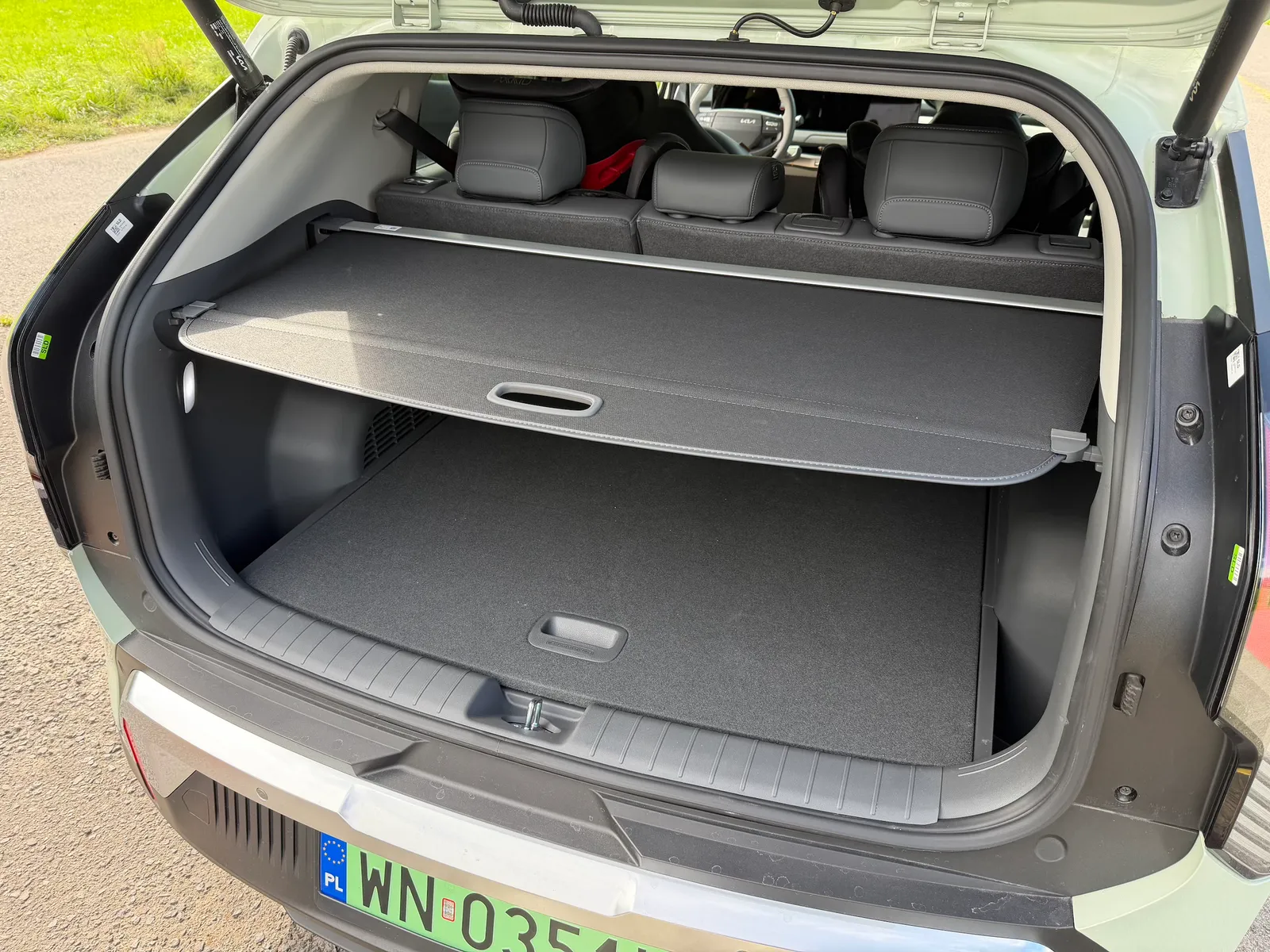
The trunk may not be particularly deep, but it easily fits suitcases and items needed for trips. Additionally, there is extra space under the floor. There’s enough of it that more items can be stored there easily. We’re talking about roughly 20-25 centimeters of extra space, which is quite good for a car of this size.
There’s also a small front pocket. It’s not a space large enough to fit an entire charging kit, but you can easily store one of the cables there. You can also hide wires or other small items, and if someone really wants to, there’s even enough space for an orange juice bottle. So it’s not a solution that will change the car’s character, but extra space is always useful.
It’s more comfortable inside than you’d expect
The cabin itself is very comfortable for both the driver and passenger. Of course, there are no miracles in the back seat. After installing two ISOFIX car seats, we can forget about having a third passenger between them. However, if we’re traveling without car seats, three people should fit on the rear seat for shorter trips. It would get tight on longer journeys, but it’s still not a situation where the middle seat can be completely ruled out.
The cockpit is typical of modern Kias. We have a main set of screens, an infotainment system screen, and a small display in between them that is used, among other things, to control the climate system. We operate the two-zone climate control from this small screen, and it still surprises me a bit. Below the screen are a volume knob along with physical buttons for adjusting temperature and airflow strength. This setup really appeals to me more than having everything moved to the main screen.
The most interesting spot is… between the seats
The part that surprised me the most was however the space between the front seats. Instead of a classic, tall tunnel, we have a sizable trunk area here, with a sliding table above it. It could be described as something like an extra countertop or cutting board. It’s hard to even find the right term for it, as I’ve never encountered anything like this before.
It’s not the entire armrest that slides here. Only its stiffer section does, which houses buttons for functions such as Auto Hold, camera activation, and parking sensors. There isn’t a large storage compartment right under the armrest; rather, there’s a small, fabric-covered space there. In the back, passengers have a tiny recess in the central tunnel, but that’s basically where all the additional storage options end.
The door mirrors are small, though they can certainly be used. Kia also didn’t forget the USB-C ports located on either side of the front seats. This feature is already present in the brand’s newer models and is particularly useful when several people are traveling in the car.
The infotainment system works as expected
The multimedia system operates smoothly with few issues. Wireless Apple CarPlay and wireless Android Auto are available. There are also USB-C ports and a standard 12 V socket in the front.
The Kia EV3 also features Vehicle-to-Load, or V2L. There’s a 230 V socket in the cabin, located at the back of the center tunnel. It looks a bit like a socket on a train and is one of those small details that can be very handy during trips.
We can also use an external adapter connected to the car’s socket. In that case, the car can become a quite useful energy bank. At a campsite, during a trip, or simply in situations where we need to power some device, we have access to the energy stored in the car’s battery.
Outside, the EV3 looks like a member of a larger family
Stylistically, the EV3 fits very well into Kia’s current lineup of electric vehicles. The car has a fairly angular design, with distinctive headlights that resemble little mustaches at the front. Next to them are “bones” that serve as position lights. We’ve seen similar designs in models such as the EV4 and EV9.
The entire front is naturally enclosed, without a traditional cooling grill. An interesting detail are also the pull handles on the front doors that extend outward. The rear is designed slightly differently. The passenger side handles are located high, near the rear window, and are quite concealed within a black trim element.
The rear is just as angular as the front. The reverse camera is cleverly positioned. It isn’t located at the very bottom of the trunk lid like in many cars, but rather roughly in the middle, right below the window. I haven’t had enough opportunities to drive the EV3 in rain to determine how well such a placement performs when the area gets heavily dirty.
EV3 Can Be Truly Fuel Efficient
However, the biggest surprise during driving was the energy consumption. I drove this car for several hundred kilometers, and in terms of fuel efficiency, the Kia EV3 really impressed me positively.
In the city, it’s possible to achieve around 11-12 kWh/100 km with no major issues, while my typical figures were around 14-15 kWh/100 km. On the road, consumption rose to about 18-19 kWh/100 km, which is still a very good result.
With a battery capacity of 81.4 kWh, this offers truly great capabilities. In the city, the theoretical range can reach around 700 kilometers, of course under favorable conditions and with steady driving. On highways, one can expect around 400 kilometers, or even more under good conditions. A lot depends here on speed, wind, rain, and temperature.
A good example is my trip from Warsaw to Wrocław. The car was packed and we were four people, yet we were able to cover that distance with almost no need to recharge. If I had the option to charge the car once we arrived, I could probably make it there with just a few percent of battery left. But since I would still have to look for a charger after unloading the car, I preferred to stop for a few minutes and top up a few percent. This way, I arrived at my destination with a comfortable buffer of about 10-12 percent.
Charging is also a strong point
The maximum charging power is around 130 kW, though the exact figure still needs to be confirmed for this version. The charging curve itself is very good. Kia doesn’t stop fast charging once 70 or 80 percent appears on the screen. The car maintains high power for a long time, and even at over 70 percent, we can still have more than 100 kW.
It is things like these that make a difference during longer trips. It’s not just about the maximum power, but also how long the car can maintain it.
The only thing that still irritates me is the wireless phone charger. Like in many modern cars, it lacks cooling here. The phone heats up very quickly, which reduces the efficiency of charging. This is something I think car manufacturers should finally start addressing.
How does the EV3 drive?
It’s very pleasant. And actually, this could be the end of it here. I’ve driven several hundred kilometers with it without any issues regarding comfort or handling. It’s a car that performs well both in the city and on highways.
Thanks to its compact size, it’s easy to maneuver, yet inside you don’t feel like you’re in a really small car. It’s spacious enough for a family, has a long range, and allows you to carry quite a lot of stuff.
Is the Kia EV3 expensive?
And here we come to the biggest issue with this car: its price. The version I tested costs 213,900 zł, and with additional features like a heat pump, it rises to around 220,000 zł.
That’s already a lot. Very much so.
We are approaching price ranges where the Tesla Model Y becomes available. The Tesla is a larger car and obviously has its advantages, though it may have a smaller battery or other specifications. For some people, the fact that it’s a Tesla will also play a role in their car choice.
Therefore, it’s hard for me to say that the EV3 at this price is an obvious choice. However, if it were possible to buy such a configuration for 170-180 thousand zlotys, the situation would be completely different. In that case, it would truly be difficult to ignore this car.
Kia EV3 as a daily driver
Despite its price, I think the EV3 is a very interesting car for everyday use. It’s small enough for city driving, yet practical enough to take the whole family on vacation. Even if luggage needs to be packed more tightly once a year, it shouldn’t be a big problem.
In addition to this, there’s very low energy consumption, a large battery, fast charging, and the ability to use the car as an energy source thanks to V2L.
And I think that’s exactly why the EV3 surprised me so positively. After the Kia PV5, I expected just a small electric car. Instead, I got a vehicle that can be driven daily without much trouble, taken on longer trips with the family, carry plenty of luggage, without having to worry too much about energy consumption.
A small car, long range, and quite a few features. It’s just a shame that Kia has already priced it at a level where truly serious alternatives start to appear.
The small Kia EV3 can fit a family and luggage, and in the city it only uses 11-12 kWh per 100 km. The problem starts with the price.