
Hyundai IONIQ 5. Test of the electric geek
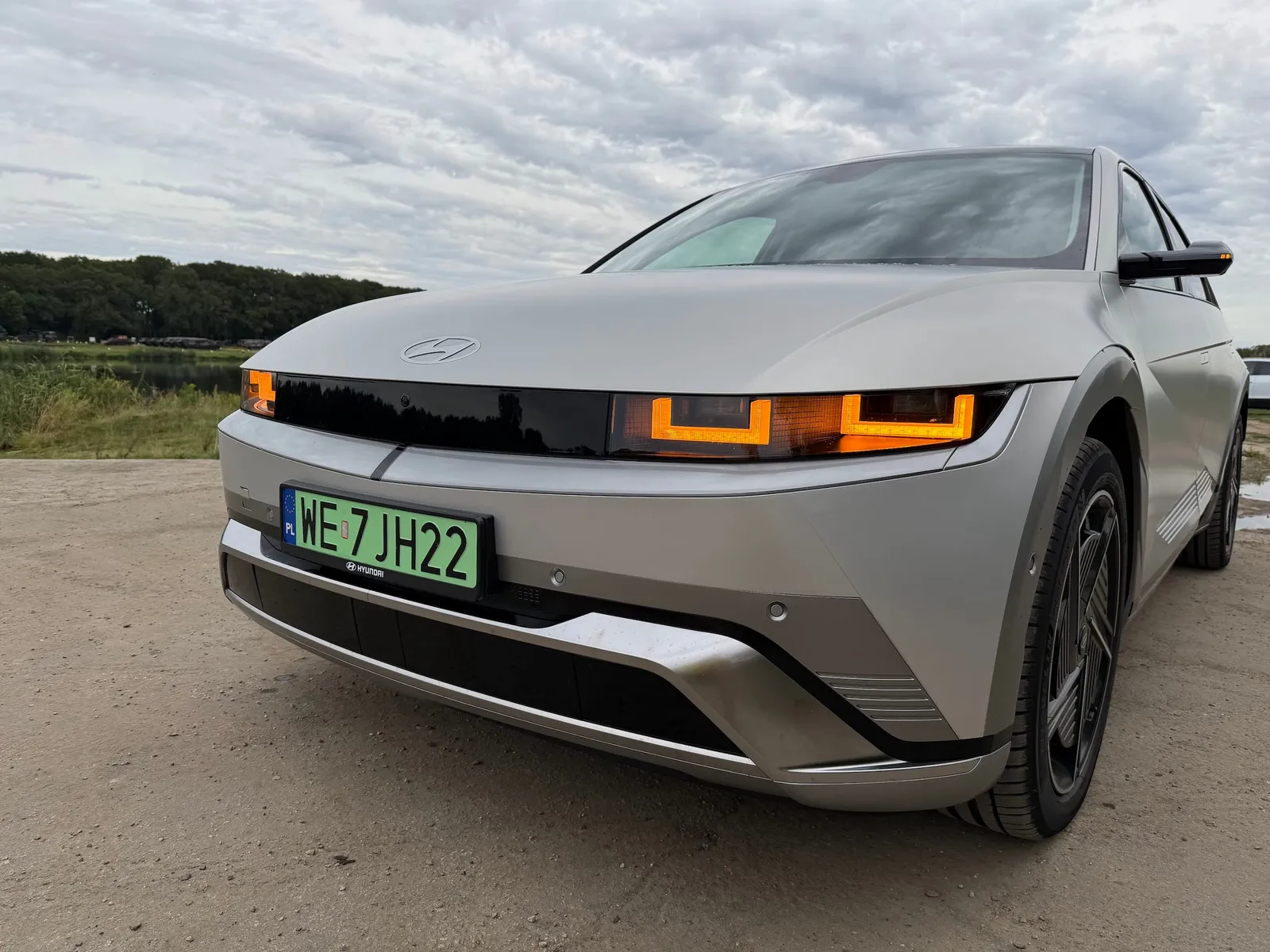
The Hyundai IONIQ 5 isn’t the latest model on the market anymore, but after spending a few days with it, I feel it still has a lot to offer. Especially if you like cars that provide plenty of interesting features and technological gadgets beyond just getting from point A to B. The version I tested has quite a few of these.
Table of Contents
Show
Hide
The IONIQ 5 is a car that’s hard to categorize clearly as an SUV. It’s relatively small on the outside, but its proportions and styling make it much more akin to a crossover. And sometimes even a slightly larger hot hatch. It’s the appearance that catches attention right from the start.
Hyundai IONIQ 5. Specifications
Dimensions: 4655 x 1890 x 1605 mm
Weight: 2120 kg
Battery: 84 kWh
Architecture: 800 V, compatible with 400 V chargers
Drive: AWD, two engines
Power: 325 HP
Maximum DC charging power: over 250 kW
Additional feature: The car supports V2L
Price: 280,500 PLN (at the time of publication)
Pixels, pixels, and more pixels
Looking at the IONIQ 5 from the front, it’s clear that the designers had a specific vision for this car. The headlights feature a pixelated style, and we find many similar motifs throughout the vehicle. I need to revise my earlier opinion that it’s the Kia EV5 that’s meant for Minecraft fans. After getting to know the IONIQ 5 better, it seems Hyundai might be an even better candidate for that title.
Pixels appear in both the front and rear lights, as well as inside the vehicle, including in various lighting elements. Added to this is the sleek body shape, distinctive front grille, and interesting light panel at the front. The overall design has a very technological feel, yet it doesn’t resemble a typical futuristic experiment.
From the side, the IONIQ 5 further demonstrates that it isn’t a classic SUV. For me, the term crossover fits much better here, or even a slightly larger hot hatch. The car looks really good and has its own distinct character, which isn’t always the case with modern electric vehicles.
At the back, we obviously have another batch of pixels. The individual squares light up with the turn signals and brake lights. This is one of those elements that some may like and others may not, but it’s hard to deny it any character.
Unassuming from the outside, surprisingly spacious inside
The IONIQ 5 is one of those cars where appearances can be a bit misleading. Looking at it from the outside, I didn’t expect such ample interior space. Yet once I sat behind the wheel, it quickly became clear that there’s actually quite a lot of room available.
Let’s start with the trunk, as there are interesting features here as well. Under the hood lies something that looks like a traditional engine cover. This is already somewhat surprising in an electric car. We open it manually by pulling a lever located under the steering wheel, and it turns out there’s indeed a trunk underneath. The problem is that it’s really small.
What can it be used for? To be honest, I’m not entirely sure myself. Maybe for a small kite? Hard to say. I have the impression that if this frunk weren’t there at all, not much would change.
The trunk itself isn’t one of the largest, but it’s more than enough for everyday use. We can easily fit groceries and all the daily necessities in there. It’s also no problem for family trips. Four cabin-sized suitcases fit under the tray, with a bit of extra space left in front of them for additional items.
We won’t find much large storage space under the floor, as we see in some other electric vehicles. In the version I tested, the main electric motor is located there. However, once the floor is raised, there are additional pockets on the sides that allow us to make better use of the available space.
A Cockpit Full of Curiosities
It gets even more interesting inside. The steering wheel is typical of Hyundai vehicles and comes with heating as well as paddles at the back to adjust regen levels. In front of the driver is a screen displaying all the most important information needed while driving.
To the left of this screen, the manufacturer placed something that I initially thought was a speaker. It turned out later to be just a magnet where we can attach things. I don’t fully understand the purpose of this element, but it’s there. And it seems that exactly such details best show that the IONIQ 5 is a car designed for people who enjoy various gadgets.
To the driver’s right side is the infotainment screen. It works very responsively, and I didn’t have any major issues using it. We have wireless Apple CarPlay and Android Auto here, and the standard navigation uses Google Maps, showing things like charging stations along the route as well as the estimated range with the current battery level.
In the version I tested with the Tech package, cameras are also used in place of traditional mirrors. I have mixed feelings about this as well.
Cameras instead of mirrors. A gadget or the future?
The solution itself is very interesting, but I don’t fully understand its purpose in a passenger car. While in trucks, reducing air resistance caused by huge mirrors can be significant, the camera arms that protrude from the doors aren’t actually much smaller than a regular mirror. For me, this is mainly a gadget for people who want their car to be packed with technology.
I, on the other hand, needed some time to get used to it. At first, it was very difficult for me to gauge perspective and determine exactly where the car ends and what the distance to other objects is. However, one can get used to this after a while.
HUD and the Camera Mirror
In front of the driver, we also have a Head Up Display. This feature is becoming increasingly common in electric cars, but combined with the rest of the IONIQ 5’s equipment, it fits well with its technological character.
An interesting feature is also the rear mirror. In normal mode, it functions like a regular mirror, but we can switch it to camera mode. The camera is located on the rear spoiler and shows an image of what’s directly behind the car. This is somewhat similar to solutions used in buses.
If we are traveling with a lot of luggage and visibility through the traditional mirror is limited, we can simply switch it to camera mode and see what’s happening behind the car.
Seats and the console that moves around the car
The seats themselves are very comfortable. Both the driver and passenger have access to heating and ventilation. The seats are naturally electrically adjustable, and the driver’s seat also has memory for two people. We can also recline it fully and use the footrest, though this function only works when the car is parked.
The headrest is nicely shaped, so it’s comfortable to rest your head on. One of the things that surprised me the most here is the ability to move the entire center console forward and backward. This feature offers plenty of options for adjusting the space to one’s own needs.
I also like that Hyundai didn’t try to put everything on the screen. We have physical knobs here for controlling volume as well as switching and searching through radio stations. The air conditioning can also be controlled from a separate touchscreen panel, not just via the main screen. With the current trend of turning everything into a display, this is quite a pleasant change.
A lot of space for all the gadgets
Around the driver, we find standard door trunks, a compartment in front of the passenger, and plenty of space in the center console. There’s a large shelf under the armrest, and the armrest itself allows us to store a few essential items like documents or a wallet.
We also have a wireless charger for one phone and two cup holders. There’s still enough space between them where we can place a second phone vertically. It’s a shame there’s no separate holder for the passenger’s phone, but at least we don’t have to put it on our legs or in the door pocket.
An interesting addition are also the buttons located on the side of the passenger seat. They allow the person sitting in the back to move the front seat and adjust the recline angle of the backrest. So if someone in the back needs more space, they can move the seat in front of them by themselves.
The back is comfortable, but not for five people
We also find many interesting features on the rear seat. The two outer seats are heated, and the entire seat can be adjusted electrically. The backrests remain mechanically adjustable, but the ability to move the rear seat electrically was a slight surprise for me.
As for space, I would say four people can travel very comfortably. It becomes noticeably tighter with five people. The situation is even simpler after installing two child seats, as there’s practically no room for anyone to sit between them. I tried it myself and simply couldn’t fit.
There’s no lack of space for two people sitting in the back. When I adjusted the driver’s seat to face me and then sat behind it, I still had enough legroom to travel comfortably.
The manual blinds on the rear windows are also a very nice addition. Until now, I had associated such features mainly with high-end limousines. Here we have them in a car that isn’t designed to be a luxury limo at all.
In addition, there’s a glass roof with an electronically controlled blind. It’s divided into two parts and opens inward in two directions, forward and backward. This is a somewhat different approach compared to many cars that simply have one long blind.
Automatic parking? I’m not convinced about this here.
The IONIQ 5 also comes with automatic parking. I didn’t have much experience with this type of feature before, so I thought since the car has it, I definitely need to try it out.
And here I have very mixed feelings.
Firstly, the parking spot search itself is extremely sluggish. I drove to what appeared to be an almost empty parking lot, yet it took the car a really long time to find a perpendicular spot. It passed nine empty spaces before it finally decided to stop next to an already parked car. Earlier, there had been several empty spots available, but somehow it wasn’t interested in them.
Even when it started parking, I didn’t feel particularly comfortable. The car began moving in next to another vehicle, and I sat inside wondering if we might end up with scratches on the doors. Perhaps after more attempts, one could gain confidence in this system, but I definitely wouldn’t trust it 100 percent.
The whole process takes a very long time for this reason. First, the car searches for a spot for a long time, then it takes a while to start parking, and the actual parking process isn’t particularly fast either. If someone is behind me who just wants to park, they would likely be getting very frustrated by now.
There is one feature, however, that is truly useful. We can drive into a very tight space, partially enter it, get out of the car, close the doors, and then remotely drive the car in completely. This can be really handy in tight parking spaces, especially in shopping malls.
How does the IONIQ 5 handle energy consumption?
While driving in the city and on local roads, the energy consumption was really good. The figures ranged between 14-15 kWh/100 km. For steady driving conditions, this is an excellent result.
On highways, the situation naturally changes. At speeds of 120-140 km/h, energy consumption rose to around 22-24 kWh/100 km. This is definitely higher, but at such speeds it’s not particularly surprising.
The biggest advantage of the IONIQ 5, however, isn’t just the energy consumption itself but what happens afterward. It’s also important to note that the car allows energy to be supplied to external devices (V2L), meaning its large battery can serve as an energy storage unit… anywhere!
800 V delivers results
The car uses an 800 V architecture and can be charged using both 800-volt and 400-volt chargers. In practice, this means the ability to recharge very quickly.
Charging from 10 to 80 percent took me about 15-18 minutes. That’s impressive. While in many cars this time would barely be enough to start eating at a gas station, here we can recover the vast majority of the energy needed for further driving.
The maximum power I was able to achieve was around 265 kW. Importantly, this isn’t just a temporary spike. The charging curve also looks quite good. Even above 80 percent, the car was still able to draw over 60 kW.
And that’s exactly why the IONIQ 5 is a car with which one can easily embark on longer trips. We don’t need to spend half an hour or forty minutes at every charger. A short stop is enough, and we can keep going.
IONIQ 5. A car for geeks?
If I had to summarize the IONIQ 5 in one sentence, I would say it’s a really cool, gadget-filled car, especially for geeks.
There’s no problem using it for daily driving. It’s also suitable for longer trips. It’s comfortable, spacious, has excellent performance, reasonable energy consumption, and above all handles fast charging very well.
On top of that, it comes with a bunch of interesting features. Cameras instead of mirrors, a digital rearview mirror, HUD, a sliding center console, electrically adjustable rear seats, blinds on the rear doors, a glass roof, and many other details that make it hard to call the IONIQ 5 a boring car.
Not everything works as it should, though. The automatic parking is definitely too slow and not very convincing for me, and I have to get used to using cameras instead of mirrors. The frunk is also more of a novelty than something we’ll actually use daily.
But overall?
The IONIQ 5 is simply a very nice car. And even though it’s not the latest model on the market, it still has many advantages. Especially if you like technology, gadgets, and features that set it apart from competitors.
It can also charge very quickly, which in an electric car is one of the most important things for longer trips.
Would I buy it instead of a Tesla Model Y? That’s a topic for a separate comparison, because the IONIQ 5 has several features that I really appreciated after just a few days. And there are also a few aspects where I’m definitely more accustomed to them in Teslas.