
GaN tech for next-era HV power systems
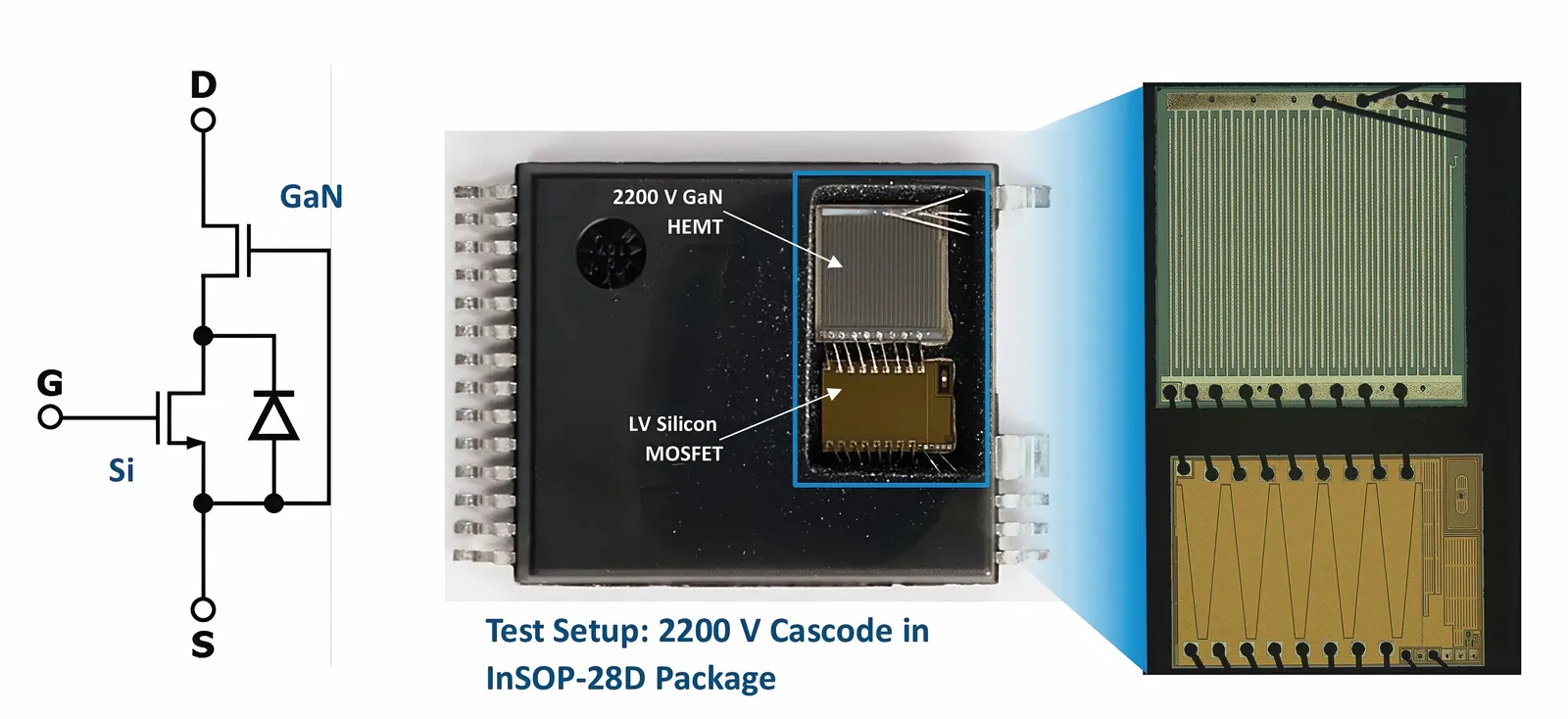
Power Integrations has developed a gallium nitride (GaN) technology that operates up to 2200 V for high-power motor inverters and megawatt charging systems, writes Nick Flaherty.
The design of the new device allows for a higher margin at high voltages, which translates into significantly higher reliability while enabling higher switching frequencies for smaller inverters.
“We started in 2017 with the 1500 V GaN and then 1700 V in 2024, which was the perfect voltage for 800 V automotive. Our 900 V part is fully AEC qualified and is already deployed in vehicles today and ramping in volume,” said Roland Saint-Pierre, vice president of product development at Power Integrations. “This 2200 V GaN future-proofs us for applications that go beyond 800 V; as you go above 1000 V, you need a higher current capability.”
The 2200 V device operates in depletion mode (D-mode) and is normally on with a silicon MOSFET in a cascode configuration. The cascode is built on a sapphire substrate, which is an important component for scaling the voltage to 2200 V.
The cascode switching means the compliance range for the gate is much higher and there is no need for a negative voltage. The threshold voltage for the MOSFET is 3 V and the highest voltage is as high as 15 or 20 V for a standard gate drive. “We also reduce the losses compared to E-mode GaN,” he said.
“For automotive megawatt chargers operating at 1500 V, the 2200 V device is ideal. We are also seeing a move to more 800 V being deployed to reduce the weight of the vehicle and there are already electric busses and trucks at 1200 V. So, now with 2200 V, you have just the right voltage,” he said.
“Leakage current starts building above 4000 V, so there is a 2000 V margin. There are two factors for the FIT [failure in time] rate that are the temperature and voltage, and this margin allows us to have a FIT rate of less than 1, which is an order of magnitude better than other devices.”
The company has shown continuous switching at 1760 V with a flat on-resistance, which it says is the first ever such demonstration above 1500 V. Rather than having more heating as the on-resistance increases with the higher breakdown voltage, the flat on-resistance provides higher reliability because the thermal effects are stable.
“We are in development of a range of products. So, this is a flag in the ground, with a product introduction in the latter half of next year [2027]. The technology is approaching final qualification now,” said Saint-Pierre. The company plans to have automotive-qualified devices available in 2028.
Click here to read the latest issue of E-Mobility Engineering.