
Changan Deepal S07. China’s rival to Tesla Model Y with a huge front trunk
The Changan Deepal S07 is another Chinese electric vehicle I had the chance to test. I must admit that it strongly resembles the Tesla Model Y at first glance. The similarity can be seen in its styling, dimensions, and overall design. It is a large, sleek SUV that aims to combine a spacious interior with modern technologies. It features several truly interesting solutions, but I also found shortcomings that could be significant during long trips and everyday use.
Table of Contents
Show
Hide
Changan Deepal S07. Specifications
Dimensions: 4750 x 1930 x 1625 mm
Weight: 2073 kg
Battery capacity: 80 kWh
Battery type: NMC
Engine power: 218 HP
Drive type: rear-wheel drive
Maximum DC charging power: 93 kW
Maximum V2L power output: 6 kW
Number of speakers: 14
Central screen: 15.6 inches
Base price: 204,900 PLN
Price of the tested version with electric folding hook: 209,400 PLN
Is this the Chinese version of the Tesla Model Y?
Let’s start with the appearance, as the resemblance to the Tesla Model Y is quite noticeable here. The Deepal S07 features a very streamlined body line typical of modern electric vehicles. From the outside, it might seem slightly shorter than the Tesla, mainly due to its higher rear end, which gives it a more crossover-like, even station wagon-like appearance. However, when we look at the dimensions, it turns out that both cars are very similar to each other. The Deepal has a length of 4,750 mm and a width of 1,930 mm, with a curb weight of 2,073 kg.
The car looks really good. At the front, we have a nicely shaped hood and distinctive LED strips that serve as daytime running lights. The whole design contrasts well with the rest of the headlights. At the back, the spoiler with a centrally located light catches the eye, standing out interestingly against the overall shape of the vehicle. It may not be a stylistic novelty, but the Deepal S07 appears modern and is certainly likely to be pleasing to many.
Similarities to Tesla can also be seen in its technological features. The car is equipped with numerous cameras located, among other places, on the sides and in the mirrors. These provide a 360-degree view, in addition to cameras at the front and back. It also comes with driving assistants, including a lane-keeping assistant. In this regard, the equipment is truly extensive.
Frunk – something Tesla would envy
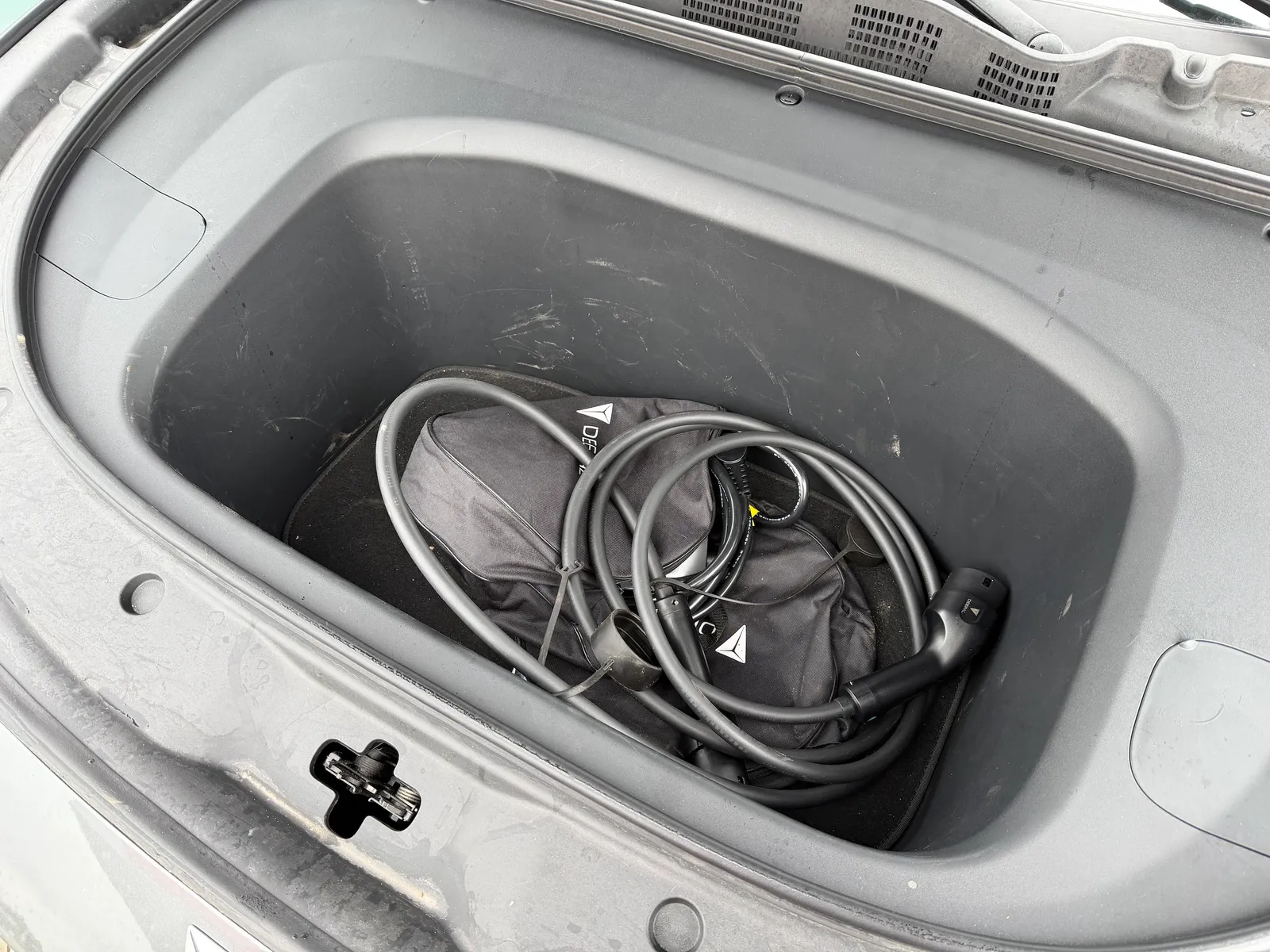
One of the first things that caught my attention is the space under the front bumper. The Deepal S07 has a huge frunk with a capacity of 125 liters. I can’t remember having tested an electric car with such a large front trunk before. It’s slightly shallower than that in the Tesla Model Y, but it’s definitely wider. We can easily fit a carry-on suitcase in there, and still have room to carry cables or chargers.
This design is very useful, especially during longer trips. Instead of cramping all the accessories in the main trunk, we can use the space in front. The Deepal also has a Vehicle to Load feature that allows it to deliver power from the car at up to 6 kW, so we can power external devices using it. It’s a handy addition for trips, camping, or working outside the home.
The interior resembles Tesla’s, but it has some unique features
Upon entering, the similarities to the Model Y remain evident. There’s a large central screen that displays driving information, speed, selected gear, and other vehicle parameters. The infotainment system and navigation are also located there. What truly sets the Deepal apart from Teslas is its large, highly dynamic head-up display.
The HUD shows basic driving information, and when using the factory-installed navigation, it can also display animated arrows indicating the direction we should drive. It’s a really nice addition that works well while driving.
The interior is nicely finished. We have leather-like materials here, plenty of soft surfaces, and as many as 14 speakers. The central screen is 15.6 inches and can be rotated. However, it doesn’t work like in some BYD models where the screen switches from vertical to horizontal orientation. Here, we can point it at the driver, passenger, or position it more centrally. It’s a rather unusual solution, but it allows the screen to be adjusted to personal preferences.
Comfortable seats, plenty of storage, and several interesting details
The interior equipment is truly extensive. We have a two-zone climate control system, with rear passengers receiving an additional small screen through which they can adjust the temperature. The driver, of course, can manage the entire system from the front. There’s also a heated steering wheel, heated seats, as well as electric seat adjustment with memory functions and ventilation. Unfortunately, there’s no massage feature.
The phone charging solution is thoughtfully designed as well. The driver has access to a 40 W induction charger equipped with cooling. This is a big plus, especially since in many cars I’ve tested, phones tend to get very hot during charging. It’s just a shame that the charger is available only to the driver. Passengers don’t have their own wireless charging spot, though they can at least place their phones down comfortably.
There is no shortage of storage space for small items. Under the charger in the center console, there is an additional shelf where you can place a bag or other belongings. The armrest is very deep, and the pockets in the doors can even hold a one-liter bottle. The manufacturer also included an extra speaker located in the upper part of the doors, near the handle, which looks really nice. The main speakers are naturally located lower down, but this additional element is an interesting finishing detail.
We open the same doors using a button, just like in a Tesla. However, the area where it’s located is finished with a decorative element that resembles artificial wood. This creates a somewhat unusual combination of modernity and a classic motif. Another big surprise is the presence of an ISOFIX attachment on the front passenger seat. This isn’t a feature we often find in cars.
The vehicle also comes equipped with a panoramic glass roof with an automatically closing sunshade. The test unit had an electrically folding tow hook as well. All you need to do is press a button, and the hook unfolds or retracts on its own. An additional cost of around 4500 zł is required for this feature, but it’s definitely more convenient than a manual attachment.
Several features I didn’t expect
One of the more surprising aspects was the way the windshield washer fluid is refilled. The filler port is located under a plastic cover under the hood. First, you need to remove the corresponding cover before finding the tank cap underneath. It might not be a huge problem, but I must admit I wasn’t expecting such a setup.
Deepal also features customizable ambient lighting and door handles with a welcome function. When we approach the car, they automatically extend, highlighting the vehicle’s modern design.
The trunk at the back is smaller than that of the Tesla Model Y, but it’s still sufficient for daily use and trips. We can easily fit a few suitcases and take the essentials for a weekend or longer outing. Combined with the large front trunk, this creates a quite practical overall cargo space.
Energy consumption is decent, but charging is disappointing
The Deepal S07 has an 80 kWh NMC battery. In urban driving, my energy consumption was around 16-17 kWh/100 km. On highways, at speeds of about 120-130 km/h, it increased to around 23 kWh/100 km.
With these figures, one can expect over 400 km of range in city driving and over 350 km on the highway, of course depending on conditions, temperature, and driving style. These aren’t wow-worthy results, but for a car of these dimensions and weight, they’re quite decent.
Unfortunately, the biggest issue arises during charging. The maximum DC charging power is only 93 kW. This is, for me, the biggest flaw of this car. With a battery capacity of 80 kWh and a vehicle meant to compete with the Tesla Model Y, I would have expected significantly better performance. Of course, you can still charge and use the car in daily driving, but for longer trips, the lower charging power means more time spent at chargers.
If the Deepal offered faster charging, it would be a much more interesting option for those who regularly travel long distances. The range is decent, energy consumption isn’t alarming, the equipment is comprehensive, and there’s no lack of space. It’s a shame that charging falls so far short compared to the rest of the car’s features.
The infotainment system still has some room for improvement
The multimedia system works quite smoothly and is responsive. It has wireless Apple CarPlay and Android Auto, so those who use their phone as the primary navigation or multimedia source should not encounter major issues. Most of the interface is translated, though there are a few language glitches here and there.
However, if we want to use all the car’s functions, it’s better to stick with the original system. And here, certain shortcomings arise. The navigation can display messages that seem to have not been properly translated. For example, when changing speeds on the cruise control, I saw a message that looked like it was in Hungarian.
The even bigger problem is navigation itself. It shows the route from point A to point B, but it doesn’t plan stops for charging and doesn’t suggest where we should stop to top up energy. Interestingly, it’s enough to access the relevant function to easily display chargers in the vicinity. Since the car can find them, why doesn’t it use this information to plan the route? This is a rather surprising oversight for an electric car of this class.
I must also admit it took me some time to get familiar with the entire system. Not everything is immediately intuitive, and finding information about energy consumption or charging required some searching. However, the system itself works well—the whole experience is smooth, responsive, and one can get used to it after a while.
A car full of contradictions. Not everything is well thought out.
Deepal S07 is a car full of contradictions. On one hand, it has a large screen, a dynamic HUD, 14 speakers, cameras around the vehicle, an electric folding tow hook, and an inductive charger with cooling. On the other hand, there are minor details I wouldn’t expect in a car costing over 200,000 zł.
For example, photochromic functionality is only available on the interior mirror. The side mirrors no longer have this feature. It might seem like a small detail, but in a car with such advanced equipment, it’s somewhat surprising. The same goes for the infotainment system. I don’t expect a brand new to the Polish market to have perfect translations for every message right away. Even manufacturers established in Europe for years can struggle with this. So I can understand occasional language errors or imperfect interfaces.
There are, however, things that are much more important. The factory-installed navigation should be able to plan stops for charging. Yet Deepal only shows the route from point A to point B, without suggesting where to stop to recharge, even though it can easily display nearby chargers.
It is such unfinished details that prevent Deepal from being a complete product yet. It’s not about everything being perfect, but at a price over 200,000 zł, I would expect the basic functions of an electric car to work as they should.
Ride comfort is one of Deepal’s greatest advantages
After a few days behind the wheel of the Deepal S07, I must admit that the car surprised me very positively with its driving comfort. The suspension is truly comfortable and performs well both in urban driving and on longer routes. I didn’t feel that the car strained the driver or passengers on uneven surfaces. On the contrary, traveling in it was simply pleasant. It’s easy to get used to such a car, allowing one to plan longer trips without much concern.
In terms of performance, the version tested offers 218 horsepower and rear-wheel drive. This might not be a number that impresses significantly compared to some electric competitors, but it’s more than sufficient for everyday use. The car doesn’t seem sluggish, and the available power enables smooth driving both in the city and outside of it.
Changan Deepal S07 vs Tesla Model Y. The price is appealing
The Deepal S07 version I tested costs 209,400 zł and includes an electrically folding tow hook. Without this feature, the price is 204,900 zł. This is lower than that of the Tesla Model Y, to which the Deepal is quite similar in terms of dimensions and overall design.
Of course, it’s not an exact match. The tested version has rear-wheel drive and 218 HP, so it doesn’t compete with the more powerful versions of Tesla in terms of performance. On the other hand, it offers a comprehensive range of features, a comfortable suspension, a large front trunk, a panoramic roof, an advanced camera system, and many interesting interior solutions. Additionally, it provides very pleasant driving comfort.
The biggest issue for me remains charging. A maximum power of 93 kW with an 80 kWh battery is definitely too low, especially if someone plans to cover longer distances regularly. Good energy consumption and a decent range don’t fully solve this problem. It is here that the Deepal falls far behind its competitors.
Nevertheless, the Changan Deepal S07 is a car worth considering. It is well-equipped, comfortable, spacious, and interestingly designed. It doesn’t try to be a sports car but rather a comfortable electric SUV for everyday use. If the manufacturer improved the charging speed and refined some software elements, it would be a much stronger offering. As it stands, it is a very pleasant electric vehicle with a few drawbacks that could be problematic for those who travel frequently on highways.