
The BYD Blade 2.0 battery heated up to 78.5 degrees Celsius. An independent test showed a higher temperature than reported by the BMS.
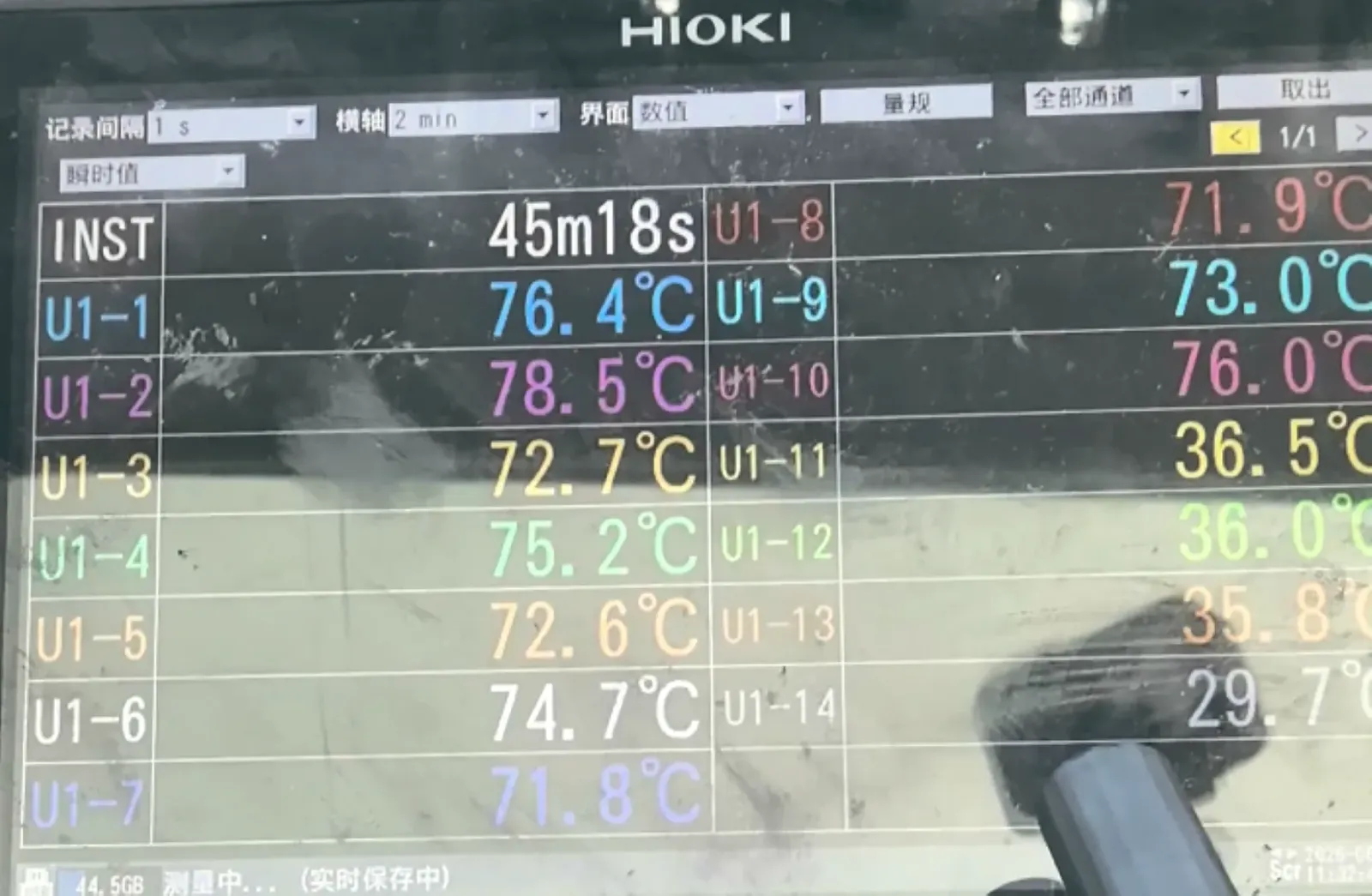
Chinese automotive blogger Cai Shen Dao had a state laboratory test the temperature of the second-generation BYD Blade battery under ultra-fast charging conditions. The result is straightforward: 78.5 degrees Celsius was recorded on the cell surface, while the car’s system showed around 70.5 degrees Celsius.
The interesting aspect isn’t that the battery got hot. At around 1,200 A, this doesn’t sound like a big deal. What’s more intriguing is that the independent measurement showed significantly higher temperatures than those reported by the BMS, and the test was conducted after Cai Shen Dao’s accounts on WeChat, Bilibili, Douyin, and Weibo were restricted as part of stricter rules regarding “independent” automotive testing.
78.5 degrees Celsius on the cell, 8 minutes and 32 seconds to go from 7% to 97%
The test was conducted on a Fang Cheng Bao Tai 3 Flash Charging Edition AWD model. The vehicle features an LFP battery with a capacity of 78.72 kWh, a system power output of 310 kW, and a CLTC range of 565 km.
During the charging session, the SUV reached 7 to 97 percent SOC in 8 minutes and 32 seconds. The maximum charging current was around 1,200 A. The ambient temperature was 29.0–29.7 degrees C, so this wasn’t a winter test that would aid cooling.
Parameter
Value
Model
Fang Cheng Bao Tai 3 Flash Charging Edition AWD
Battery
78.72 kWh LFP
Power
310 kW
Range
565 km CLTC
Charging time in test
7–97 percent in 8:32
Max. charging current
around 1,200 A
Max. cell surface temperature
78.5 degrees C
BMS reading
around 70.5 degrees C
Price in China
169,800 yuan
The highest temperature was recorded on the large flat surface of the cell where a physical probe was installed. After charging ended, the battery temperature dropped below 70 degrees Celsius after 14 minutes, and below 60 degrees Celsius after 32 minutes and 56 seconds.
Why is there a difference between the probe and BMS?
There’s no great secret here. A laboratory probe measures locally, right at the point of contact with the cell surface. The BMS monitors temperature through the entire pack’s architecture and sensors located in other places. These are not identical measurement points, so the results will not be exactly the same.
Still, a difference of around 8 degrees Celsius is worth considering. If someone only looks at the car’s dashboard or BMS logs, they might simply not see the hottest areas in the pack. And during flash charging, it is these local spikes that are most interesting.
This isn’t the first time this team has conducted such a test
Cai Shen Dao previously disassembled the BYD Blade 2.0 pack and showed the cell structure from the inside. In May 2026, the team also conducted their own temperature test during fast charging. At that time, 76.42 degrees Celsius was measured on the cell surface, while the BMS showed 71.0 degrees Celsius.
Now the result from an accredited laboratory is even higher, but it’s not a huge difference compared to the previous test. It’s more of a confirmation that at very high currents, BYD pushes the parameters hard, causing the temperature to rise. It sounds good on paper, as 7–97 percent charge in 8.5 minutes is impressive. The question is how such a charging regime will affect the pack’s durability after hundreds of cycles, since this test obviously doesn’t show that.
The model used in the study hit the market on March 13, 2026. The AWD version costs 169,800 yuan, while the base RWD model starts at 153,800 yuan.
BYD has shown it can charge at an absurdly fast speed, but this test reminds us of one thing: high power doesn’t come out of nowhere. Is 8.5 minutes to 97 percent worth a cell temperature of 78.5 degrees Celsius for you?