
Xiaomi posts further loss in Q2 with its EV division
Xiaomi's Smart EV, AI and Other New Initiatives segment remained in the red in Q2 of 2026. Despite significantly higher vehicle deliveries, the division recorded an operating loss of 2.6 billion yuan. However, the deficit has fallen compared to the first quarter.
In the second quarter of 2026, Xiaomi’s division ‘Smart EV, AI and Other New Initiatives’ generated revenue of 24.9 billion yuan (~€3.0 billion euros). This represents a 17.1 per cent increase compared to the same quarter last year and a 25.3 per cent rise compared to the first three months of this year. The EV business alone accounted for 23.9 billion yuan, marking a 15.9 per cent year-on-year increase. Other business areas, including revenue from Xiaomi’s AI model series MiMo, contributed one billion yuan.
As in previous quarters, Xiaomi does not report its EV business separately but combines it with AI and other new initiatives. While vehicle sales, totalling 23.9 out of 24.9 billion yuan, continue to dominate the segment’s revenue, the operating loss and gross margin cannot be directly attributed to the automotive business alone.
Regardless, the division remains unprofitable. The operating loss for the second quarter amounted to 2.6 billion yuan (~€315 million euros), marking the second consecutive quarter of losses. However, Xiaomi reduced the loss compared to the first quarter, when it recorded a deficit of 3.1 billion yuan (~€400 million). Previously, the division had achieved profitability in the third and fourth quarters of 2025, closing its first full year with an operating profit.
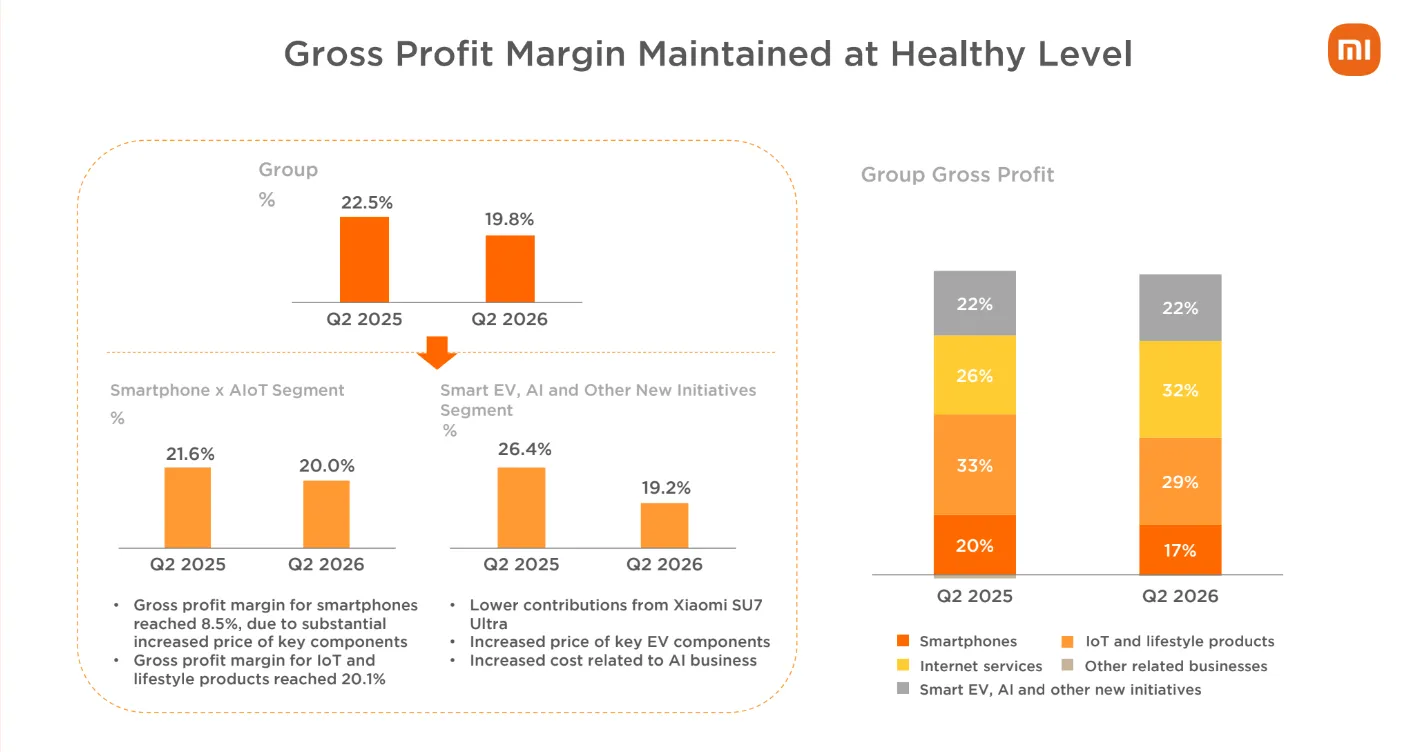
At the same time, the division’s gross margin came under further pressure, declining from 26.4 per cent in the second quarter of 2025 to 19.2 per cent. In the first quarter of 2026, it stood at 20.1 per cent, significantly below the previous year’s level. Xiaomi attributes the further decline to a lower share of the high-priced SU7 Ultra in the sales mix, rising prices for key components, and higher costs in the AI business. The division’s operating expenses increased by 25.7 per cent year-on-year to 7.4 billion yuan.
Deliveries rise to over 100,000 vehicles
In contrast, vehicle deliveries continued to show strong growth. Between April and June, Xiaomi delivered 104,199 BEVs, a 28.2 per cent increase compared to the same period last year. Compared to the 80,856 vehicles delivered in the first quarter, this represents a nearly 29 per cent rise. However, the average selling price fell to 229,312 yuan (~€27,700 euros), a 9.6 per cent decrease year-on-year, reflecting the lower share of the more expensive SU7 Ultra in the sales mix.
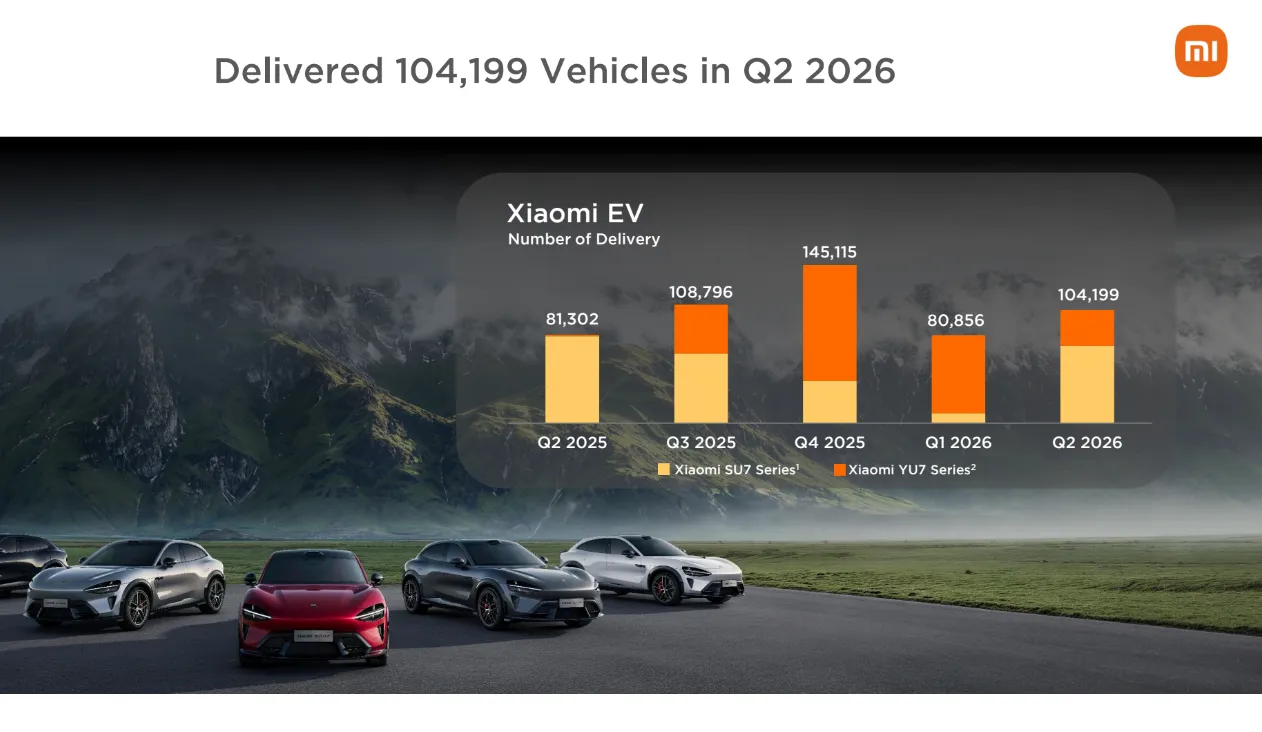
Nevertheless, the SU7 remains a cornerstone of Xiaomi’s fledgling automotive business. By 17 August, Xiaomi had delivered over 500,000 units of the model series. In the first half of 2026, the SU7 was also the best-selling battery-electric saloon priced above 200,000 yuan in the Chinese market.
Meanwhile, Xiaomi continues to invest heavily in expansion. Of the group’s total investment expenditure of 3.6 billion yuan in the second quarter, 2.4 billion yuan was allocated to the division for electric vehicles, AI, and other new initiatives. The group’s research and development expenses also rose 18.9 per cent to 9.2 billion yuan.
For the full year, Xiaomi has set a target of delivering 550,000 vehicles. From January to July, 216,322 units were delivered, according to CnEVPost. In July, deliveries declined by around 10 per cent compared to June, totalling 31,267 vehicles. To achieve the annual target, Xiaomi would need to deliver an average of around 66,700 vehicles per month over the remaining five months—a figure significantly above recent monthly levels.