
The SsangYong CCR-1: An Early Korean EV Experiment
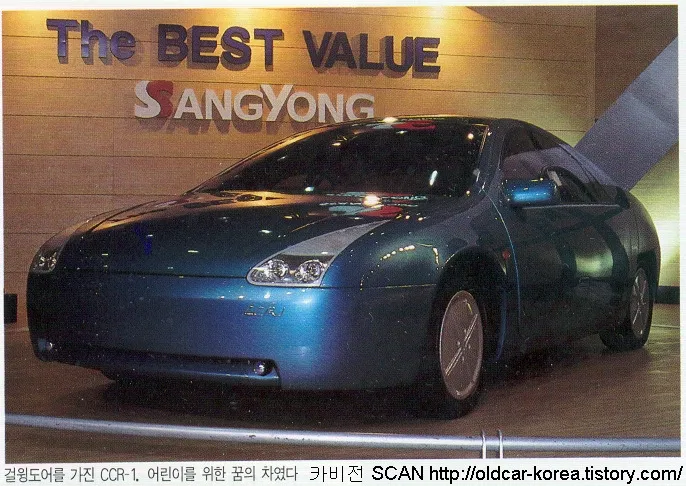
Early photos of the CCR-1. (Photo from Ssangyong archived in oldkoreacars.com)
Support CleanTechnica's work through a Substack subscription, on Patreon, or on Stripe. Help us produce all of the high-quality, original content we publish week after week despite the challenges of content-scraping AI, antisocial media, inflation, and other hurdles.
SEOUL, South Korea — Long before SsangYong Motor became part of the electric-vehicle transition now reshaping South Korea’s automotive industry, it built an electric sports car that looked as if it had arrived from a different future.
The SsangYong CCR-1, short for Clean Car 1, was unveiled in 1995 as a lightweight, mid-engined electric sports coupe with gull-wing doors. Unlike many concept vehicles of the period that existed primarily as styling exercises, the CCR-1 was a running prototype capable of test drives, giving SsangYong an opportunity to explore electric propulsion, lightweight construction and aerodynamic efficiency at a time when battery-powered cars remained largely experimental.
California is the trigger
The project began in April 1993, against a backdrop of tightening environmental regulations in California’s 1990 Zero Emission Vehicle laws. The mandate had pushed automakers to investigate electric propulsion as a potential route to future regulatory compliance, while manufacturers in Europe and Asia were also beginning to examine alternatives to conventional internal-combustion powertrains.
For SsangYong, the project represented more than an emissions experiment. The company was then best known for rugged utility vehicles, diesel-powered SUVs and commercial vehicles. The CCR-1 offered an opportunity to demonstrate that its engineering organization could develop an advanced passenger vehicle and explore technologies that could eventually be applied beyond its traditional product range.
The project’s name reflected its purpose. Clean Car 1 was conceived around the idea of zero-emission urban transportation, but its designers did not take the conventional approach of turning an existing sedan into an electric vehicle. Instead, the engineering team created a low-slung two-seat coupe intended to combine aerodynamic efficiency with the visual appeal of a sports car.
Team Manager Lee Myung-hak, who led the engineering effort, described one of the central challenges of the project as defining what an electric car should be at a time when there was no established formula for building one.
A rolling lab
The CCR-1 is a rolling laboratory. Its chassis used an extruded aluminum space-frame structure designed to reduce weight, while the body panels were made from high-rigidity fiber-reinforced plastic. The approach addressed one of the fundamental problems confronting early electric vehicles: battery weight.
The electric powertrain was mounted behind the two-seat cabin in a mid-engine, rear-wheel-drive configuration. The motor was a multi-face bipolar brushless DC unit producing about 37 kilowatts, equivalent to roughly 50 horsepower, with peak torque of 196 Newton-meters.
Power came from a high-performance lead-acid battery pack. By modern EV standards, the technology was primitive, but the CCR-1 demonstrated how careful attention to weight, aerodynamics and rolling resistance could compensate for limitations in battery energy density.
SsangYong claimed a top speed of 120 kilometers per hour and a maximum test range of about 200 kilometers on a single charge. Those figures would still be modest for a contemporary electric vehicle, but they were significant for a lead-acid-powered prototype developed in the early 1990s.
An EV tire
The engineering team also worked with Hankook Tire to develop specialized low-rolling-resistance tires for the vehicle. The 195/65VR15 tires were designed to reduce rolling resistance by about 7 percent compared with conventional tires of the period, highlighting how the project approached efficiency as a system rather than simply a motor-and-battery problem.
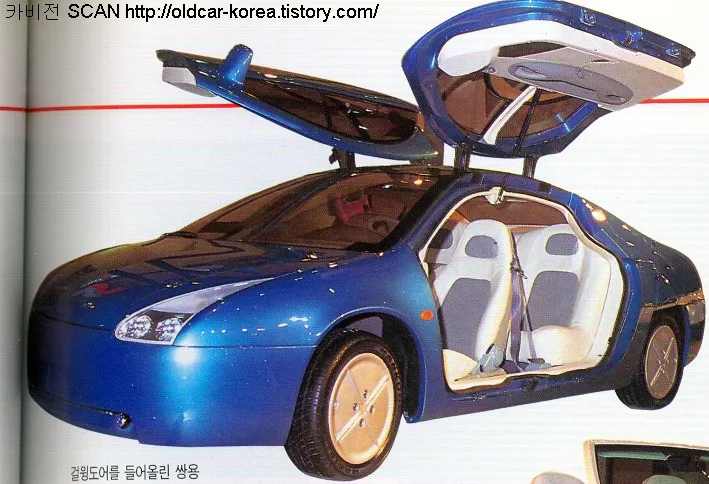
The gull-wing doors provided the most obvious visual statement. Hydraulically assisted doors rose upward from the body, complementing the CCR-1’s low roofline and teardrop-shaped profile.
The concept made its world debut at the first Seoul Motor Show in May 1995 at the Korea General Exhibition Center, now known as COEX. SsangYong displayed the CCR-1 alongside the CRS, another experimental vehicle, as the company sought to present a more technologically ambitious image.
The electric coupe subsequently traveled to Germany for its European debut at the Frankfurt Motor Show in September 1995. Its appearance there placed a South Korean electric sports-car concept before an international automotive audience at a time when battery-powered performance cars were still largely a curiosity.
The CCR-1, however, never progressed to production. The timing was particularly unfavorable. Within two years of its international debut, South Korea was engulfed by the Asian financial crisis. The economic shock placed enormous pressure on the country’s industrial groups and forced companies to concentrate capital on projects with clearer and more immediate commercial returns.
Why it didn’t happen
SsangYong Motor was already under financial pressure, and in 1998 the company was acquired by Daewoo Motors. Experimental programs were unlikely to receive priority as the business concentrated on its established SUV and commercial-vehicle operations, it remained a one-off prototype rather than becoming a limited-production electric sports car.
Its significance, however, extends beyond the vehicle itself. The project gave SsangYong engineers experience with aluminum space-frame construction, composite bodywork, electric propulsion, battery integration, aerodynamic efficiency and low-resistance tires at a time when the global EV industry was still in its infancy.
The prototype eventually became part of SsangYong’s institutional history, while the company itself went through several ownership changes before emerging as KG Mobility.
Decades after the CCR-1, KG Mobility returned to battery-electric vehicles with models such as the Korando e-Motion and Torres EVX. Those vehicles belong to a very different era, with lithium-ion batteries, modern power electronics and increasingly sophisticated charging infrastructure.
Specifications of CCR-1
Ssangyong
CCR-1
Propulsion / Vehicle type
Electric car
Motor
Motor type
MPBLS DC
Rated voltage (V)
DC 144
Rated output (HP)
50
Maximum torque
(kg.m/rpm)
20/5,000
Powertrain
Drive
MID MOTOR/Rear-wheel drive
Drivetrain
DIRECT COUPLING WITH MOTOR
Vehicle specifications
Total length (mm)
4,290
Width (mm)
1,840
Total height (mm)
1,300
Vehicle weight (kg)
1,212
Gross vehicle
weight (kg)
1,332
Maximum speed (km/h)
120
Constant speed fuel efficiency (km/l)
200 km/on a single charge (40 km/h)
Maximum number of passengers
4
Battery
Classification (1995)
DCM-24
Type
Pb-ACID
Capacity
12V-50A
Co-developer
Korea Battery Co., Ltd
Tire
Size
195/65VR15
Co-developer
Hankook Tire Co., Ltd