
Tesla drops out of top 10 ‘most innovative’ EV manufacturers; Mercedes gains ground
Rankings of the most innovative EV manufacturers in the world continue to be dominated by Chinese and German companies. The Center of Automotive Management (CAM) sees the Geely Group, the Volkswagen Group, BYD, Mercedes-Benz, and BMW among the top 10, while Tesla has dropped out.
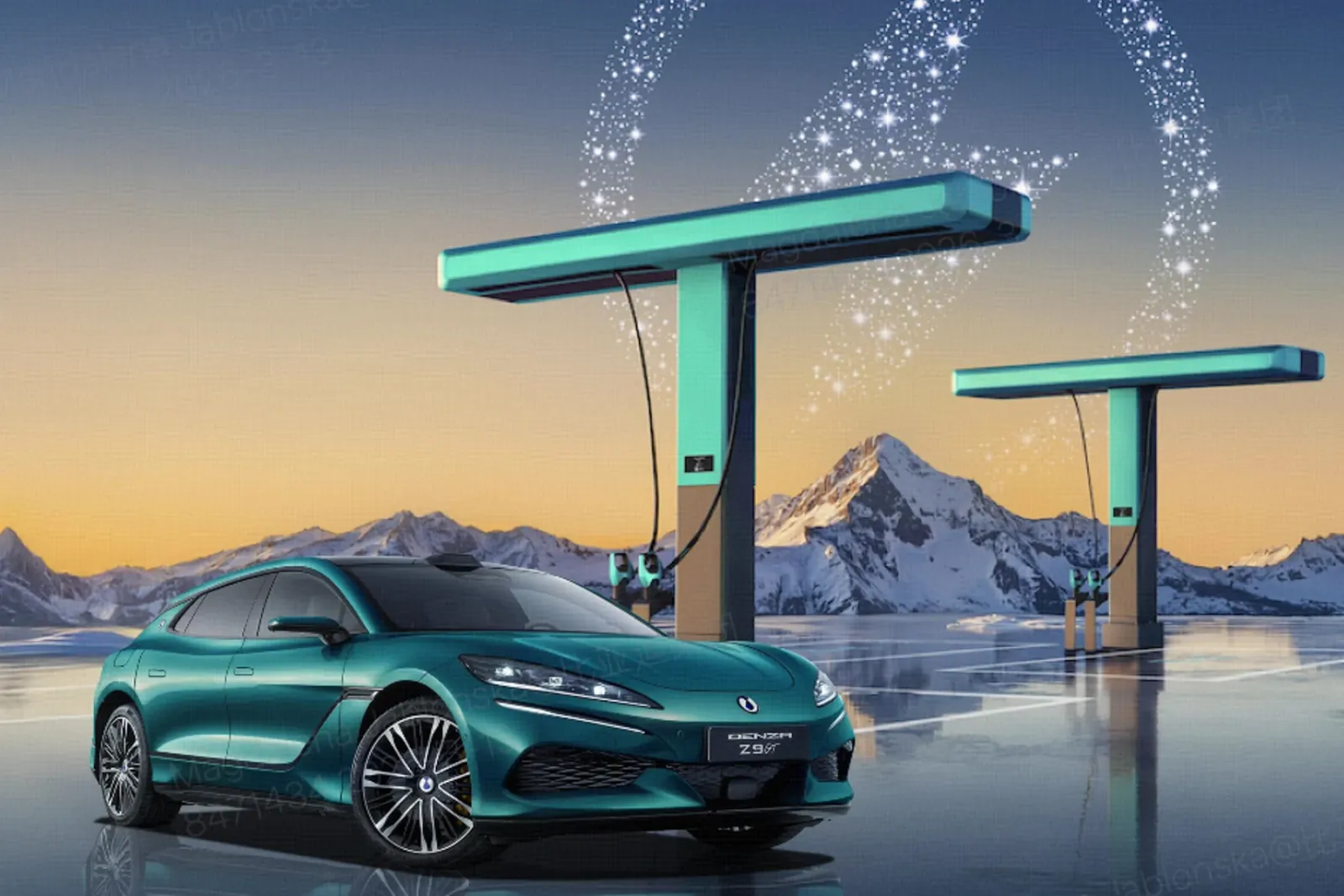
BYD's Flash Charger is among the mentioned innovations
Image: BYD
The Center of Automotive Management (CAM) in Bergisch-Gladbach, led by Prof. Dr. Stefan Bratzel, regularly publishes two report series. _Automotive Innovations_ focuses on innovations across all drivetrain types, with BYD taking the lead for the first time in April. Meanwhile, the newly released _Electromobility Report_ examines innovations exclusively in battery-electric vehicles.
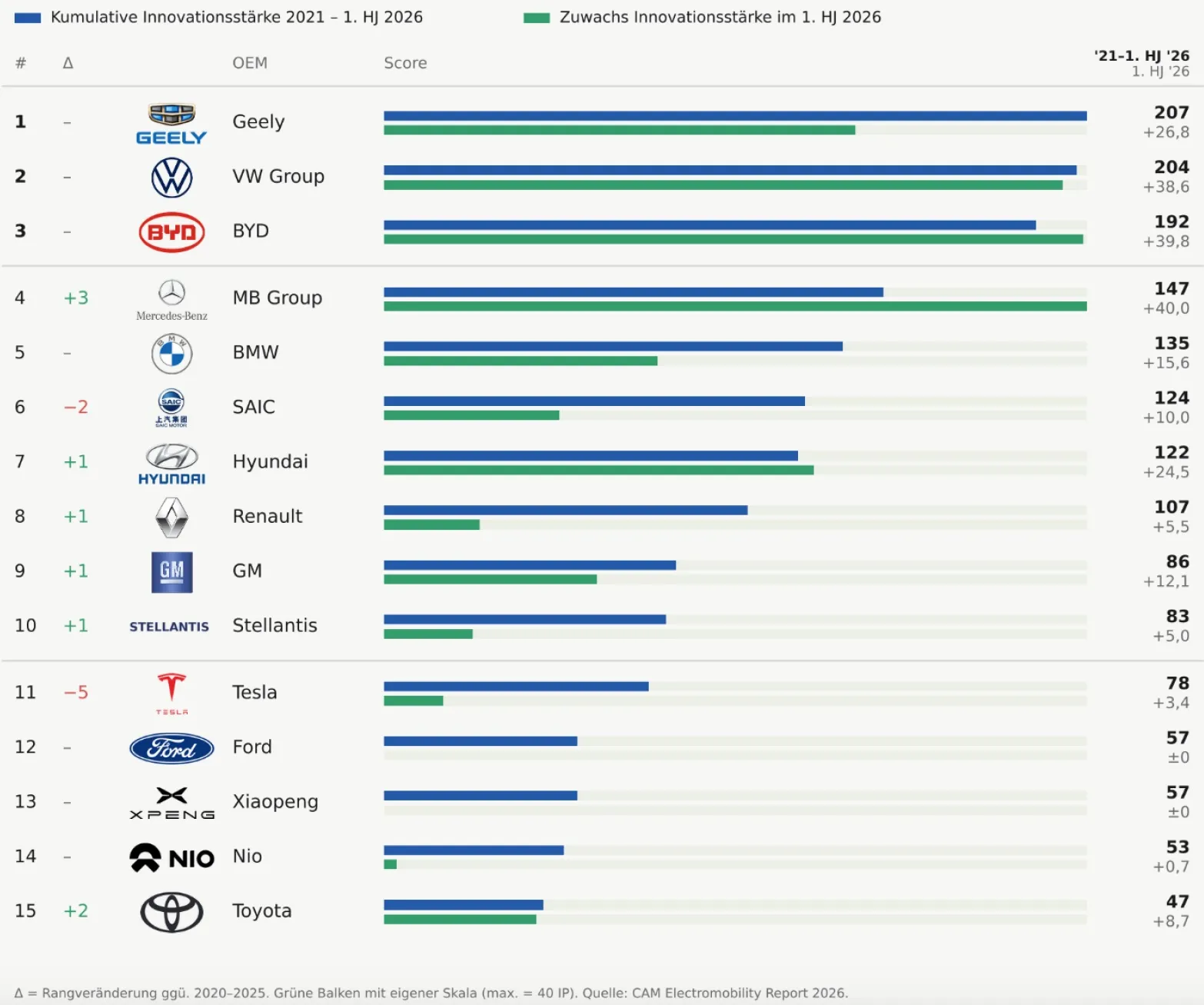
First, the top three positions remain unchanged compared to the last ranking from January. Once again, the Chinese Geely Group (207 index points, IP), the Volkswagen Group (204 IP), and BYD (192 IP) secured the top spots on the podium.
There was more movement further down the rankings: the Mercedes-Benz Group climbed three places to rank 4 with 147 IP. It is followed by BMW, SAIC, Hyundai, Renault, GM, and Stellantis, completing the top 10.
Tesla out of top 10 for the first time in a decade
Tesla, on the other hand, experienced a sharp decline: the US EV manufacturer dropped from 6th to 11th place, scoring 78 index points. Although this still represents an increase of 3.4 index points, other manufacturers overtook Tesla by introducing significantly more innovations in EVs. This marks the first time since the ranking’s introduction in 2016 – when Tesla topped the list – that the company is no longer in the top 10.
The CAM highlights several series innovations from the first half of 2026, with a particular focus on range, charging power, efficiency, and the electro-ecosystem (V2H, V2G). Mercedes, for example, stands out with the wide range of its models across various segments (EQS, VLE) and offers bidirectional charging functions similar to BMW. BYD is a pioneer in flash charging, achieving a charging power of up to 1,500 kW via a single charging port with the Denza Z9 GT. Elsewhere, the European version charges from 10 to 97 per cent in around nine minutes, even at minus 30 degrees Celsius. In terms of efficiency, the VW ID.3 Neo excels with its new APP350 electric motor, more efficient powertrain, and intelligent thermal management, delivering a segment-leading range of 629 km (WLTP) with a 79-kWh battery and consumption starting at 14.3 kWh/100 km.
Study leader Stefan Bratzel commented: “Leadership in electromobility innovation continues to be shaped primarily by Chinese and German manufacturers. Mercedes-Benz’s catch-up is particularly noteworthy, while Geely and BYD have demonstrated sustained high innovation strength. Tesla, however, is losing significant ground in the innovation race.
“The decisive factor is no longer just who offers electric vehicles, but who delivers the most compelling overall packages in terms of range, charging power, efficiency, and cost. Chinese manufacturers are increasingly showing that they can translate their technological strength into market share, even in Germany. A doubling of their new EV registrations is a clear warning signal for established manufacturers.”
Regarding methodology: the current study period from 2021 to the first half of 2026, CAM recorded and evaluated a total of 910 series innovations from 38 automotive manufacturer groups in the field of electromobility. The evaluation of innovations in electromobility focuses on the CAM triad, consisting of range, power consumption, and charging power, which are considered the central customer-relevant performance parameters of electromobility. Additionally, segment coverage (e.g., the first introduction of electric drivetrains in specific vehicle segments) and other innovation-relevant developments in electromobility are taken into account. These include advancements in battery technology, charging control, or related system components.
_Source: per email_