
Tesla and Pilot Travel Centers launch proprietary truck charging network
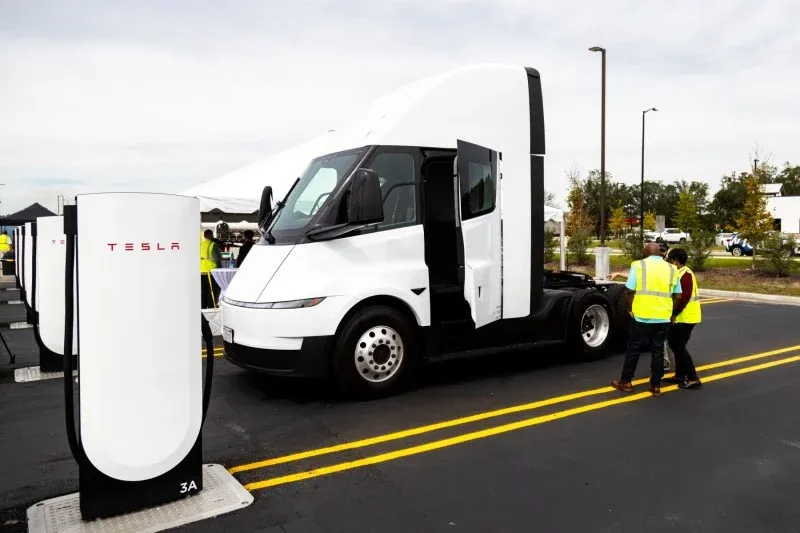
Pilot Travel Centers, the largest operator of truck stops in North America, has begun installing its proprietary charging stations for the Tesla Semi, as announced in January. The first six "Megachargers" have been commissioned at the Pilot rest area in Ellabell, Georgia.
Image: Pilot Travel Centers
According to Pilot Travel Centers, twelve additional locations are currently under construction, with three nearing completion and expected to be commissioned soon. Each site will feature four to eight charging stations powered by Tesla’s V4 charging technology.
“Pilot is proud to bring heavy-duty charging directly to key trucking routes and pair it with the services and amenities drivers rely on,” said Shannon Sturgil, senior vice president of alternative fuels at Pilot. “With these initial locations, we’re making fleet electrification a more accessible option for long-haul transportation and are excited to continue working with Tesla to move at the pace and preference of our customers.
The first six charging stations for heavy-duty vehicles are now operational at Pilot location No. 1390 in Ellabell (130 Interstate Exchange Way). According to Tesla, each charging point can deliver up to 1.2 megawatts of power. In January, Tesla and Pilot Travel Centers announced plans to install their proprietary truck charging stations primarily along Interstate 5 and 10, as well as several other major traffic corridors. Initial Pilot locations are set to be established in California, Georgia, Nevada, New Mexico, and Texas.
The agreement between Pilot Travel Centers and Tesla initially provides for the exclusive use of the truck chargers by Tesla customers, and the two companies have stated that the network will initially focus on providing charging infrastructure for Tesla’s Semi trucks. In the future, however, the charging stations could be opened to third-party brands, similar to what has happened with Tesla’s Superchargers in the passenger car sector.
The partners select the locations based on where the demand for charging stations for heavy vehicles is particularly high. Pilot Travel Centers operates over 900 locations across 44 US states and five Canadian provinces, serving an average of 1.2 million customers daily. Founded in 1958 and headquartered in Knoxville, the company is a wholly owned subsidiary of Berkshire Hathaway. Pilot Travel Centers is installing universally accessible truck chargers through an existing agreement with Volvo Group announced in 2022.
The turnkey solution for the planned truck charging network is Tesla’s 1.2 MW charging solution, announced last spring for the Semi, based on its proprietary V4 technology. The latter is also used by the manufacturer to enhance the performance of its passenger car chargers. The system consists of a decentralised setup with slim satellite chargers and a separate technical cabinet, known as the Powerunit. When scaled up, the technology can achieve the mentioned 1.2 MW, which is said to restore “the majority of the Semi’s 800-kilometre range in half an hour”.
In an earlier press statement, Dan Priestley, Head of the Semi Programme at Tesla, noted that most of the internal components between Tesla’s passenger car and truck chargers are identical and only the cable, plug, and a few other minor details have been adapted for high-power applications. He said this strategy allows Tesla to leverage its volume and scaling to enable charging at a lower cost.
Compared to current charging solutions for electric trucks, Tesla’s system is said to reduce space requirements by over 50 per cent due to its decentralised design. However, the full 1.2 MW is only available when a single vehicle is charging. Fundamentally, the solution can use power-sharing to charge up to eight vehicles at correspondingly lower power levels.
In parallel, Tesla is also building its own public 1.2 MW Megachargers in North America. The first location was opened in July at a new charging park in Bloomington, California, also featuring six charging stations. Tesla’s website charging map now lists five locations: three in California (Bloomington, Vernon, Tulare) and two in Georgia (Conley and Ellabell).
At the same time, Tesla has recently begun delivering the Semi in larger quantities, and the first major orders in the hundreds and thousands are coming in— including 2,500 units for the new US-based shippers’ alliance called ZET SCALE and 500 units for Einride. The Semi’s market launch marks the end of a long period of delayed rollouts. Unveiled in 2017 and initially promised for 2019, the Semi only actually went on sale in 2026.