
T&E study predicts strong competition for EU electric truck market
Ahead of IAA Transportation, a new T&E analysis warns that European truck manufacturers could face significant competition by 2030. According to the report, a quarter of the electric truck market could be lost to new competitors from China and the US within three years.
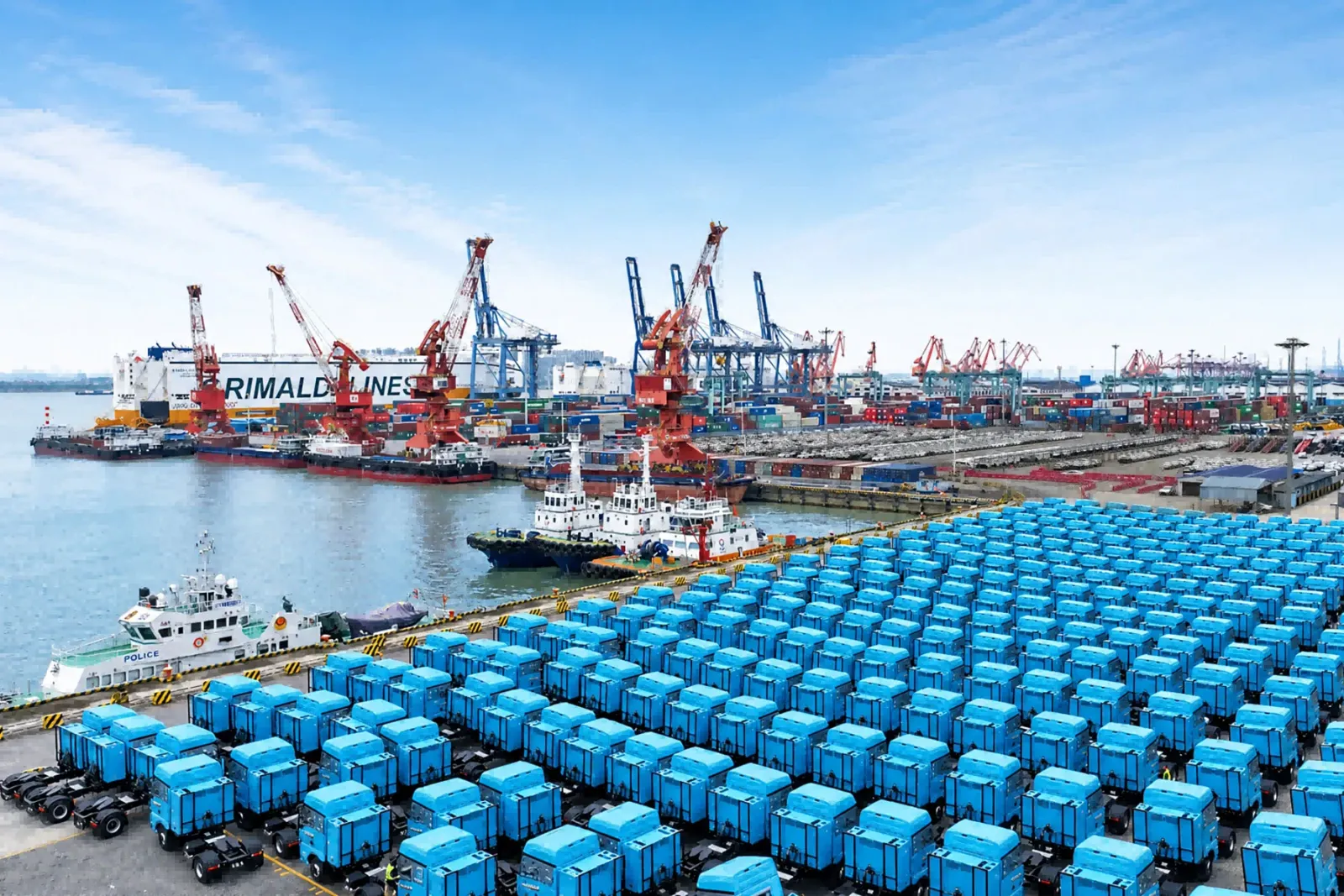
Electric Sany trucks ready for shipping.
Image: SANY Truck
The organisation Transport & Environment (T&E) has published a competitive analysis on the development of the European electric truck market. For this study, the researchers examined costs, technical requirements, and manufacturer targets, using these findings as the basis for their modelling. The context is that the EU truck market, with an annual volume of 245,000 vehicles, is currently dominated by a few established manufacturers – namely Daimler Truck, Traton with its subsidiaries Scania and MAN, Iveco, DAF, and the Volvo Group with its subsidiaries Volvo Trucks and Renault Trucks. At the same time, the share of electric trucks is rising: although it remains at a very low level, the growth rates are so strong that electric trucks are expected to account for an increasingly significant proportion of new registrations in the coming years.
T&E has taken a closer look at this segment in its modelling. The key message of its analysis: Chinese and US truck manufacturers could capture a quarter of the European electric truck market by 2030 if domestic manufacturers do not accelerate electrification. T&E states verbatim: “Maintaining ambition of the truck CO2 standards will be critical to EU manufacturers remaining market leaders.” In other words, the analysts advise a proactive approach to electrification.
Third country importers eye EU expansion
This year, a number of commercial vehicle manufacturers from China – some new, some established – have registered for IAA Transportation (read more in our comprehensive e-truck trade fair overview). These manufacturers – including Sany, Sinotruk, SuperPanther, FAW Trucks, Foton, and others – will primarily enter the European market with electric trucks. Some are startups, while others are established manufacturers with decades of industrial experience. Additionally, these players may benefit from a head start in experience due to China’s more mature electric truck market.
From across the Atlantic, Tesla has announced serious expansion plans for Europe as the first US manufacturer of electric trucks. However, since the technical details and prices for the European version of the Tesla Semi will only be revealed at the trade fair, little can be said about its market positioning at this stage. Consequently, T&E specialists have had to rely on US specifications of the Tesla for their analysis. This is one weakness of the study: when it comes to the prices and technical specifications of future competing models, as well as the manufacturers’ goals, the analysts are inevitably relying on information that, in some cases, is still incomplete or has only been briefly teased so far.
It is important to keep this in mind when considering the results. In its analysis, T&E concludes that the total cost of ownership of a Chinese electric truck could be up to 12 per cent lower compared to an equivalent European model – which could equate to “a saving of up to €43,000 over five years”. As part of this estimate, the study team examined typical heavy-duty 4×2 tractor units for long-haul transport purchased in Germany in 2026 (assuming a discount rate of 9.5 per cent). Here is the associated graphic:
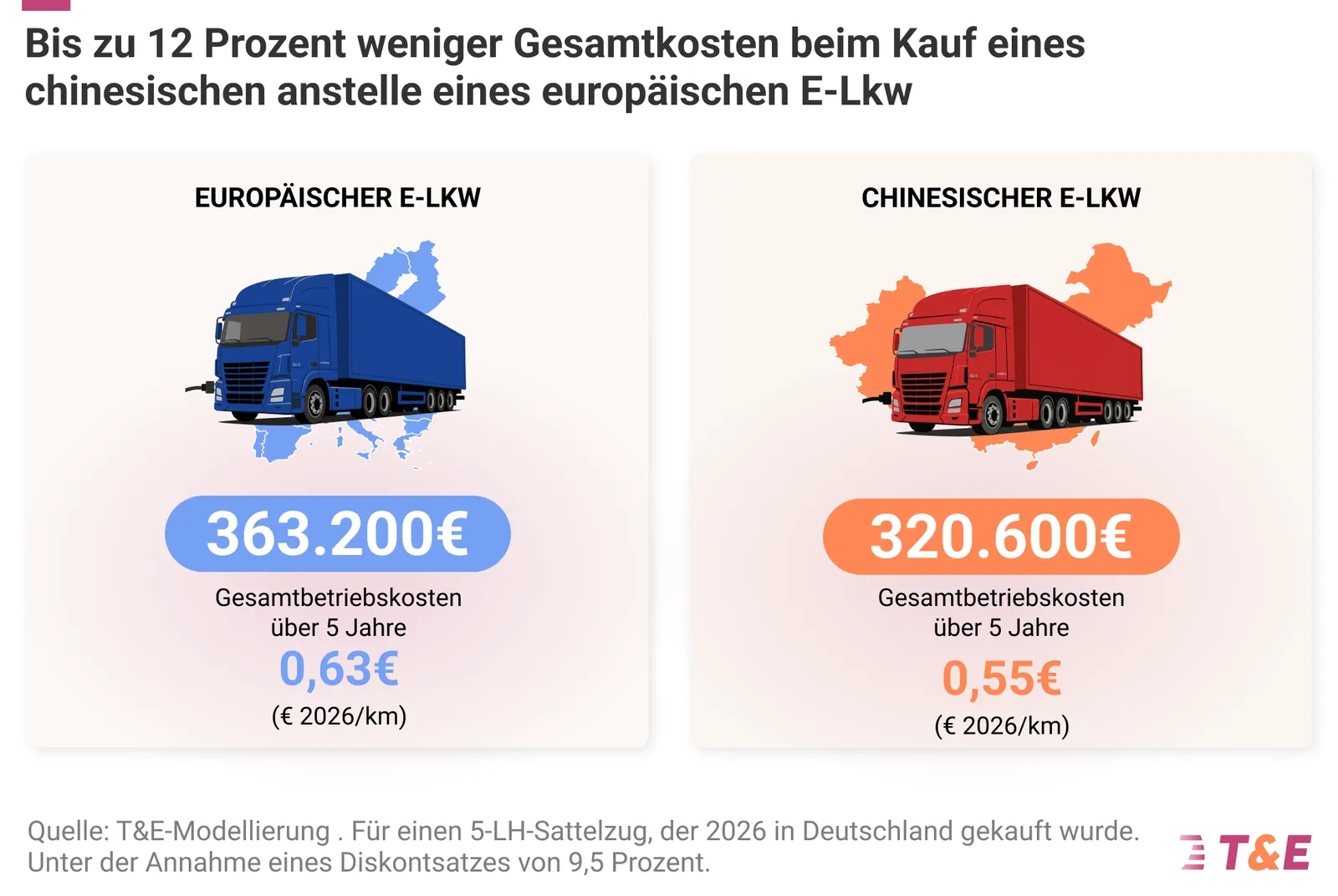
This lower TCO could be decisive for potential customers, especially since “electric trucks from new entrants perform as well as European trucks on key metrics, including driving range, charging time, maximum payload, and energy efficiency,” the T&E report continues. And: “new entrants hope to gain up to a quarter of the heavy e-truck market by 2030.” This can be inferred from their stated goals for the European electric truck market.
Johanna Braun, Manager of E-Mobility for Trucks and Infrastructure at T&E Germany, concludes: “Competitive electric trucks from China and the US are already entering the European market, with more models announced. At this critical juncture, truck manufacturers should learn from the mistakes of the automotive industry. Slowing down electrification now would pave the way for competitors from the US and China. They could gain a significant market share in Europe and worldwide.”
Customers with high cost sensitivity
T&E bases this hypothesis on the premise that customers primarily consider cost factors when making investment decisions for trucks. A reduction in total cost of ownership of more than 10 per cent could be decisive in the transport industry, which operates on razor-thin profit margins of just 1.5 to 2 per cent. “A German transport operator today, opting for an electric truck from a new entrant instead of a European model, could bring the TCO down from €0.63/km to €0.55/km (including residual value),” the analysts explain.
As is typical for T&E, the organisation links its study findings with warnings and policy recommendations. Given the market’s domination by a few players, new, competitive entrants could quickly capture a large market share by offering comparable quality at lower prices, the T&E team writes. The ongoing ramp-up of electric trucks in the EU is, in its view, closely linked to the CO₂ fleet emission standards for trucks that have applied since July 2025 and falling battery prices. The organisation therefore calls on the German federal government to advocate for the retention of ambitious CO₂ fleet emission standards for trucks at the EU level in Brussels.
Johanna Braun summarises: “The race for market leadership in electric trucks is in full swing. Chancellor Friedrich Merz should advocate for ambitious decarbonisation targets at the European level if he wants to prevent a similar crisis in the truck sector to the one we are currently seeing in the automotive industry. Increased competition can benefit logistics companies and consumers. European manufacturers should stop resisting fleet emission standards and, like their new competitors, consistently focus on electric trucks.”