
SNE Research: Chinese OEMs increasingly dominate global EV battery market
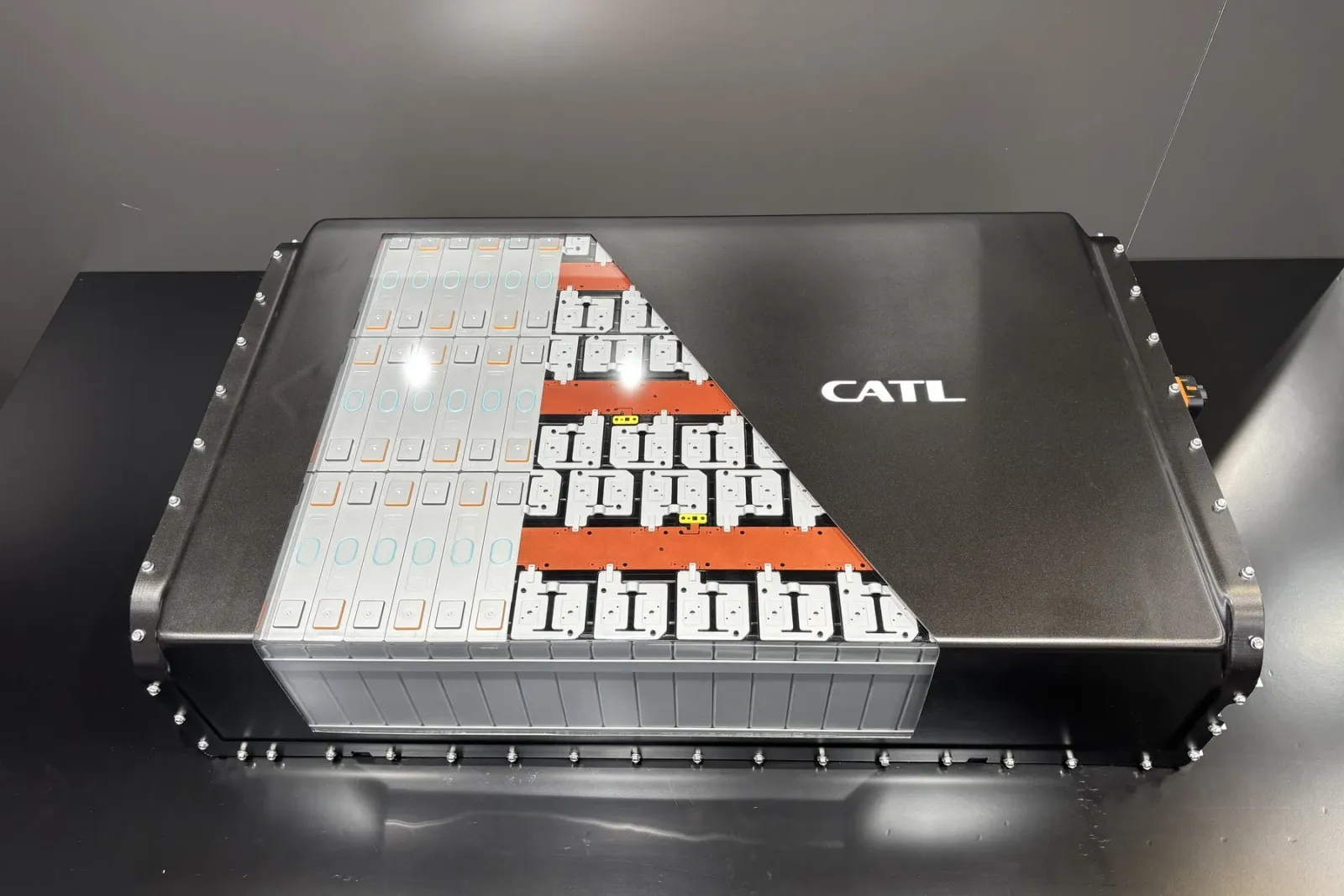
In the first nine months of this year, Chinese manufacturers secured more than half of the battery market for electric and hybrid vehicles outside China - while Korean and Japanese suppliers lost ground. This is according to a new analysis by SNE Research.
Image: Cora Werwitzke
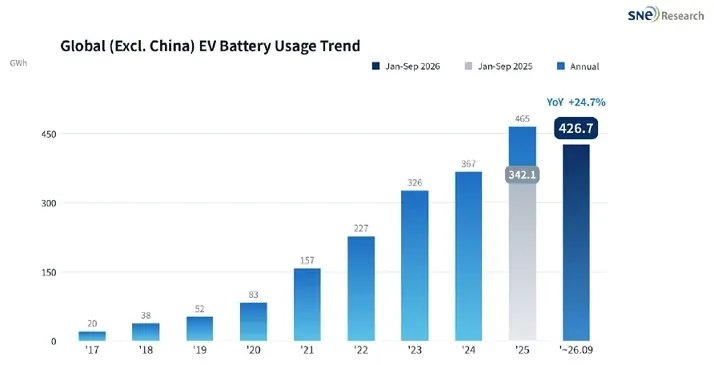
South Korean market research firm SNE Research has analysed the dynamics and market share distribution of the EV battery market outside China. The key finding: the total capacity of these batteries climbed to 426.7 GWh from January to September. The market thus grew by 24.7 per cent compared to the same period the previous year. The clear beneficiaries are Chinese battery manufacturers.
“The combined market share of the six Chinese companies, including [CATL, BYD, Gotion, SVOLT, CALB and EVE] rose 13.3 per cent from 43.1 to 56.4 per cent, exceeding half of the non-China market,” writes SNE Research. CATL and BYD alone account for 44.5 per cent of the market. In the same period in 2023, this figure was still 36.7 per cent.
SNE Research specifically analysed the sales of batteries for battery-electric vehicles (BEVs), plug-in hybrids (PHEVs), and other hybrids, highlighting that regional demand developed differently. The Korean analysts note that demand in Europe and Asia compensated for the ongoing weakness in North America. Interestingly, China itself also appears to be faltering. While SNE Research certifies 24.7 per cent growth for the global market excluding China, the increase including China is only 19.7 per cent. Overall momentum is thus slowing in the People’s Republic.
The following figures are available for the manufacturers themselves: The three Korean manufacturers – LG Energy Solution, SK On and Samsung SDI – contributed a total of 113.0 GWh worldwide (excluding China) from January to September, a decline of 13.5 per cent compared to the previous year. Their combined market share fell sharply by 11.7 percentage points, from 38.2 per cent to 26.5 per cent. According to SNE Research, business in North America crumbled in particular, where the installed battery capacity of the trio nearly halved from 56.1 to 28.1 GWh. In Europe, however, there was a slight increase (from 58.7 to 63.0 GWh), as well as in Asia (from 13.1 to 17.5 GWh).
But let’s take it step by step. After the first nine months, CATL once again leads the ranking. Outside China, the company achieved a volume of 143.7 GWh, which corresponds to exactly one-third of the market. Compared to the previous year, CATL grew by 47 per cent. Its market share increased by 5.1 percentage points to 33.7 per cent. For Europe, SNE Research statistics show a 35 per cent increase from 71.5 to 96.8 GWh, while in Asia, the volume doubled to 27.1 GWh.
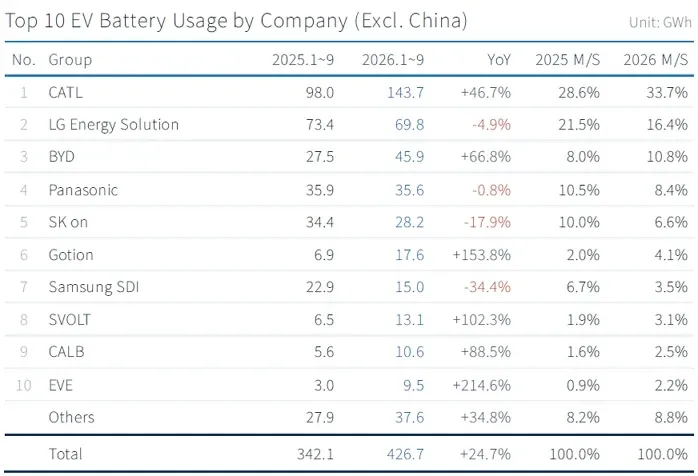
According to the analysts, LG Energy Solution maintains second place with 69.8 GWh (-4.9 per cent year-over-year). Its business in Europe and Asia developed positively. In Europe, it increased by 13 per cent to 38.6 GWh, and in Asia by 49 per cent to 11.1 GWh. However, this was not enough to offset the sharp decline in North America (-45 per cent year-over-year, from 29.9 to 16.5 GWh). LGES’s market share fell significantly by 5.1 percentage points, from 21.5 per cent to 16.4 per cent.
Next is BYD – with 45.9 GWh (+67 per cent year-over-year) – in third place. The company’s market share grew from 8.0 per cent to 10.8 per cent. According to SNE Research, this growth was distributed across Europe (17.4 GWh, +67 per cent year-over-year), Asia (14.8 GWh, +41 per cent year-over-year) and South America (7.1 GWh, +136 per cent year-over-year).
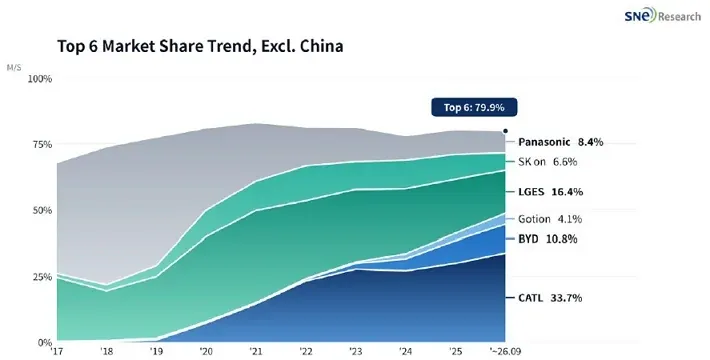
Panasonic ranks fourth after the first nine months of the year with 35.6 GWh (-0.8 per cent year-over-year). “Tesla’s North American volumes supported its results, but growth fell well short of the non-China market,” the authors said. Panasonic’s market share fell by 2.1 percentage points to 8.4 per cent. Looking further back, Panasonic’s example particularly illustrates how much the market has changed in recent years:
Meanwhile, SK On in fifth place recorded significant losses, with its volume dropping to 28.2 GWh (-18 per cent year-over-year). Its market share plummeted from 10.0% to 6.6 per cent. “The company supplies batteries to Hyundai Motor Group, Ford, Volkswagen, and Mercedes-Benz, among others, but its usage declined 46.7 per cent in North America and 2.2 per cent in Europe,” the study states.
VW partner Gotion grew by 153.8 per cent to 17.6 GWh, thereby overtaking Samsung SDI, which slipped to seventh place. Samsung SDI recorded only 15.0 GWh (-34.4 per cent year-over-year) – the sharpest decline among the top 10. Its market share fell from 6.7 per cent to 3.5 per cent. While sales in Europe remained stable at 9.4 GWh, Samsung SDI experienced a debacle in North America (-66 per cent year-over-year, from 12.0 to 4.1 GWh).
The top 10 is rounded out by three second-tier Chinese suppliers – namely SVOLT, CALB and EVE Energy. SVOLT grew by 102 per cent to 13.1 GWh, CALB by 88.5 per cent to 10.6 GWh, and EVE Energy achieved a massive increase of 215 per cent to 9.5 GWh.
In summary, it can be concluded that the three Korean manufacturers and Panasonic each had to cede market share in the global market excluding China, while the six mentioned Chinese companies consistently and rapidly expanded their volume in Europe. A major factor here is cell chemistry: “The LFP share of the non-China market rising 11.9 per cent from 15.8 per cent to 27.7 per cent reflects the same trend. In North America,” the SNE research analysts stated. This is because it is primarily Chinese manufacturers that are leading the way in LFP technology. In Europe, the adoption of LFP is increasing – “mainly in entry-level models, making price competitiveness a key criterion in supplier selection,” they added.
Based on the data, the study’s authors believe that regional political frameworks and the diversification of demand will primarily determine the competitiveness of suppliers. Some manufacturers are now increasingly shifting to batteries for stationary storage to achieve greater diversification – particularly in North America. With regard to Europe, the analysts consider the Auto Package and the associated incentive of the so-called combustion engine phase-out, as well as potential ‘Made-in-Europe’ rules, to be a decisive influencing factor.