
ProLogium and Rimac target 2028 for solid-state battery vehicle tests
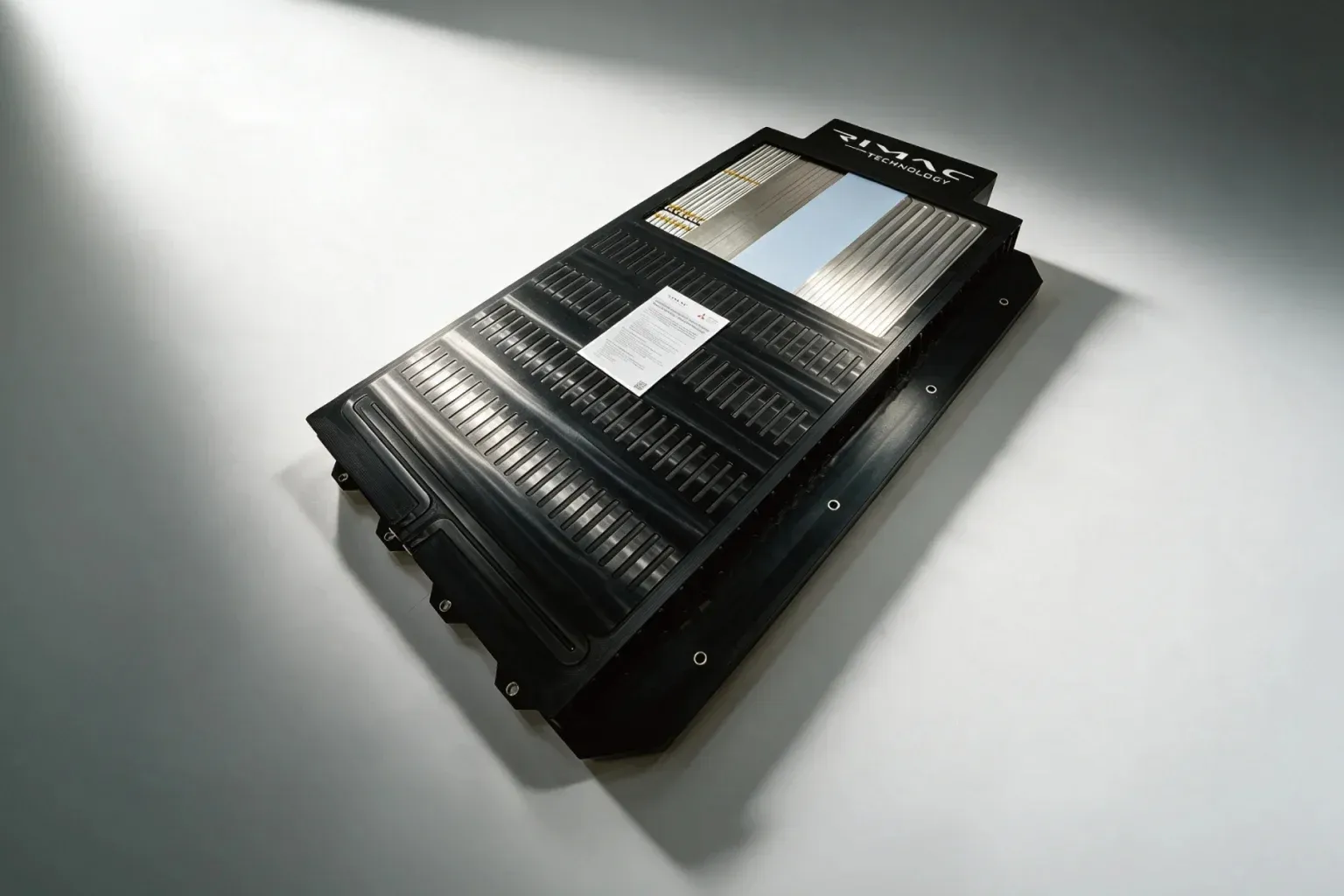
ProLogium and Rimac Technology are continuing to move forward with their next-gen battery collaboration. At the Paris Motor Show, the partners are initially showcasing a pack mockup; functional hardware and a complete battery pack are expected to follow in 2027, with the first vehicle tests planned for 2028.
The battery pack is still a mockup; the hardware is expected to follow in 2027.
Image: ProLogium
In Paris, the two companies have unveiled a concept mock-up of the planned battery pack for the first time. The next step of development is a functional battery segment, which will be used to test thermal management, cell integration and pack architecture, among other aspects.
The focus is on a cell-to-pack architecture for pouch cells. Rimac Technology describes it as a scalable integration solution for solid-state pouch cells. ProLogium contributes its cell technology, while Rimac handles system development and integration.
However, this is explicitly not yet about a near-series battery pack. The companies are pursuing a multi-stage development path: following the current mock-up, a functional battery segment will be developed first, then a fully functional battery pack, and finally integration into a vehicle.
The technical core of the collaboration lies at the system level. High energy densities at the cell level cannot automatically translate into a lighter or more compact vehicle battery system. Only the pack design, cooling, mechanical integration and safety concept determine which advantages actually benefit the vehicle.
Thermal management and cell integration in focus
Rimac is therefore investigating several integration variants in parallel. These include different approaches to thermal management, handling cell swelling, mechanical cell integration and system design. Some concepts aim primarily at maximum energy density and reduced installation space or weight, while others focus more on high performance. According to Rimac, the goal is to develop the battery from the vehicle perspective: components and functions should be consolidated, complexity and weight reduced, while simultaneously maintaining high levels of charging power and performance output.
If the approach proves successful at the vehicle level, manufacturers could utilise the weight advantages in various ways. Possible options include more energy – and thus greater range – with the same battery weight, a smaller and lighter battery pack with the same range, or hybrid solutions combining both approaches.
ProLogium CEO Vincent Yang emphasises that the step from the cell lab to the vehicle goes far beyond good cell performance. Only integration into a battery pack tailored to thermal, architectural and mechanical requirements makes the technology usable for electric vehicles.
Functional segment in 2027, road tests in 2028
There is already a timeline for the further development steps. According to Rimac Technology, the functional battery segment currently under development will be showcased at CES 2027. A fully functional battery pack is then planned for the second half of 2027.
In the second half of 2028, vehicle tests on public roads are finally set to begin. This would gradually expand the validation of individual integration concepts up to full-scale vehicle deployment. ProLogium itself refers to its latest cell generation as the “Superfluidized Inorganic Next-Generation Lithium Ceramic Battery”. The technology is said to combine properties of solid-state and liquid electrolyte concepts while remaining industrially scalable.
The fact that ProLogium’s cell technology is already generating interest from major manufacturers is also evident from its collaboration with Mercedes-Benz. Since September 2026, Mercedes has been testing ProLogium’s Gen4 cells in its own and external testing facilities for electrical, thermal and safety-relevant properties. A decision on series production has not yet been made.
For the European supply chain, ProLogium’s expansion in France is also relevant. A gigafactory is currently under construction in the French city of Dunkirk, with the first phase designed for an annual production capacity of 4 GWh. This capacity is to be gradually increased by 2030. In the long term, the site is planned to reach up to 44 GWh per year.
As early as 2024, ProLogium also opened a research and development centre in Paris-Saclay. This is intended to more closely link development and future production in France.
Rimac Technology is also expanding its role as a battery system supplier. For BMW, the Croatian company is developing and producing a new high-voltage storage system for the revised i7. There, Rimac combines cylindrical Gen6 cells in the 4695 format with a Gen5 module design; the finished battery systems are produced in Croatia and delivered to BMW’s Dingolfing plant.