
Kia introduces larger PV7 electric van with 800-volt technology
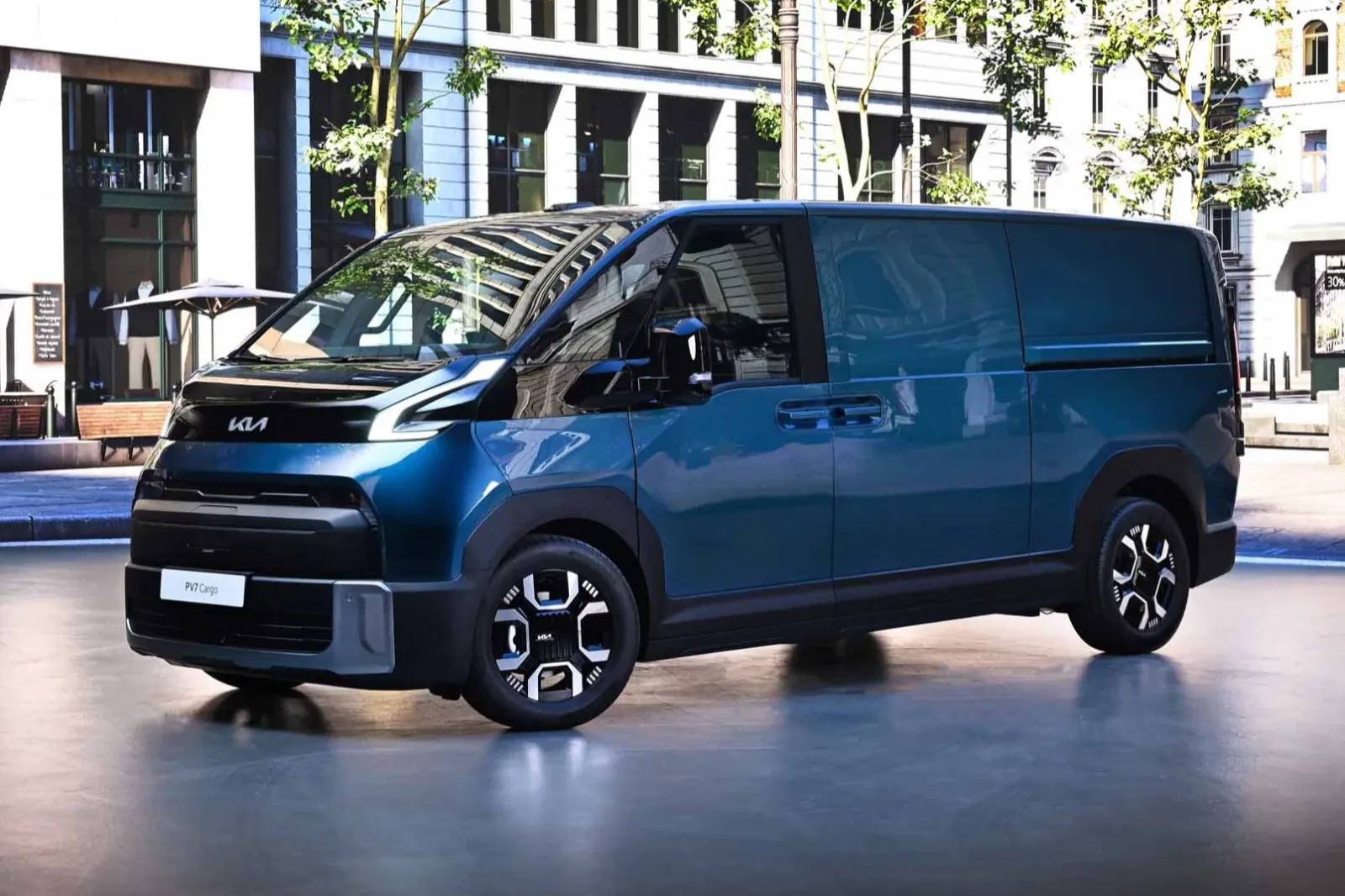
Kia has unveiled the PV7 at the IAA Transportation. Compared to the PV5, the second representative of the PBV strategy not only grows in dimensions, cargo space, and battery energy content but also switches to 800-volt technology. In Europe, the PV7 is set to launch in the second half of 2027.
Image: Kia
Kia’s intention to enter the light commercial vehicle market has been clear since the company presented its “Platform Beyond Vehicle” (PBV) future strategy at the beginning of 2024. The first step was the small electric van PV5 – available as a Passenger (see our test drive report) for passenger transport or as a Cargo for goods transport.
With the PV7, Kia is now moving up a class in the electric light commercial vehicle segment. Kia itself conceptually differentiates the two models with the PV5’s so-called “Open Box” concept, primarily designed for flexibility in urban use, and the PV7’s “Tool Box” approach. The larger van was developed to offer more cargo space and payload for more demanding applications and larger-scale operations.
Significantly larger than the PV5
Like the PV5, the PV7 is not based on the familiar E-GMP passenger car architecture but on the new E-GMP.S (“Electric Global Modular Platform for Service”), specifically tailored to commercial applications.
However, the shared platform should not obscure the fact that the two models compete in different vehicle classes. The long-wheelbase version of the PV7 has a length of 5.35 metres, a width of 1.995 metres, and a height of 1.99 metres. The wheelbase is 3.50 metres. In comparison, the long PV5 L2 is 4.67 metres long and has a wheelbase of three metres. A shorter standard version of the PV7 has been announced, but the South Korean company has not yet specified its dimensions or cargo volume.
Two batteries, front-wheel drive at launch
Depending on the market and configuration, the standard front-wheel-drive model delivers up to 200 kW and produces 420 Nm of torque. An all-wheel-drive variant is set to follow at a later date. The drivetrains are to be combined with two batteries featuring NMC cell chemistry, with energy capacities of 71.5 and 96.2 kWh. For the PV7 Cargo with the larger battery, Kia quotes a range of up to around 460 kilometres, based on internal measurements according to WLTP criteria – homologation is still pending. In the international version of the announcement, Kia states more than 460 kilometres at the same point.
The PV5 now offers battery options ranging from 43.3 to 51.5 and 71.2 kWh. The 51.5 and 71.2 kWh variants deliver 89 and 120 kW, respectively, each with 250 Nm of torque, while the 43.3 kWh version produces 111 kW. For the PV5 Cargo, the maximum range with the largest battery is 416 kilometres according to WLTP.
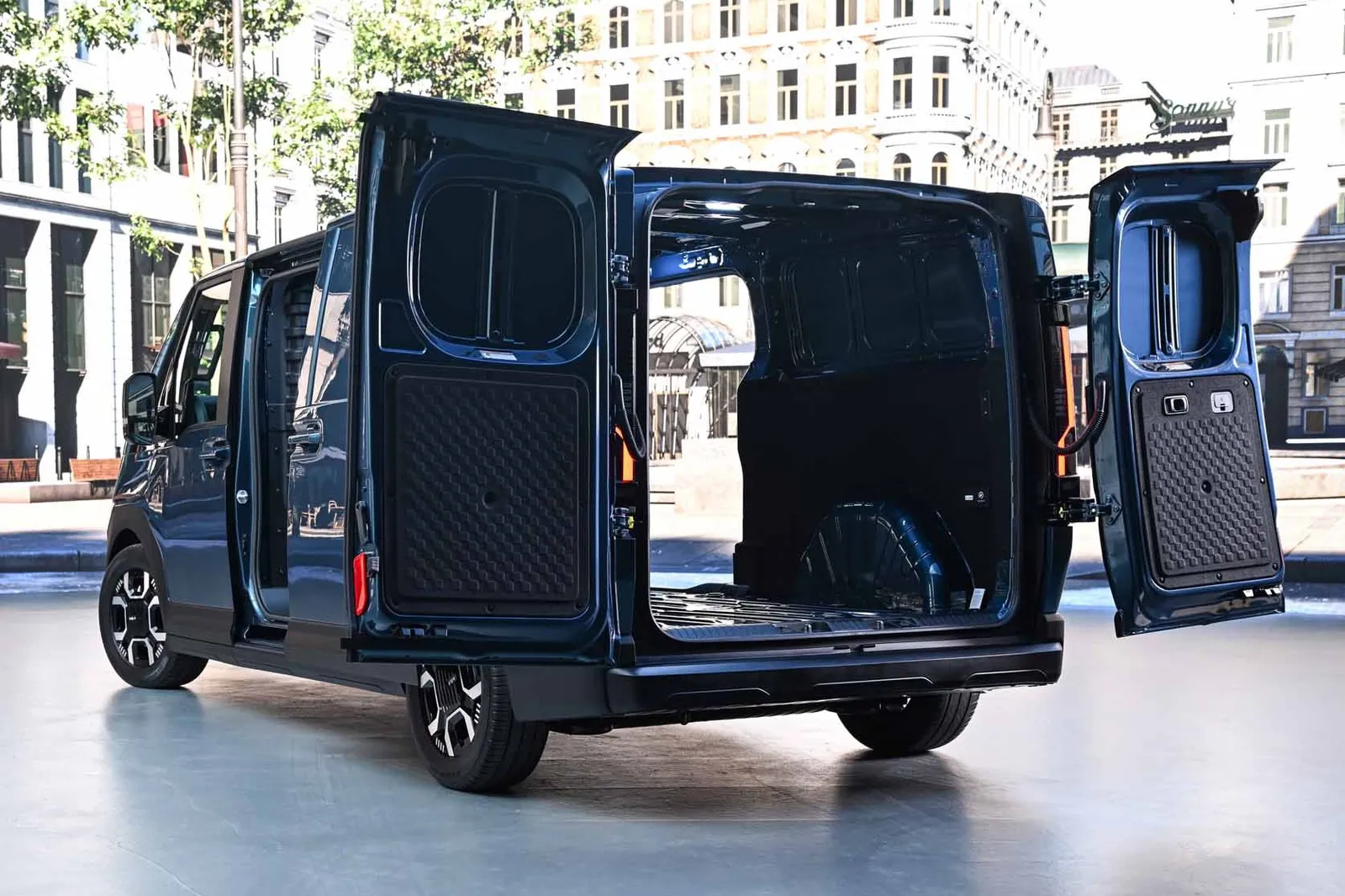
Image: Kia
- 1/11
- 2/11
- 3/11
- 4/11
- 5/11
- 6/11
- 7/11
- 8/11
- 9/11
- 10/11
- 11/11
800 volts instead of 400 volts
There is another difference in the charging technology. The smaller van operates at 400 volts, with all three batteries requiring around 30 minutes to charge from ten to 80 per cent. The PV7 uses an 800-volt architecture and is said to charge from ten to 80 per cent in around 25 minutes at a 350 kW charging station. Kia has not disclosed whether this figure applies to both battery sizes, nor has it specified the vehicle’s maximum DC charging power. There are also no details yet on the AC charging power.
A special feature is the two charging ports: one at the front with a combined AC/DC port, and an additional AC port optionally available at the rear. According to Kia, the PV7 is the brand’s first electric vehicle to feature this solution, designed to save manoeuvring space in tight depots and at roadside charging points. The vehicle also provides 230-volt sockets inside and outside via the V2L (vehicle-to-load) function.
Up to eight cubic metres and 1.2 tonnes of payload
The increased external dimensions are particularly noticeable in the Cargo version. The long-wheelbase version with a standard roof height offers up to 6.1 cubic metres of cargo space according to VDA standards, providing room for up to three Euro pallets. The high-roof version is said to offer up to 8.0 cubic metres. By comparison, the PV5 Cargo L2H1 has 4.42 cubic metres, while the already announced PV5 L2H2 with a high roof offers over five cubic metres. The short PV5 L1H1version has 4.03 cubic metres.
The increase in payload is similarly significant. Kia quotes a maximum payload of 1,165 kilograms for the long-wheelbase PV7 Cargo and 1,200 kilograms for the shorter standard version. For the PV5 Cargo, the payload ranges from 605 to 800 kilograms depending on the body, battery, and equipment – the best figure applies to the short version with the mid-range 51.5 kWh battery in basic trim, while the long-wheelbase version with the large battery and full equipment is at the lower end. Compared to the respective maximum values, the PV7 offers a 50 per cent increase. Kia has not yet disclosed the permissible gross vehicle weight – for the PV5 Cargo, it is 2,650 kilograms.
The loading edge is at 550 millimetres, which is noticeably higher than the PV5’s 399 millimetres at the side and 419 millimetres at the rear. Kia’s advertising claim of a low loading edge height therefore refers to the larger vehicle class, not its own model range. For heavy freight, there is a driving mode that adjusts the vehicle control to the payload. The Cargo is offered with two or three seats. At the rear, there is a choice of double doors or an upward-swinging tailgate. A partition with a load-through option is reserved for the three-seater version.
Nine seats in the passenger version
The PV7 Passenger has been developed for personnel transport, shuttle and rental car services, tourist services, and as a family vehicle. In Europe, the model will be available with up to nine seats, while in Korea, it will even be offered with eleven.
In the seven-seater, the seats are said to slide on long rails and be removable, while the nine-seater will be available with or without a fourth row of seats. This positions the PV7 above the PV5 in passenger transport, as the latter’s Passenger range in this country is limited to variants with up to seven seats.
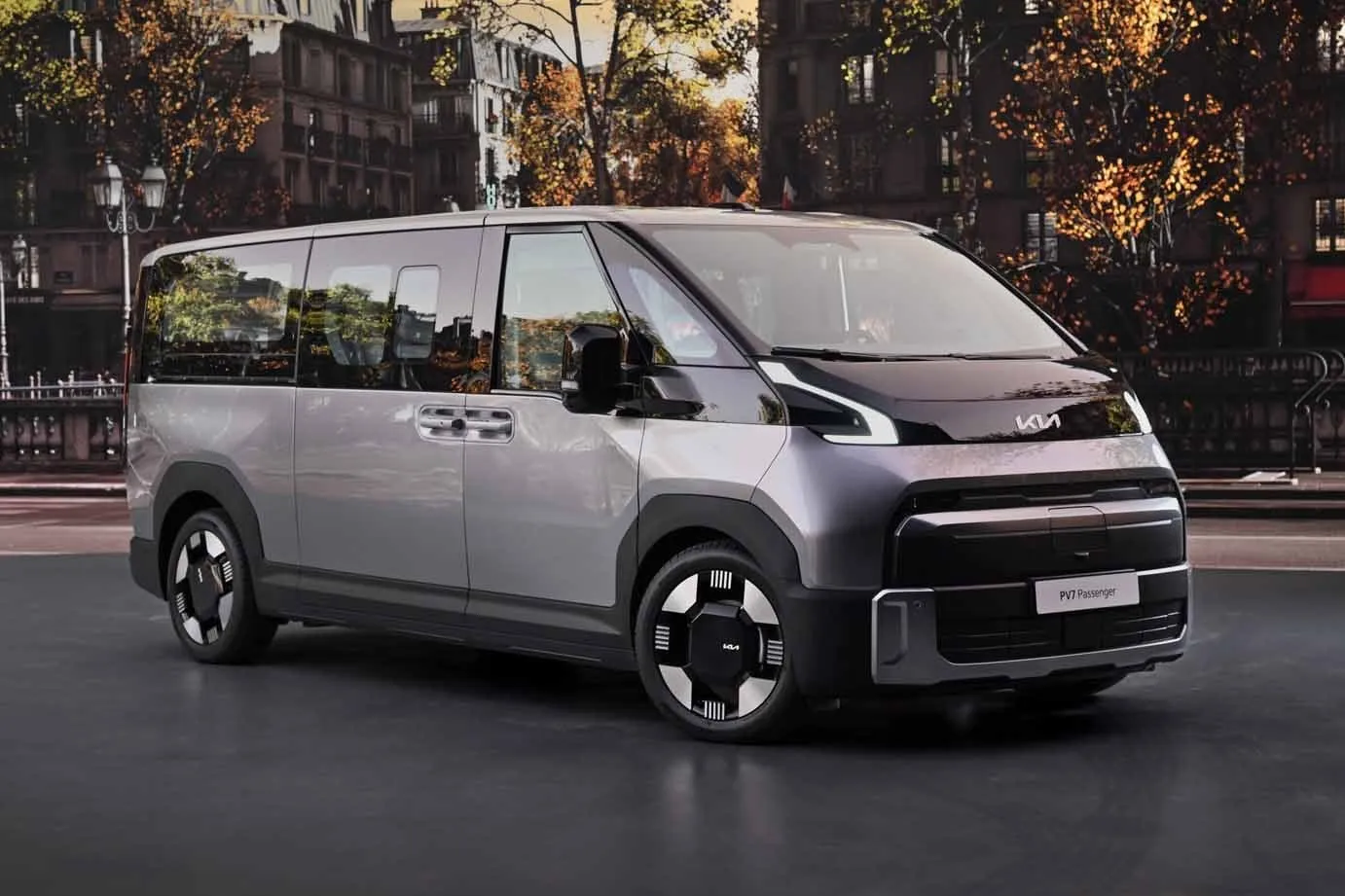
Image: Kia
- 1/8
- 2/8
- 3/8
- 4/8
- 5/8
- 6/8
- 7/8
- 8/8
In the cockpit, the Pleos Connect infotainment system, based on Android Automotive OS, operates with an open app marketplace, over-the-air updates, and the Gleo AI voice assistant. It also features displays of 12.9 and 14.6 inches. For commercial customers, Kia bundles a fleet management system, interfaces for connected vehicle data, and uptime services for predictive diagnostics and maintenance under the name Business Solutions.
Modular body for 23 variants
In the long term, the PV7 range is set to grow to a total of 23 variants. These include three Cargo versions (standard, long, and high-roof), two Passenger variants, a Chassis Cab, and various conversions. This diversity is made possible by the Flexible Body System (FBS), a modular body architecture that allows body variants, derivatives, and conversion models to be developed on a standardised vehicle structure.
At its Hannover trade fair stand, the South Korean company is initially presenting only three PV7 variants – a long-wheelbase PV7 Passenger and two long-wheelbase PV7 Cargo versions. However, the mentioned high-roof version and the standard version, which has so far only been announced, are not on display. Prices for the PV7 have not yet been announced. Kia also intends to release the final technical data for the German market closer to the launch date.
In addition to the PV5 and PV7, the model range is also set to expand further upwards. For 2029, the next member of the PBV family, the even larger PV9, has already been announced.
_Source: Info per E-Mail_, kia.com