
Industrial Accelerator Act: industry may fail to meet battery demand in EU
The EU is currently debating a draft of the 'Industrial Accelerator Act' (IAA), which aims to boost production and competitiveness within the Union. The ACEA has now presented a study examining whether the European battery supply chain would even be capable of meeting the requirements of this legislative package.
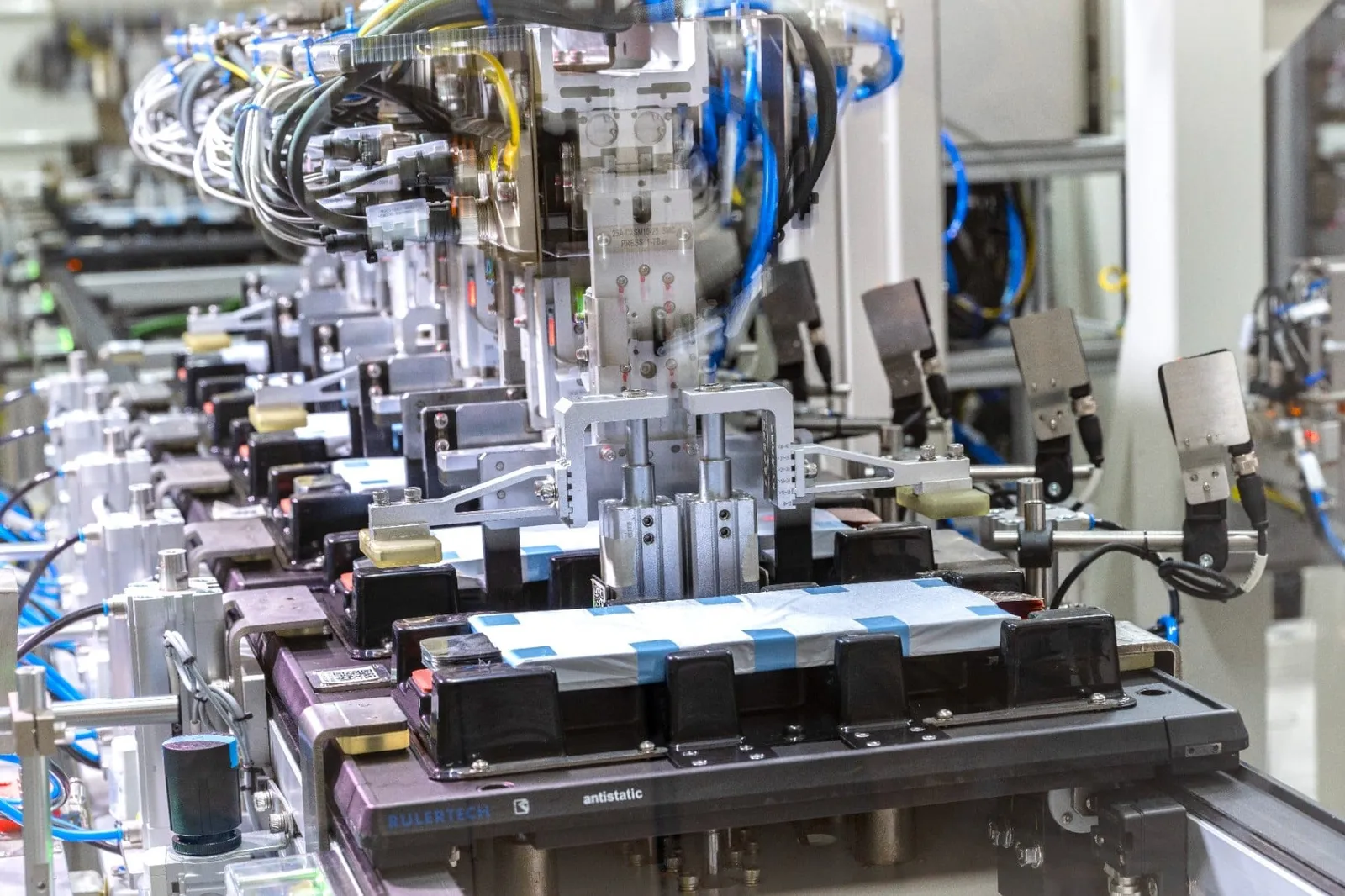
Battery production at VW subsidiary PowerCo in Salzgitter.
Image: PowerCo
The European Automobile Manufacturers’ Association (ACEA) commissioned analysts from Mobility Global to conduct a study, which has now resulted in a 19-page executive summary entitled ‘IAA Impact Assessment: European Battery Supply Chain Outlook’. The paper assesses the potential impact on companies in the battery sector and the broader automotive industry if the Industrial Accelerator Act (IAA) is implemented as proposed by the Commission in March. Importantly, the law has not yet been finalised, as negotiations in the European Parliament and Council are still ongoing.
The study’s core message is that stringent localisation requirements for battery production alone are insufficient to guarantee the practical establishment of a battery value chain in Europe. The analysts identify “deeper structural obstacles to localising battery production”, which could take years to overcome.
To break it down: according to the proposed IAA draft, requirements for batteries used in Europe would be introduced in two phases. Six months after the law enters into force (around 2027–2028, according to the study authors), batteries would need to include three EU-sourced components, including battery cells. Three years after adoption (around 2030–2031), this number would increase to five EU-sourced components, including battery cells, battery management systems, and active cathode materials.
Mobility Global examined three scenarios with varying levels of industrial demand for European batteries. The result: in all scenarios, supply cannot keep pace with demand – despite the expected growth of European battery cell production to 306 GWh by 2032. This means that, in the medium term, there will not be enough IAA-compliant batteries to fully supply the electric vehicle industry in the European Union. The study focuses on the next ten years.
ACEA concludes: “Limited supply will remain the key constraint to expanding the number of cars that would be eligible for “made in the EU”incentives. For example, around 3 million cars may be unable to qualify for the associated incentives because of the lack of supply if the IAA enters into force in 2028.” (The so-called “Made in the EU” subsidies are another aspect of the legislative package aimed at ensuring that national programmes primarily subsidise the EU’s own economy.)
ACEA further emphasises that the challenge is even more pronounced for medium- and heavy-duty commercial vehicles than for passenger cars: “The supply-demand gap continues to widen through 2032, reaching 23 GWh, with demand around four times available European supply,” according to a key finding of the study.
The association highlights that the battery value chain in the EU currently has weak structures. The analysts list the following specific issues:
- Most planned European gigafactories are focused on NMC batteries, while demand is increasingly shifting towards more cost-effective LFP batteries.
- Cells produced in Europe remain significantly more expensive than imported ones.
- Announced production capacities are subject to financing, approval, and implementation risks. Announced capacities should therefore not be equated with operational capacities.
- Further upstream, Europe continues to face persistent shortages of cathode and anode active materials (CAM/AAM). The analysis suggests that this deficit may only be resolved between 2038 and 2040, even in a low-demand scenario.
ACEA concludes that the results “underline the need for a realistic and economically viable approach to localisation”. The effectiveness of the IAA will ultimately depend not only on the ambition of its requirements but also on “whether Europe can build the upstream capacity, competitive operating conditions and investment framework needed to deliver them in practice”.
The association supplements its assessment with recommendations on how to bridge the gap between ambition and reality. ACEA advises:
- Massive upstream investments: To produce CAM and AAM locally and meet demand, substantial investments must be targeted at building foundational upstream components – such as facilities for precursor cathode active material (pCAM) production and graphite purification (AAM).
- Shift in policy towards operational support: Policymakers must move beyond merely funding factory construction and begin subsidising ongoing operating costs – particularly high energy costs – while also fast-tracking environmental permits to accelerate project timelines.
- Leverage global partnerships and near-shoring: Current EU policy remains highly ambiguous, with unclear “rules of origin” that do not specify whether near-shoring free trade partners like Morocco are treated as equivalent to local EU production. Clarifying these rules to formally include strategic free trade partners is essential; this would enable Europe to avoid high domestic energy costs and utilise international joint ventures to close the material gap.
acea.auto, acea.auto (Study, PDF)