
ICCT report: China pulls ahead in battery-electric truck and bus sales
In China, almost 30 per cent of all new registrations in the heavy truck segment last year were fully electric. While other world regions also report more electric commercial vehicle sales, none can keep up even remotely with China's pace. This is according to a new ICCT report on global demand for electric commercial vehicles.
The International Council on Clean Transportation (ICCT) regularly provides insights into the electrification progress of various world regions. In its latest report, titled “The ICCT Global EV Market Monitor: Trucks and Buses,” the organisation’s analysts examine how battery-electric buses and trucks are establishing themselves in the global market. The study covers 34 countries, which account for approximately 80 per cent of global truck and bus sales and 99 per cent of zero-emission truck and bus sales.
The ICCT’s study focuses on medium- and heavy-duty zero-emission vehicles, using the abbreviation ZE-MHDV (“zero-emission medium- and heavy-duty vehicle”). The threshold for trucks begins at a gross vehicle weight of over 3.5 tonnes. This means larger battery-electric vans, such as the Mercedes eSprinter with a gross weight of 4.25 tonnes, are also included in the statistics. It is important to note this definition.
With this scope in mind, here are the key findings: across the 34 countries analysed, sales of electric trucks and buses nearly doubled for the second consecutive year in 2025, rising by 86 per cent year-on-year, according to the ICCT. Total sales reached 520,000 electric units, corresponding to a global market share of around 14 per cent. This rapid growth is primarily driven by China, which accounted for 88 per cent of global sales of medium- and heavy-duty zero-emission vehicles. However, the analysts note that China’s relative market share has begun to decline slightly, stating: “its share has begun to decline as sales in other markets accelerate”.
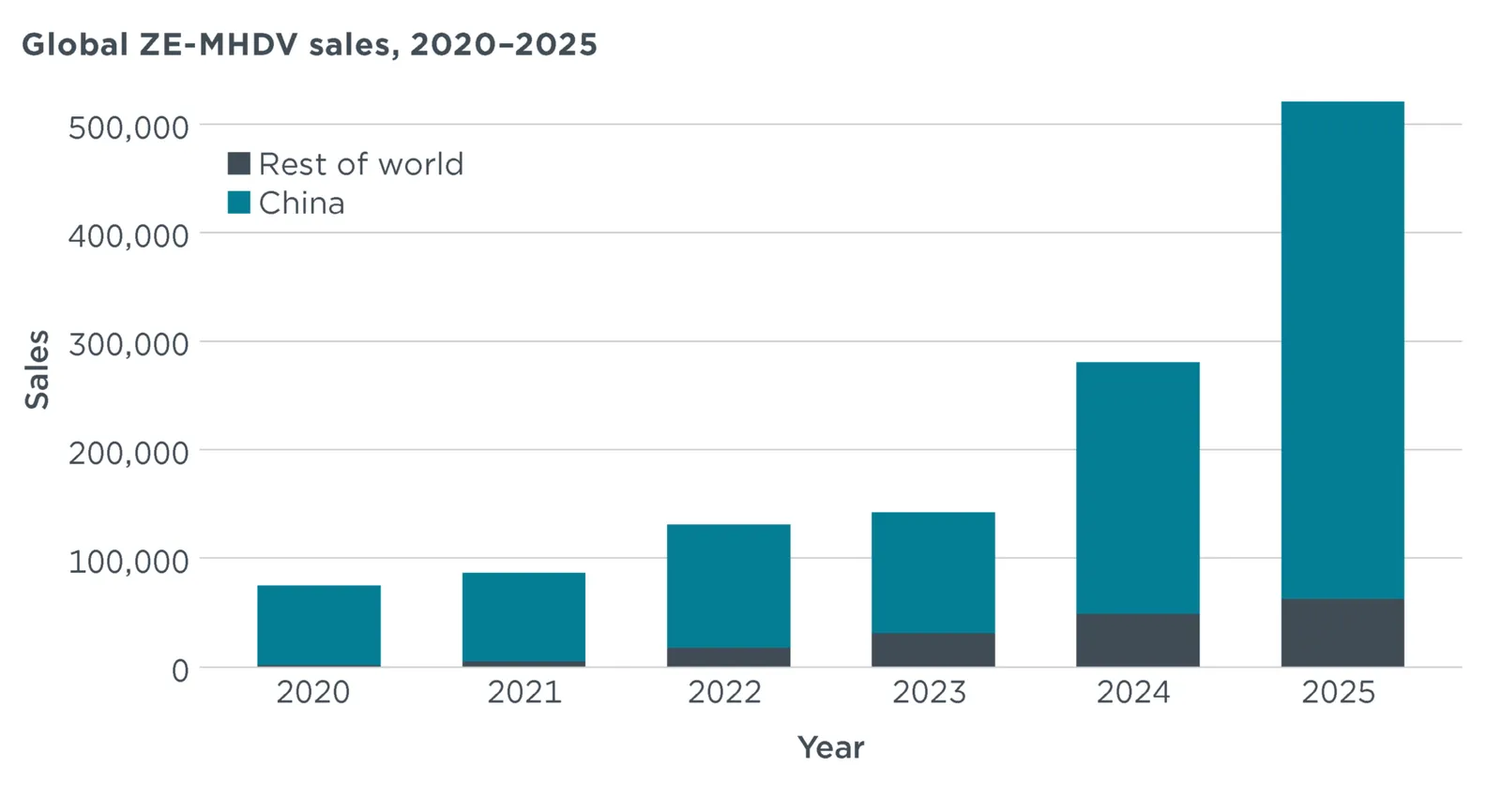
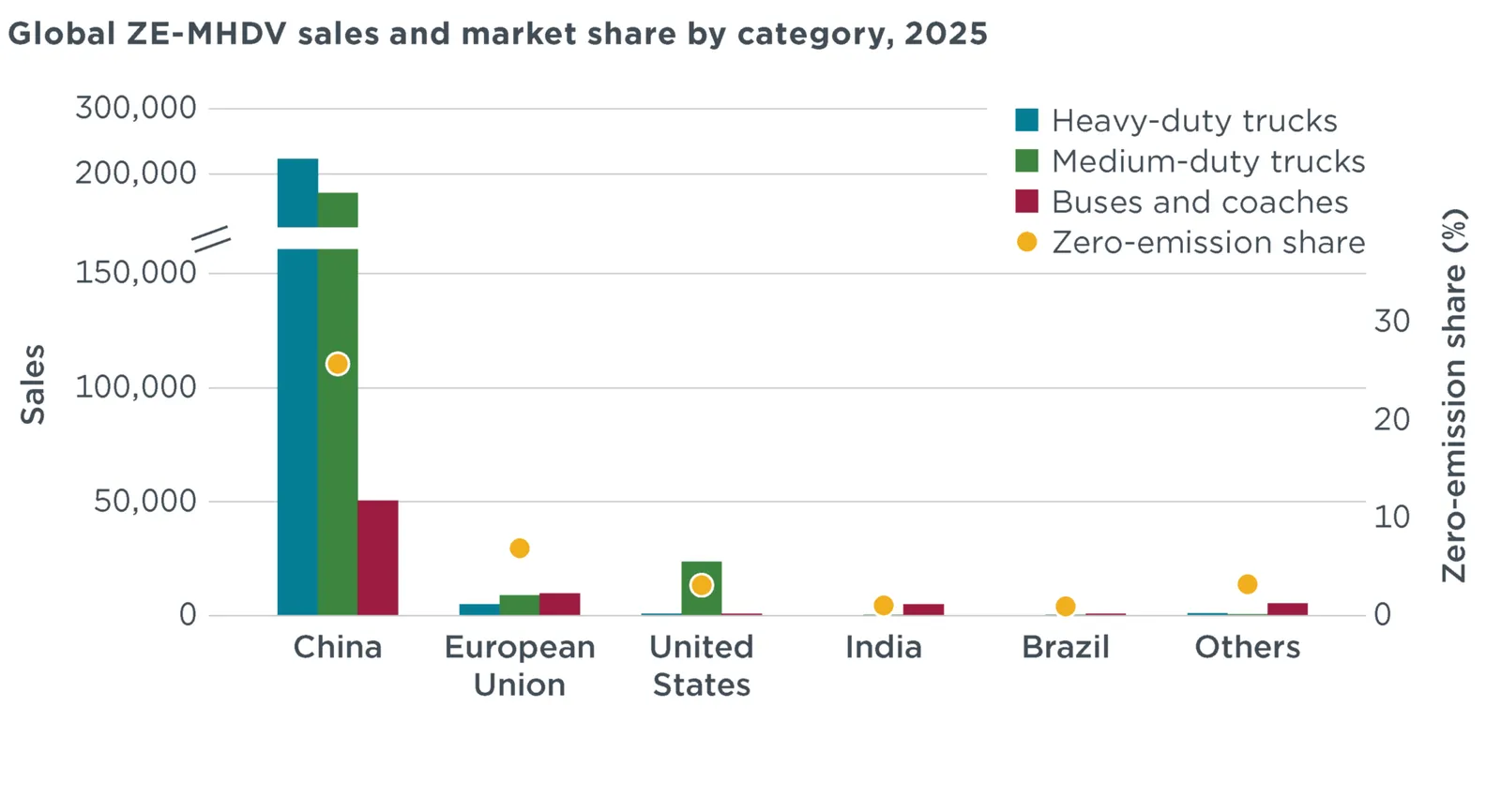
Nevertheless, China’s dominant position remains unchallenged. Of the approximately 520,000 electric units sold, 457,300 were registered in China. Excluding China, global sales of medium- and heavy-duty zero-emission vehicles in 2025 amounted to around 63,000 units, led by the United States, the European Union, and India. The US accounted for about 40 per cent of sales outside China, which the study’s authors attribute primarily to medium-duty battery-electric trucks.
Indeed, the composition of zero-emission vehicle sales in 2025 varied significantly by country. In China, of the 457,300 units sold, heavy and medium-duty trucks dominated, while buses accounted for only 11 per cent of sales. In the United States, by contrast, over 90 per cent of electric vehicle sales in the analysed segment were medium-duty trucks, with buses and heavy trucks each making up only about 3 per cent to 4 per cent. In India and Brazil, the zero-emission vehicle market was predominantly driven by buses and coaches, which represented over half of EV sales in these regions. Battery-electric trucks, however, remain rare there. Here is an overview:
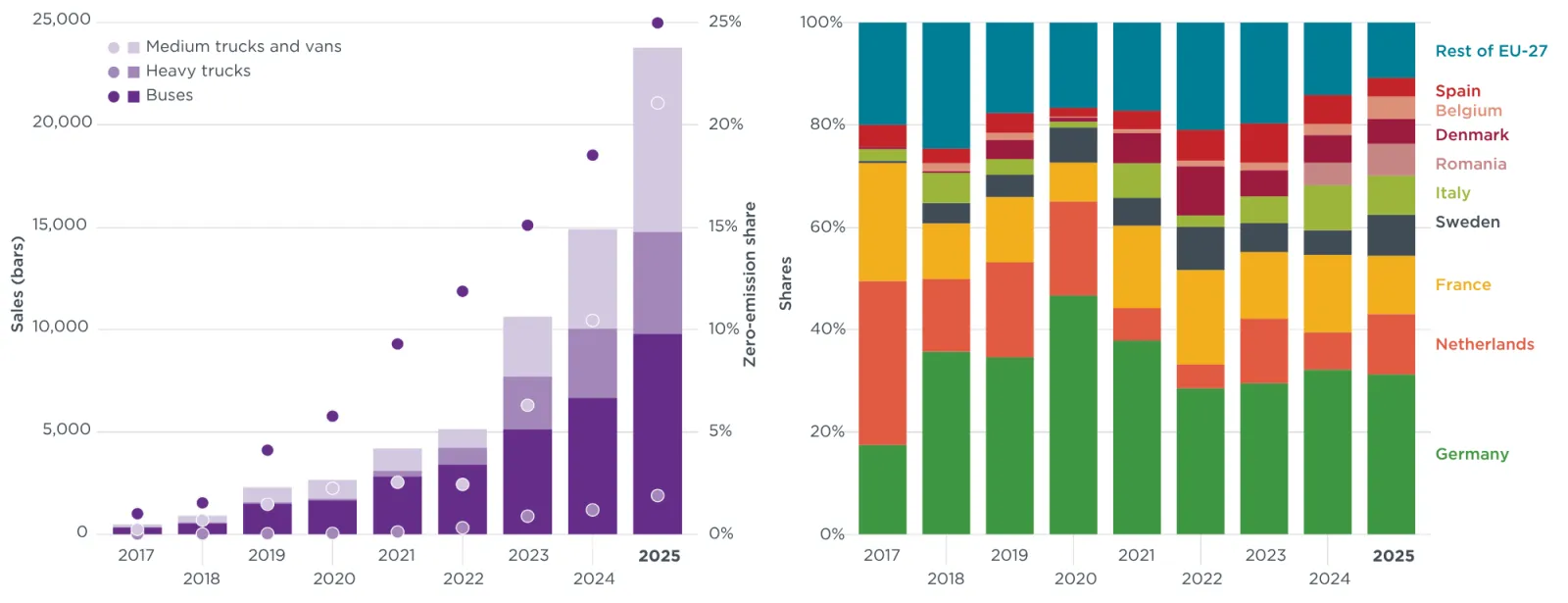
In the European Union, both segments – battery-electric buses and trucks – are growing. In 2025, the ICCT recorded over 23,700 new medium- and heavy-duty zero-emission vehicles in Europe. Zero-emission trucks (over 3.5 tonnes) achieved a sales share of 4.5 per cent, while battery-electric buses already accounted for 24.8 per cent of the total market.
“Sales growth was particularly strong in the zero-emission medium-duty truck and van segment (3.5–12 tonnes), where the ZE sales share more than doubled from 10.4 per cent in 2024 to 21.0 per cent in 2025,” the report states. The market for zero-emission buses and coaches, which continues to be largely driven by city buses, also saw significant growth. The sales share of battery-electric city buses in total registrations rose from 45 per cent in 2024 to 58 per cent in 2025, while the share of battery-electric intercity and coach buses stagnated at around 4 per cent in both years. The following two graphics provide details on the development of zero-emission vehicle sales in the European Union (EU-27):
Across all countries analysed, the ICCT notes that the composition of vehicle categories in global sales has shifted significantly from battery-electric buses to battery-electric trucks between 2020 and 2025. This trend is primarily attributed to the rapid growth in China’s truck sector. In 2020, buses accounted for the majority of zero-emission vehicles registered worldwide, reflecting the initial focus of electrification on urban public transport. By 2022, however, the combined sales of medium- and heavy-duty battery-electric trucks surpassed those of battery-electric buses for the first time – “and the gap widened rapidly thereafter,” according to the ICCT. This is illustrated in the following graphic:
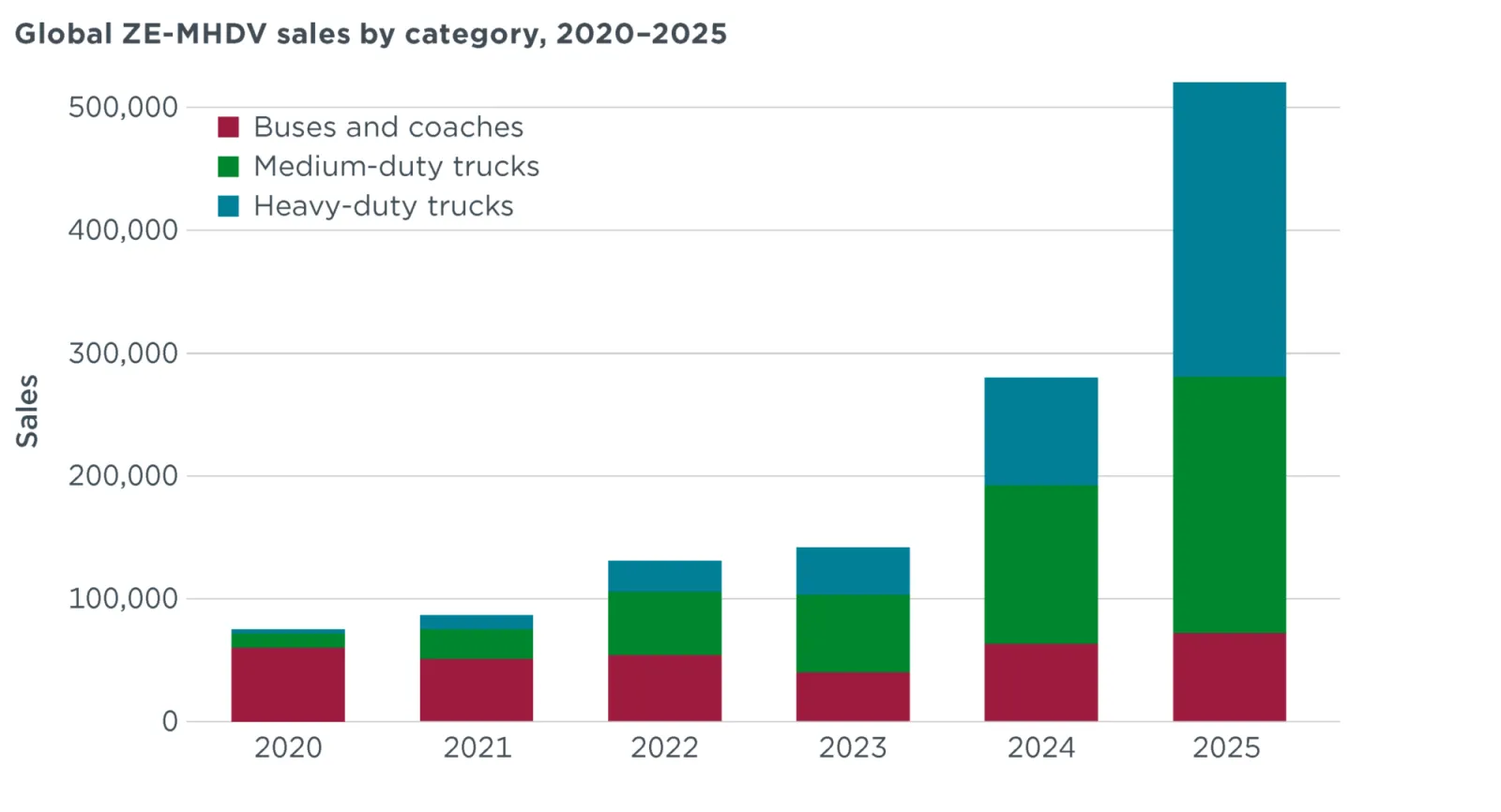
In 2025, battery-electric trucks accounted for 86 per cent of all electric vehicles included in the statistics, reversing the proportions seen in 2020. The sales volume of heavy battery-electric trucks alone more than doubled from 2024 to 2025, reaching nearly 240,000 units last year. This made heavy trucks the largest single category of zero-emission vehicles analysed worldwide, according to the ICCT. China remains the driving force: in the heavy truck segment, 28 per cent of all new registrations in China were purely electric in the past year, with sales more than quintupling within two years. Battery-swapping systems have played a key role in this growth: as the study’s authors emphasise, innovative charging and battery-swapping infrastructures, along with standardised battery-swapping systems, have further accelerated adoption.
In the medium-duty battery-electric truck segment, China recorded 174,700 units (22 per cent electric share of the Chinese market) in the past year, while heavy battery-electric trucks reached 232,000 units (28 per cent electric share). For buses and coaches, the ICCT counted 50,500 electric units (29 per cent electric share in China, with city buses achieving an almost 100 per cent electric share). The strength of this growth trajectory is underscored by the ICCT’s finding that sales of medium- and heavy-duty zero-emission vehicles in China have increased by 527 per cent since 2020. From 2024 to 2025 alone, sales rose by 98 per cent.
The situation in the US presents a stark contrast: there, the 25,427 newly registered medium- and heavy-duty zero-emission vehicles accounted for just 3.1 per cent of the total market. By segment, medium-duty battery-electric trucks led with 23,655 units (4.4 per cent electric share in the US), followed by buses and coaches with 897 electric units (also 4.4 per cent electric share), and heavy trucks with 875 units (0.3 per cent electric share). Cumulatively, sales of these zero-emission vehicles showed almost no change compared to 2024, with only a 2 per cent year-on-year increase. In the US, this market is not growing.