
ICCT: Relaxing CO₂ standards for passenger cars threatens jobs
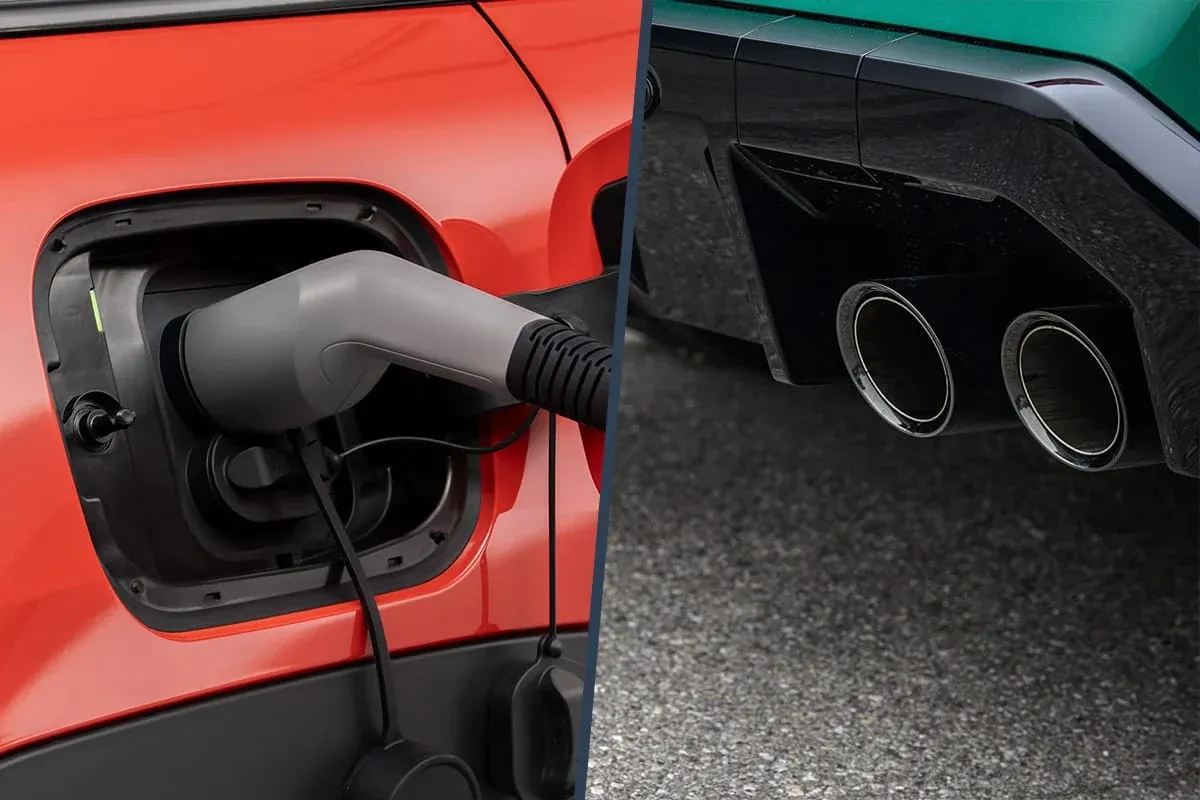
At the EU level, there are signs of a relaxation of CO₂ fleet limits for passenger cars. An ICCT study now warns that this could cost the European automotive industry up to 185,000 jobs. Notably, the auto industry itself sees jobs at risk primarily due to the strict 2035 target currently in place.
Images: BMW / Montage: electrive
The International Council on Clean Transportation (ICCT) has summarised the impact of current political decisions on CO₂ regulations for passenger cars on employment in the European automotive industry. The title of the 58-page study is: “Powering jobs: employment under the EU’s passenger car CO₂ standards”. The analysts’ core message is that maintaining current targets – i.e. effectively phasing out new internal combustion engine (ICE) vehicles by 2035 – would secure current employment levels. Relaxing the standards at this stage, however, would endanger jobs. Maintaining the current standards, combined with additional instruments (e.g., EU production incentives), could even generate job growth.
ICCT warns of net job losses
The ICCT authors argue that while the currently debated weakening of CO₂ targets for passenger cars by 2035 might temporarily halt job cuts in ICE production, it would slow employment growth in electric vehicle (EV) manufacturing, battery production, recycling and charging infrastructure development. The net result, according to the forecast, would be a “net loss in employment”.
Maintaining the current EU standards, on the other hand, would likely keep employment largely stable until 2035. As the study emphasises: “Although implementation pathways will inevitably lead to a decrease in jobs linked to ICEV production, they will also impact employment associated with battery production, battery recycling, and charging infrastructure. Depending on the scenario, job gains in these fields can offset losses in ICEV production.”
Furthermore, combining these standards with additional industrial measures to promote production within the EU could, as the paper states, even “bolster long-term employment across vehicle production and BEV-related industries”.
Before examining the details, a brief overview of the current legislation: For the period 2025 to 2027, OEMs in the EU must achieve a fleet average of 93.6 g CO₂/km, representing a 15 per cent reduction compared to the 2021 baseline. By 2030, the target tightens to a 55 per cent reduction, and by 2035, it reaches 100 per cent.
This is the current status. However, in its draft ‘Auto Package’ at the end of 2025, the European Commission proposed relaxing this framework. Some parliamentary committees are already following this path. The majority of MEPs want to obligate manufacturers to achieve only a 95 per cent CO₂ reduction by 2035, with OEMs allowed to fall a further 7.5 percentage points below this target if they use climate-friendly European steel in their vehicles as compensation. This proposal, however, still needs to pass through further committee stages.
ICCT authors analysed three scenarios
The ICCT study aims to provide guidance on the impact of the imminent political decisions. While the industry itself warns that current CO₂ targets – and particularly the rapid transition to EVs – could cost European jobs, the ICCT reaches the opposite conclusion. Sandra Wappelhorst, Research Lead at ICCT and the study’s lead author, commented: ““Weakening the CO2 standards is being presented as a way to protect jobs, but our analysis shows the opposite. “Instead, the EU should consider complementing its standards with measures to strengthen domestic EV supply chains. Clinging to an obsolete technology like the internal combustion engine won’t help workers in the long run.”
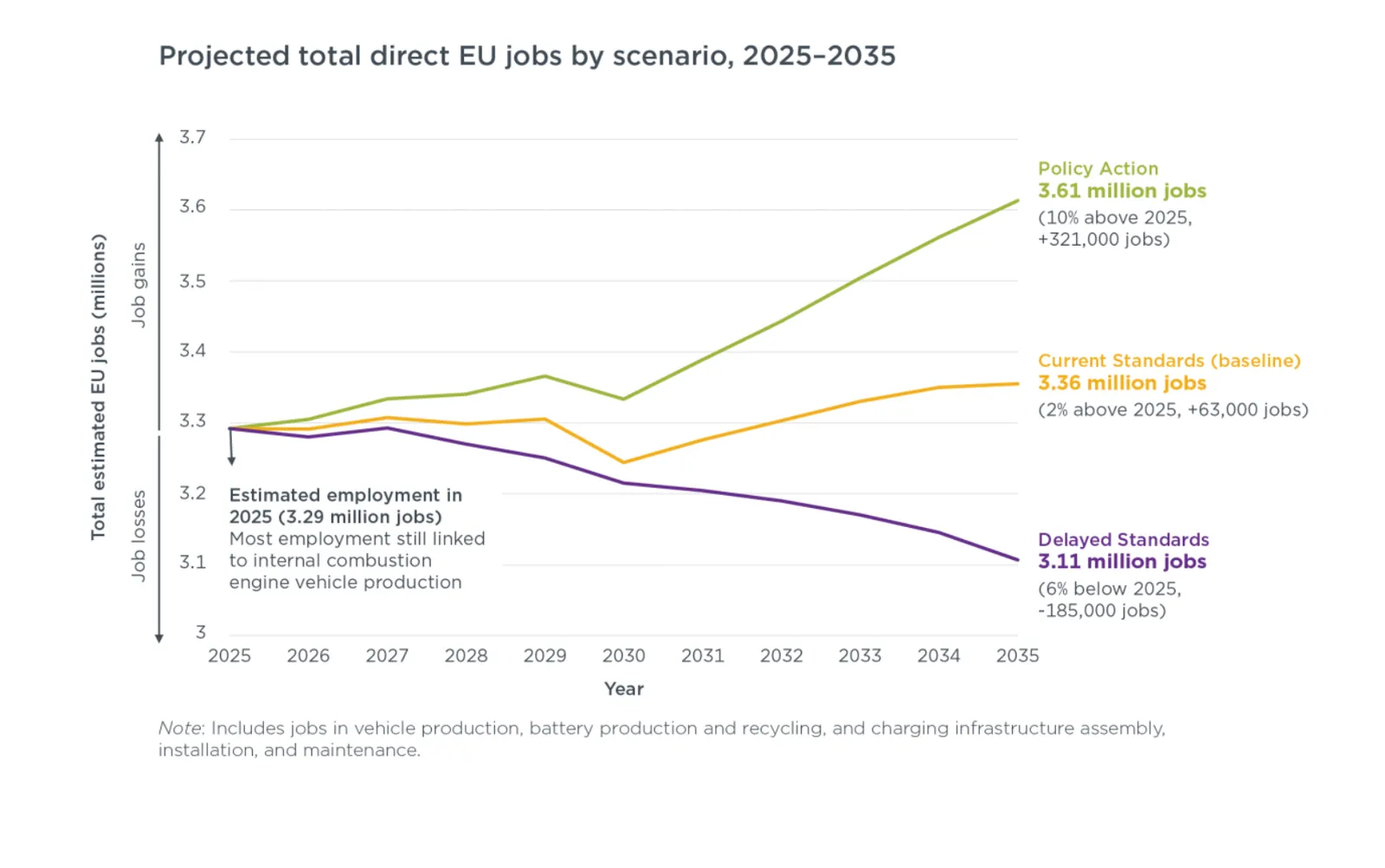
The author team has calculated three specific scenarios. The Baseline Scenario (“Current Standards”) projects employment based on the currently applicable rules. The “Policy Measures” Scenario models how jobs would evolve if the EU, in addition, implemented measures to strengthen value creation within the EU. These could include guidelines on local value-added content (such as those proposed in the “Industry Accelerator Act”), plus national-level approaches or targeted production incentives. Importantly, the authors note: “Rather than modelling these measures individually in the analysis, we incorporate broad assumptions linking them to a higher EU production share of BEVs and PHEVs.”
In the third “Delayed Standards” Scenario, the ICCT assumes a five-year delay in implementing CO₂ standards, resulting in a slower pace of electrification (“where the shares of BEVs and PHEVs would rise moderately by 2030 and reach 100% BEVs in new car sales by 2040”). The ICCT itself describes the five-year delay as a “simplifying assumption”, as in practice, relaxing regulations could take various forms.
Other influences on employment are excluded
Methodologically, it is important to note that the ICCT has deliberately focused the study on the effects of CO₂ legislation on industry employment. Other factors that could influence future employment – such as advancements in automation and digitalisation, or geopolitical and broader economic trends – are excluded. Additional aspects, such as workforce upskilling needs, are also not assessed. The study purely examines job effects in the context of the upcoming political decisions.
Regarding the findings: The ICCT analysis shows that short-term employment differences between the various regulatory scenarios remain relatively small until 2030. By 2035, however, a clear picture emerges: While maintaining the current CO₂ standards would keep employment in 2035 at a level only about two percent below that of 2025, additional industrial measures to promote production in the EU could increase net employment by around ten per cent – or roughly 320,000 additional jobs.
Weakening CO₂ standards, according to the study, would have the opposite effect: Employment could drop by up to six percent below the 2025 level, which the ICCT experts equate to a loss of up to 185,000 jobs. “Instead, the EU should consider complementing its standards with measures to strengthen domestic EV supply chains. Clinging to an obsolete technology like the internal combustion engine won’t help workers in the long run,” the author team concludes.
The pace of the powertrain transition is decisive
The ICCT adds: “Instead, the EU should consider complementing its standards with measures to strengthen domestic EV supply chains. Clinging to an obsolete technology like the internal combustion engine won’t help workers in the long run.” Both factors are also heavily influenced by future political frameworks.
It is clear that passenger car production accounts for the largest share of the differences between the three scenarios, with battery production/recycling and the development and maintenance of charging infrastructure becoming increasingly significant. Peter Mock, Director of ICCT Europe, summarises: “Instead, the EU should consider complementing its standards with measures to strengthen domestic EV supply chains. Clinging to an obsolete technology like the internal combustion engine won’t help workers in the long run. Maintaining the current CO2 standards will help move European manufacturers to the forefront of the EV market.”