
Grid at its limit: a bottleneck for electric truck depots?
As battery-electric truck fleets grow, grid capacity is becoming one of the biggest constraints on depot charging—not only in Germany but across Europe and other major logistics markets. Fleet operators increasingly hear the same advice: engage with the local grid operator as early as possible. In a recent interview with electrive, Professor Markus Lienkamp of the Technical University of Munich described one of the ‘actually relevant questions’ as: ‘How quickly can logistics depots secure their grid connections or adjusted power supply levels?’
That puts distribution system operators at the centre of the transition. They must accommodate growing demand from heat pumps, electric vehicle charging infrastructure, data centres and renewable energy installations while maintaining grid stability. Germany’s electricity distribution network is unusually fragmented, with more than 860 distribution system operators (DSOs), making it a useful case study for the challenges of coordinating grid upgrades for transport electrification.
To better understand their perspective, electrive spoke to one of the companies already putting new approaches into practice. Netze BW, one of Germany’s largest electricity distribution network operators, is currently testing grid-friendly charging for electric trucks at logistics depots through its FlexCharge BW (“Grid Lab for Electric Trucks”) pilot project, which we first reported on in May. The field trial involves two logistics companies in southwest Germany. A few months after the project began, we caught up with the two project leads, Dr Kathrin Walz and Nadine Eisinger, to discuss the latest progress. Here are their responses:
* * *
The NETZlabor E-Lkw has launched: How far along are you at the four participating sites – and which parts of the project are already operating under real-world conditions?
We are now in the middle of the field trial phase. At all four sites, we are collecting real-world charging and operational data. This forms the foundation that allows us to better understand charging processes in everyday logistics and develop and test grid-oriented charging. In parallel, we are working on digital tools and processes to intelligently align the grid and logistics in the future.
What matters most to us is this: We are not testing under idealised laboratory conditions, but where the technology must ultimately prove itself – in the daily operations of haulage companies. This way, we can identify early what works in practice and where adjustments are needed.
What has emerged as the biggest practical challenge in the first few weeks: the technology, data exchange, the operational processes of the logistics operators, or coordination among the stakeholders?
The biggest challenge is coordinating two very different systems: the electricity grid and logistics operations. The question is how to shift charging in response to grid conditions without disrupting fleet operations. Developing a solution that satisfies both requirements is the focus of the project.
The central question is thus: How can we flexibly control charging times without disrupting the ongoing operations of a freight company? This is precisely what we are currently working on – with the goal of developing a solution that is both technically sound and practical for everyday use.
Can you already draw from the initial results how much temporal flexibility exists in practice for charging electric trucks?
Initial analyses show that time windows emerge between the arrival of vehicles, the charging process, and their next deployment, offering scope for flexible charging control. In some cases, it seems possible to shift charging processes to the night or increase charging power during these periods. However, it is still too early for firm conclusions.
Have you already observed situations where grid-oriented charging allowed additional vehicles or higher charging capacities without immediately requiring grid connection upgrades?
We are currently examining how flexibly charging processes can be shifted and aligning these possibilities with the respective periods of peak grid demand in the local power grid. These vary depending on the grid region and the location of the logistics company. Initial analyses indicate that there is potential to increase charging capacities during periods of lower grid utilisation or high local renewable energy feed-in.
Whether these findings will be confirmed in practical operation will be shown by the field test, which begins in September.
How resilient are grid-oriented charging schedules to real-world disruptions such as delayed vehicles or last-minute route changes?
In principle, charging management systems already available on the market can respond to external signals at short notice – such as electricity prices, last-minute route changes, or power limitations. These systems are therefore fundamentally suitable for implementing grid-oriented charging schedules.
At the same time, it is important to us that the operational processes of logistics operators function reliably. That is why we are working in the field test with charging schedules that are finalised at the latest by the day before. Additionally, we are examining whether schedules communicated earlier can also be effectively implemented in practice.
The project involves a single depot and an operation across multiple sites: What differences are emerging in grid-oriented charging between these two structures?
With a single depot, charging operations can usually be monitored and controlled relatively easily. In contrast, a company with multiple sites inherently offers more opportunities to plan and distribute charging processes flexibly across different locations. However, coordination becomes more complex as more vehicles, routes, charging points, and grid situations come together.
The decisive factor is not just the number of sites and the size of the fleet. The degree of digitalisation in operational processes and the respective grid region also play a crucial role. The better these factors interact, the more precisely charging processes can be controlled in a grid-oriented and practical manner.
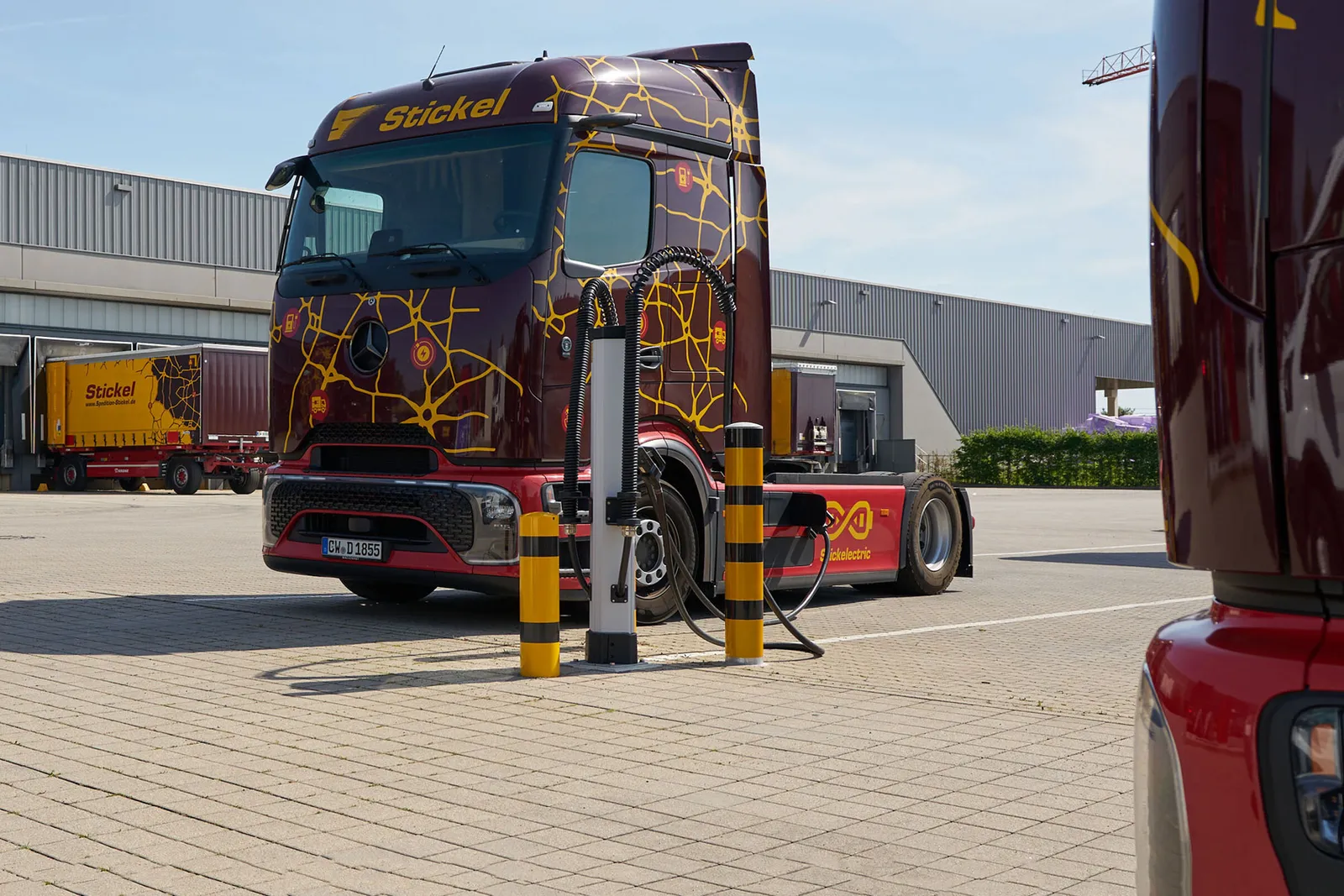
At Spedition Stickel, photovoltaics, a planned battery storage system, and dynamic electricity tariffs also play a role. How well can favourable electricity prices, local generation, and the current grid situation be harmonised?
This is precisely what we want to find out in our field test this autumn. For the first time, we are investigating in practice how these three factors – favourable electricity prices, locally generated power, and the respective local grid situation – can be considered together.
I see, so we will have to be patient. But what is your view: Is grid-oriented charging primarily a stopgap solution to bridge the time until grid expansion – or can it also significantly reduce the need for new grid capacities in the long term?
Grid-oriented charging does not replace grid expansion. Grid expansion remains a key prerequisite for the electrification of freight transport. At the same time, grid-oriented charging can help use existing grid infrastructure more efficiently in the long term.
For example: If several battery-electric trucks are parked at a logistics depot overnight, not all vehicles need to be charged at full power immediately. Vehicles that are not needed until the next morning can charge later or at adjusted power levels – for instance, when the grid is less congested or when a high proportion of renewable energy is available. This keeps operations predictable while relieving the grid and making better use of existing capacities.
What information do DSOs and logistics companies need to exchange in real time in the future to make such models scalable – and how far along are you with technical standards and interfaces?
From the DSO’s perspective, a reliable forecast of the expected power demand of logistics companies is particularly important – that is, a prediction of when and how much power will be needed at a site. Based on this, companies could in future receive a schedule from us as the DSO: a flexible power specification for the grid connection point, aligned with the respective grid situation.
The key is that this information is exchanged digitally and as automatically as possible. Only then can grid-oriented charging function reliably on a larger scale.
What initial thesis would you formulate based on the current progress of the project? Or, to put it another way: What needs to happen from your perspective as a DSO to accelerate the development of charging infrastructure for battery-electric trucks in haulage depots?
Our initial thesis is: The electrification of road freight transport will not succeed through infrastructure expansion alone. The decisive factor is the intelligent interaction between the power grid and logistics. The sooner both sides align their processes, the faster new capacities can be created and used effectively.
Many local authorities and logistics companies fear that electrification will fail because the grid connection capacity in industrial zones, where depots are located, is insufficient. Can you understand this concern, and how do you respond as a DSO?
Yes, this concern is understandable. Battery-electric truck fleets can have high power demands, and expanding the power grid takes time. At the same time, there are often additional courses of action between “not yet possible today” and a fully expanded grid. This is precisely where FlexCharge BW comes in: We are investigating how existing grid capacities can be better utilised through intelligent charging – enabling companies to start electrification sooner and with greater predictability.
Initial experiences also show that some logistics companies require less connection capacity than initially assumed. It is therefore worthwhile to consider charging management, energy management, and the ecost-effective design of the charging infrastructure early on.
Our goal as a DSO is clear: We need both – forward-looking grid expansion and intelligent solutions that make efficient use of existing infrastructure. Only through this combination can the ramp-up of battery-electric truck mobility succeed faster and more reliably.
Dr Walz, Ms Eisinger – thank you very much for the conversation!
* * *
The electrive Truck Charging Theme Week offers specialist articles, podcasts, and videos on the topic from 20 to 26 July 2026. All content can be found here.