
Greater range at the same weight: silicon battery passes laboratory test
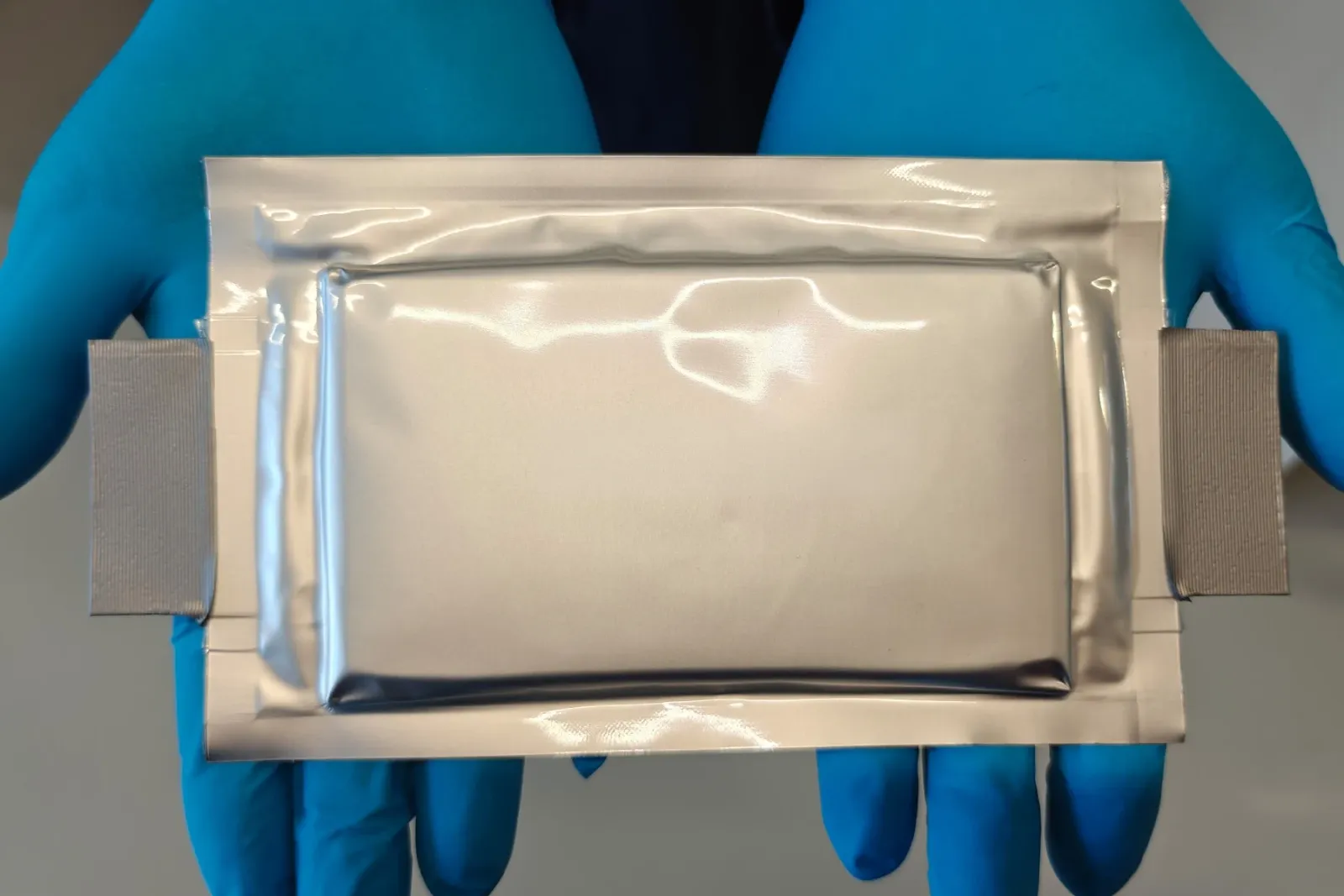
A critical breakthrough in battery research saw film cells with silicon-rich anodes endure over 1,000 cycles in testing without dropping below 80 per cent capacity. We explore the parameters that play a key role and what this progress could mean for electric vehicles.
Image: Fraunhofer ISE
Researchers at the Fraunhofer Institute for Solar Energy Systems (ISE) have successfully operated a self-manufactured 25-Ah pouch cell with silicon-rich anodes for over 1,000 full cycles as part of the ‘StrOboBatt’ project. After testing, the cell retained more than 83 per cent of its capacity. This achievement marks an important milestone in battery development: 1,000 full cycles with at least 80 per cent capacity retention are considered the minimum requirement for commercial use.
Silicon: high energy density, but extreme expansion
The pouch cell stands out due to its silicon-rich anode, which enables higher energy density compared to conventional graphite anodes. However, silicon has not yet been widely adopted as an anode material because its volume expands by up to 300 per cent (quadrupling) during charging due to lithium-ion absorption and then shrinks again during discharging. This significant movement leads to the loss of electrical contact within the electrode and accelerates the decomposition of the electrolyte. As a result, the cell degrades too quickly for practical use. By comparison, graphite expands by only about 10 to 12 per cent.
To reduce the mechanical stress caused by this extreme expansion, the researchers at Fraunhofer ISE used a silicon-carbon composite, which accounts for 51 per cent of the anode’s active material. Combined with a nickel-rich cathode, the pouch cell was produced on an industry-scale pilot line.
Pressure and charging dynamics are key factors
In the laboratory, the battery cell prototypes were also subjected to an axial pressure of 1,000 kilopascals (approx. 10 bar) during charging and discharging. Despite the material’s movement, the electrode contact remained stable. At a lower pressure of 300 kilopascals (approx. 3 bar), however, the usable capacity decreased significantly faster. Thus, external mechanical pressure proved to be a decisive parameter.
Tests under dynamic real-world conditions also showed that usable capacity declines more rapidly at high power levels than during gentle test cycles. This provides an important insight for future use in electric vehicles, whose battery management systems must account for this factor.
The tested cells achieved a gravimetric energy density of 280 Wh/kg. However, Fraunhofer ISE states that industrially optimised mass production could achieve around 330 Wh/kg. A battery with 330 Wh/kg would represent an increase of approx. 20 to 35 per cent compared to today’s NMC and NCA cells and almost double the energy density of LFP cells.
European raw materials for greater range
In practical terms, this means that an electric vehicle could carry nearly 100 kWh of storage capacity instead of today’s approximately 75 kWh at the same battery weight. This would increase the realistic range of a mid-sized vehicle from around 450 km to well over 600 km.
In addition to the range increase, the technology offers a strategic advantage for the industrial sector. Since graphite is currently imported primarily from outside Europe, the increased use of silicon composites enables a partial shift in raw material value creation to Europe, as silicon can be sourced and produced synthetically on a regional basis.