
Fraunhofer opens research centre in Braunschweig
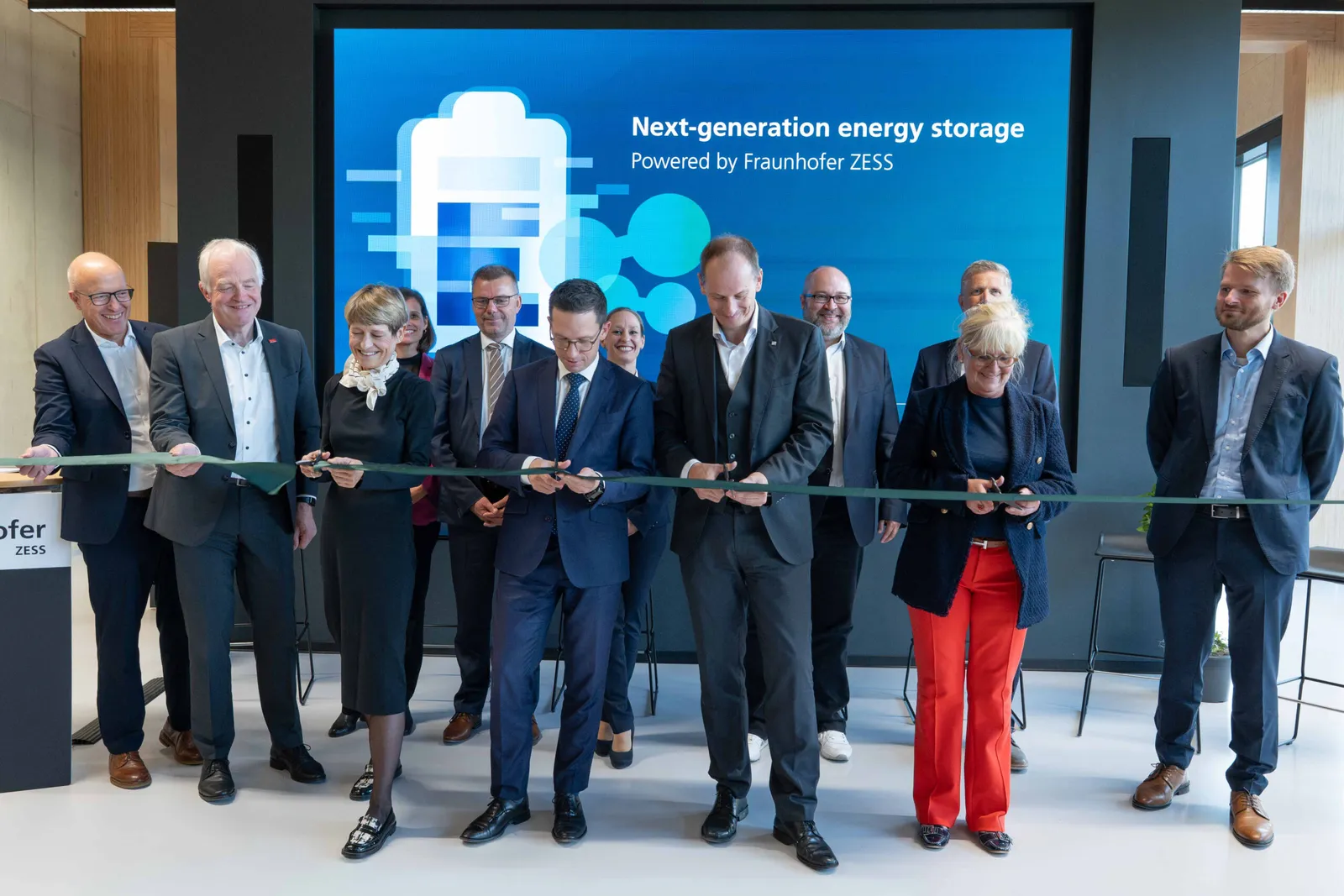
The Fraunhofer-Gesellschaft has inaugurated the new Center for Energy Storage and Systems (ZESS) in Braunschweig. The federal government and the state have invested nearly €50 million euros in the research hub, which focuses on solid-state batteries, cell production, and hydrogen technologies, among other areas.
Fraunhofer opens ZESS for battery and hydrogen research in Braunschweig.
Image: Fraunhofer IST
The centre provides approximately 1,750 square metres of laboratory space and a 450 square metre dry room on a total of around 3,300 square metres. The infrastructure is designed for the development of next-generation solid-state batteries and innovative hydrogen technologies.
The German federal government and the state of Lower Saxony have jointly invested around €49.85 million in the new building. The centre aims to more closely integrate research and industrial application, accelerating the scaling and commercialisation of new technologies.
At the ZESS, the Fraunhofer Institute for Surface Engineering and Thin Films IST, the Fraunhofer Institute for Manufacturing Technology and Advanced Materials IFAM, and the Fraunhofer Institute for Ceramic Technologies and Systems IKTS pool their expertise. In the battery sector, their approach spans new materials, production processes, sustainability, and the circular economy.
A key focus is on solid-state batteries. The ZESS is meant to not only investigate new cell chemistries and manufacturing processes in the laboratory but also advance their industrial scalability.
Fraunhofer ZESS examines the battery process chain
“At the Fraunhofer ZESS, we consider the entire process chain–from new materials, through production technologies, and on to sustainability and the circular economy,” said Christoph Herrmann, Director of the Fraunhofer IST and spokesperson for the ZESS. Through combining expertise, the hope is that solid-state batteries and hydrogen technologies will be developed for industrial applications.
The centre is also closely integrated into the research environment of the TU Braunschweig. This includes, among others, the Battery LabFactory Braunschweig and the Center for Circular Production of Next Batteries and Fuel Cells. The goal is to create a regional network for battery and fuel cell research as well as industrial technology transfer.
In parallel, Fraunhofer is expanding its international battery research. At the beginning of October, the Fraunhofer Battery Alliance agreed with partners from South Korea on closer collaboration in battery materials, cell production, and recycling. While the FFB in Münster primarily addresses the near-series scaling of cell and production technologies, the ZESS in Braunschweig additionally focuses on solid-state batteries and hydrogen technologies.
Fraunhofer has also prioritised sustainability in the building itself. The research facility was constructed as a wood-hybrid structure with reduced concrete usage. Photovoltaic systems on the roof and façade, green roofs, and multifunctional research spaces are designed to lower energy demand and facilitate adaptation to new research priorities in future.
