
Fraunhofer automates x-ray analysis of EV batteries
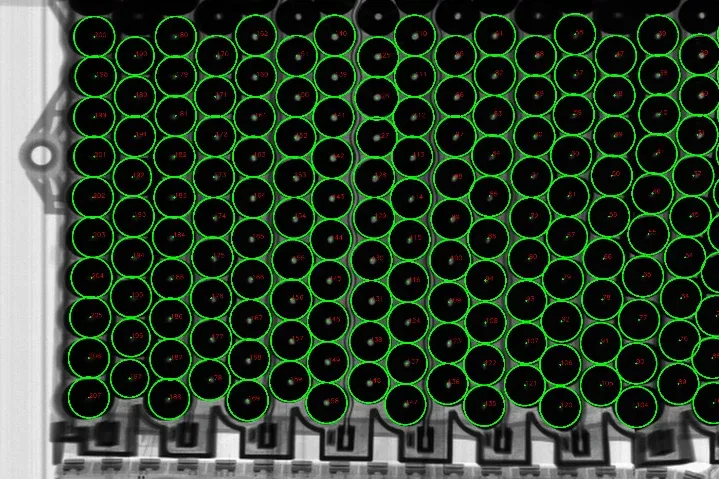
The Fraunhofer IIS has developed software that automatically examines X-ray images of complete EV batteries for mechanical irregularities. The method, developed in the AIR research project, is intended to complement classical battery diagnostics and provide additional information for accident-damaged vehicles and before potential second-life use.
The X-ray software detects displaced round cells and automatically delineates deformed areas.
Image: Fraunhofer IIS
In collaboration with Munich University of Applied Sciences, the X-ray Technology Development Centre at Fraunhofer IIS has developed a method that enables complete high-voltage batteries to be x-rayed without opening the battery housing or removing individual components. The AIR system (AIR stands for *Antriebsbatterieinspektion mittels Röntgentechnik*, or traction battery inspection using X-ray technology) is not new: Fraunhofer first presented the testing technology in 2024 and tested it on more than 100 private electric cars, among others. What is new, however, is a software library that automatically evaluates the generated 2D X-ray projections.
According to Fraunhofer IIS, the software can automatically locate cylindrical cells, prismatic cells, and pouch cells in the battery types examined so far. It can then detect geometric irregularities, which may indicate shifted or deformed cells as well as cell swelling.
The measurement setup resembles a car wash: an X-ray source positioned above the vehicle scans the vehicle and the underfloor battery, while a detector below captures the radiation. Depending on the test setup, only the battery pack can also be examined. Fraunhofer had previously stated a measurement time of around ten minutes for scanning a complete vehicle. In the test environment used, the newly presented automated evaluation of a battery pack took about five minutes, according to the institute. However, the total testing time depends on factors such as pack size, measurement setup, and the number of projections required.
In addition to X-ray analysis, there are already various methods for evaluating used EV batteries, primarily to determine their electrical and electrochemical state or State of Health (SoH). The relevance of individual testing was recently demonstrated by an evaluation by Aviloo: among more than 500,000 examined EVs, the SoH varied significantly even between vehicles of the same model and with comparable mileage.
However, the SoH does not directly indicate whether cells and modules inside a closed battery pack are mechanically intact. Ageing, vibrations, or accidents can cause shifts and deformations. This is precisely where the AIR project comes in.
X-Ray analysis complements classical battery diagnostics
The X-ray inspection is not intended to replace electrical battery tests. Rather, the images are meant to provide additional information about mechanical integrity, thereby becoming part of a more comprehensive condition and safety assessment. This could be relevant, for example, to deciding whether an accident-damaged battery should be further examined, transported, stored, reused, or recycled.
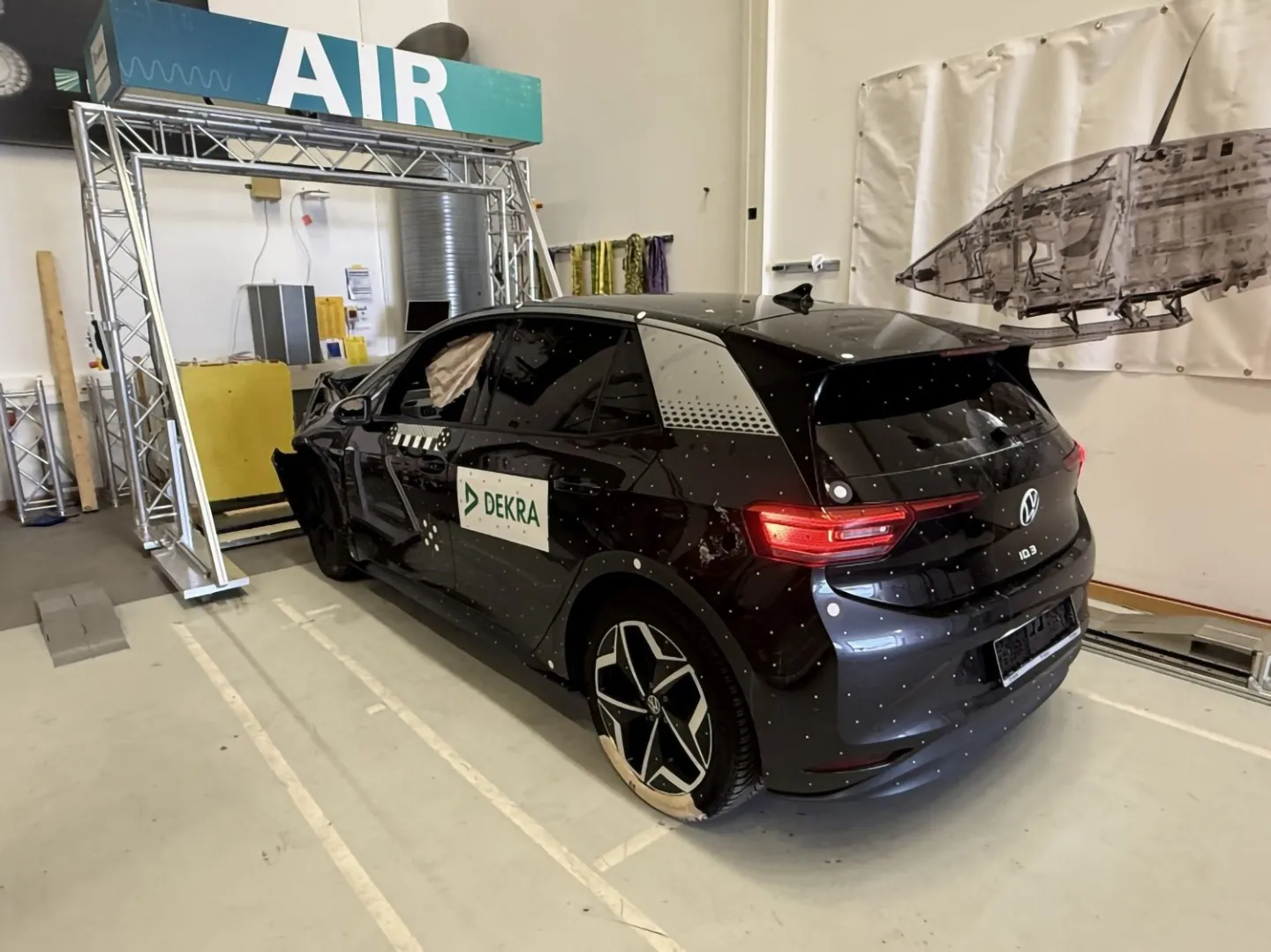
To demonstrate how this can work, the project examined a VW ID.3, among other things. The vehicle was driven forward at 79 km/h into the rear of a stationary VW Tiguan under laboratory conditions at DEKRA. Despite significant deformations in the front area, Fraunhofer reported that no safety-critical structural irregularities were detectable in the evaluated X-ray projections of the underfloor battery.
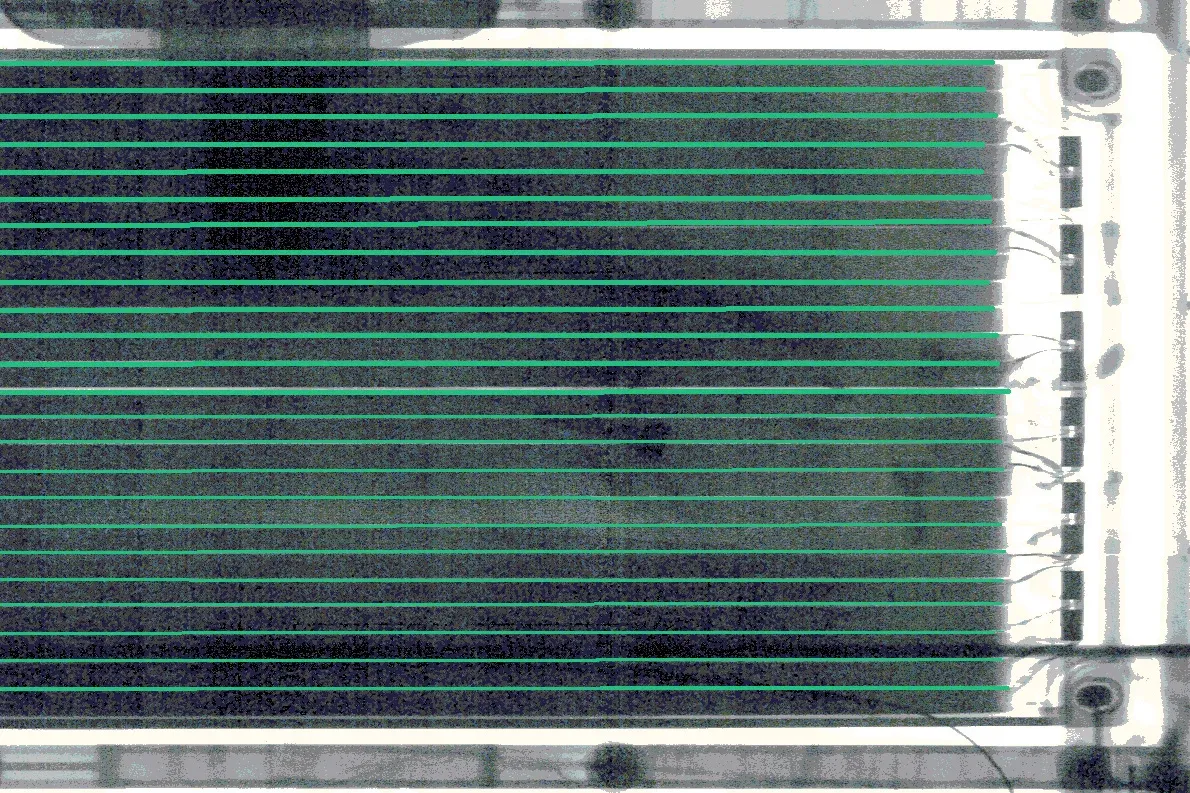
The software automatically located the pouch cells in the nine battery modules and compared, among other things, the curvature of selected cell edges. According to the institute, no critical deviations, overlaps, or bulges were found.
However, the battery was not cleared for further use based solely on these images. Additional assessments included a hazard evaluation according to DEKRA guidelines, data from the Event Data Recorder and the Battery Management System, as well as further electrical tests. Based on this comprehensive evaluation, the high-voltage battery was classified in the lowest EUCAR hazard level 0 and approved for further use.
In another crash-damaged battery with cylindrical cells, the analysis yielded a different result. Here, the software detected a significantly deformed area and cells that were shifted compared to a reference. Although no signs of cell swelling were found, the battery was still not recommended for further use due to the mechanical deformation.
X-ray technology is also used elsewhere to examine batteries. For example, Fraunhofer EMI has developed a high-speed X-ray system that can visualise dynamic processes inside individual large-format battery cells during load and safety tests. Such a system is scheduled to be installed at Volkswagen’s battery subsidiary PowerCo in Salzgitter in 2028.
In the meantime, the AIR approach could be relevant for additional use cases beyond accident vehicles. Fraunhofer IIS cites second-life applications as a potential area of use. The institute also considers the technology potentially relevant for future inspection concepts in the context of the periodic technical inspection (HU) of electric vehicles. However, Fraunhofer has not yet announced any concrete plans for use in the regular HU process. In the future, the planned “Giant Eye” CT system at the X-ray Technology Development Centre in Fürth is also expected to enable three-dimensional analyses of complete electric vehicles.