
Electric cars now cost less than half as much as diesel to fuel, says T&E
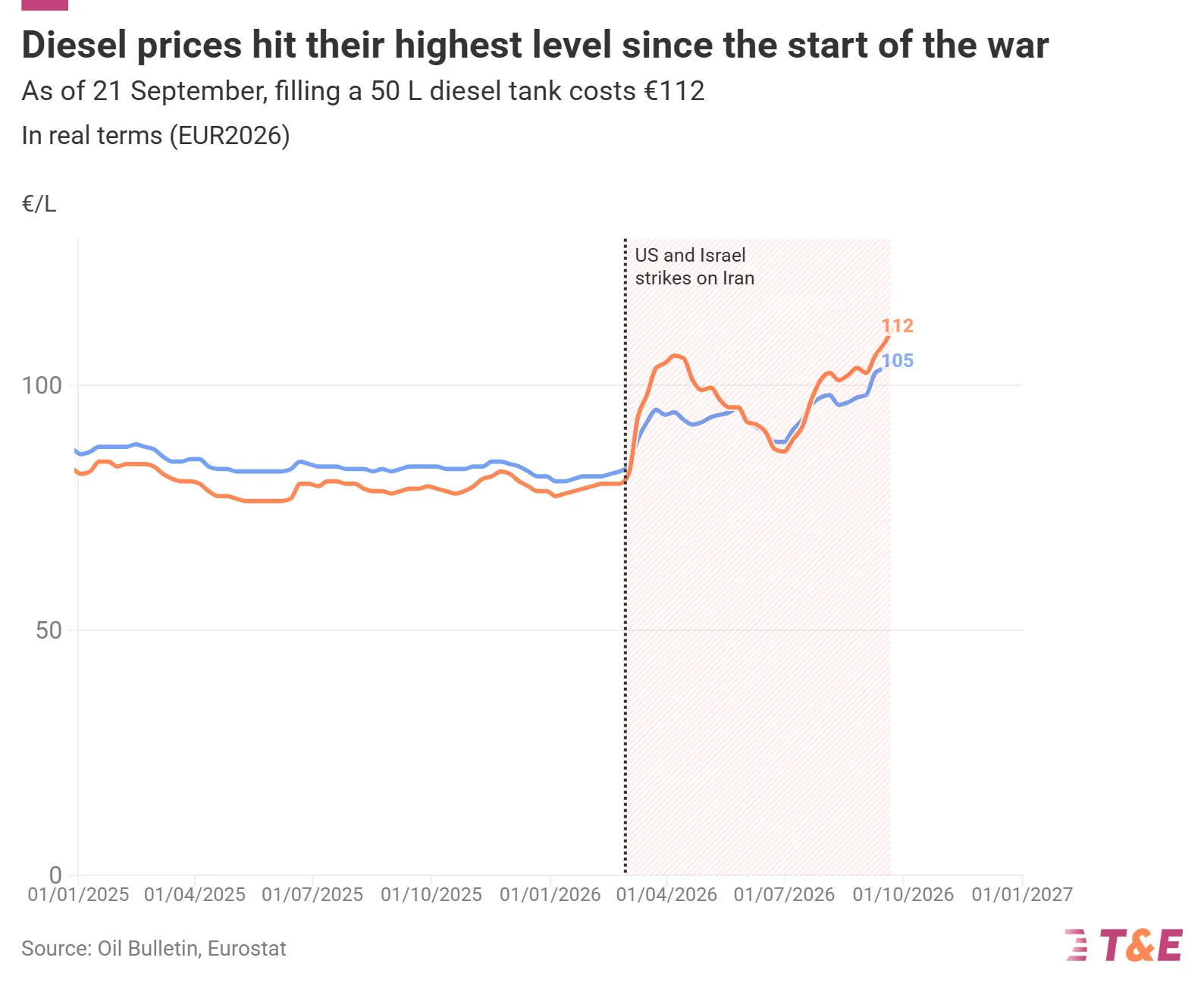
Electric vehicle drivers in Europe are spending less than half as much on energy per kilometre as diesel motorists, according to new Transport & Environment analysis, as rising fuel prices intensify pressure on households and businesses.
The clean transport campaign group says filling a 50-litre diesel tank now costs €32 more than in February, with roughly €16 of that increase attributable to higher refinery margins.
Its comparison covers refuelling and charging, rather than total ownership costs. It assumes diesel consumption of 6.9 litres per 100km (40.9mpg), EV consumption of 20.2kWh per 100km (3.08 miles per kWh) and electricity costing €0.343/kWh. That puts the electric car’s energy bill at approximately €6.93 per 100km (11p per mile).
“Electrification is the only way to ensure this is the last oil crisis,” said Antony Froggatt, senior director at T&E.
The organisation says its electricity estimate allows for gas price increases feeding through to household bills over time and is likely to represent an upper bound.
The European figures should not be read as a promise that every British driver will halve their bills by changing cars.
T&E is calling for governments to direct help towards poorer households and finance electrification through taxes on windfall oil profits. It argues that general fuel duty cuts transfer costs to taxpayers without resolving dependence on oil.
Its earlier analysis, published on 23 September, put Europe’s additional diesel bill at €203 million a day on average since the conflict began. Diesel cars account for 38% of the EU passenger car fleet, leaving the region particularly exposed.
Around 30% of Europe’s diesel fleet is more than 15 years old. T&E argues that scrappage incentives could help replace these vehicles, while tackling a source of continuing fuel expenditure.
The organisation calculated that, if the diesel premium persisted until Christmas, the accumulated spending would equal the cost of offering €2,000 towards scrapping every diesel car over 15 years old.
That comparison is intended to illustrate the scale of the extra fuel bill. It does not mean such a replacement programme has been approved, or that a €2,000 incentive would cover the cost of buying an electric car.
The supply pressures extend beyond crude oil prices. In its accompanying briefing, T&E links the squeeze to the Middle East conflict and outages at Russian refineries, which have constrained supplies of refined products.
This matters because the price motorists pay for diesel depends on more than the cost of crude. A shortage of refining capacity or finished fuel can widen the gap between the two, adding pressure at the pump even before tax is considered.
Road transport accounts for 77% of EU diesel and gas oil consumption, according to figures cited in the briefing. Higher prices therefore reach beyond private motorists into haulage, deliveries and the cost of moving goods.
T&E also identifies measures that could reduce consumption before replacement vehicles become available. Its proposals include reducing motorway speeds by 10km/h, encouraging more economical driving and sharing car journeys.
Together, it estimates these measures could cut diesel demand by 15%. These are recommendations, rather than an announcement of new speed restrictions.
The call for windfall taxation draws on separate research into oil company earnings. T&E estimates that eight businesses generated €7.5 billion in additional profits attributable to the EU during the first half of 2026.
The companies covered were Shell, BP, TotalEnergies, Eni, Orlen, Repsol, OMV and Moeve. T&E compared adjusted net income with the equivalent quarters of 2025, allocating a share to the EU using geographical revenue disclosures.
On that basis, it calculated additional earnings of approximately €1.6 billion in the first quarter and €5.9 billion in the second. The second quarter covered a longer period of the conflict.
These figures reflect T&E’s definition of excess profits, rather than a tax assessment. The analysis supports its argument that some of the gains accruing to oil companies should help fund alternatives for consumers.
Commercial vehicles form another part of that argument. Research released by T&E on 28 September found electric heavy trucks already offered lower total ownership costs in six of nine major EU markets studied.
Those six markets account for 46% of new EU heavy truck sales. The finding concerns the markets in which electric trucks have a financial advantage; it does not mean nearly half of trucks sold are electric.
The report attributes the improvement to lower vehicle prices, greater production scale and national support, including purchase incentives and reduced road tolls.
It also projects that electric trucks could become cheaper across all nine markets by 2030, provided existing policies continue alongside additional measures. That forecast depends on its assumptions about policy and costs being realised.
Unlike the passenger car fuel comparison, this research considers total ownership expenditure, making the two findings distinct measures of the financial case for electrification.
The associated truck announcement puts potential five-year savings at €100,000 in the Netherlands and €85,000 in Germany, with payback possible after two years. Under higher diesel prices, those savings could reach €123,000 and €106,000 respectively.
T&E wants governments to accelerate charging infrastructure and electricity grid connections alongside incentives. It also urges European manufacturers to increase electric truck production to reduce purchase prices and compete with overseas suppliers.
Stef Cornelis, T&E’s director of freight and fleets, said: “Europe’s truckers are on the front line of the diesel crisis.”
For car drivers, the ability to compare charging prices remains a separate practical issue. In another paper published on 29 September, T&E called for clearer pricing across Europe’s public charging network.
It wants tariffs presented through three standard components: electricity supplied, any idle or overstay charge, and additional commercial fees such as roaming. Conditions should be visible before charging starts.
The organisation also advocates standard card payments without subscriptions at all physical public chargers, alongside clearer disclosure of differences between direct payment and third-party services.
These proposals acknowledge that the price of electricity alone does not always describe the final charging bill. Extra fees and differing payment arrangements can make comparisons harder.
For prospective UK buyers, the useful calculation is therefore personal: expected annual mileage, vehicle efficiency and the charging arrangements they can actually use. Purchase price, finance, insurance and depreciation then need assessing separately.
A household with a different tariff or a different mix of charging locations should calculate its own cost per mile before applying a European average. The same applies when comparing an efficient diesel with a larger electric vehicle, or vice versa.
T&E’s public charging proposals would make that exercise easier by exposing the full price before a session begins. They accompany its push for cleaner vehicles with a demand for more understandable information about the cost of using them.