
Electric cars lead UK market as October registrations jump 54%
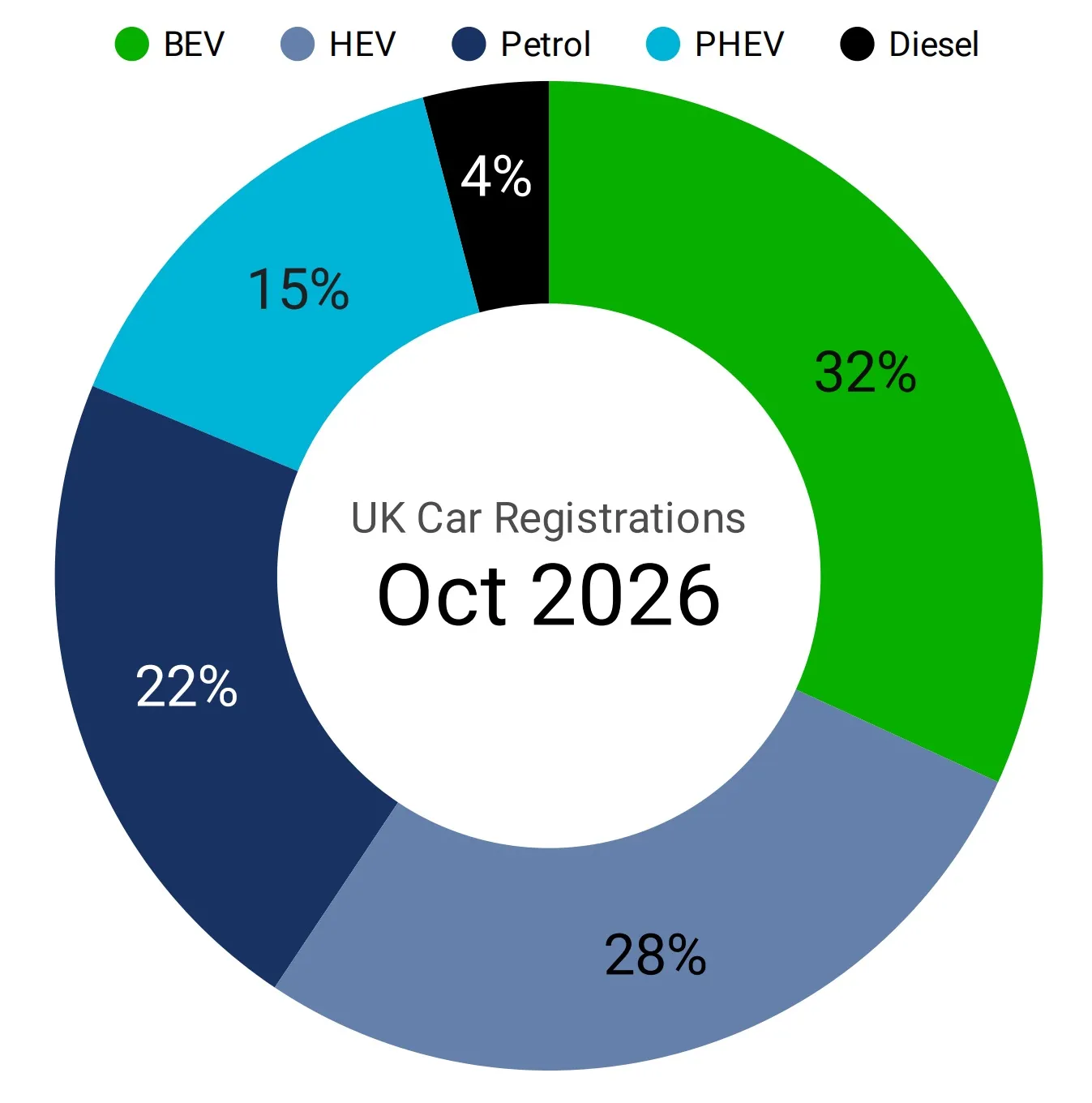
Battery electric cars were the largest single category in the UK’s new car market in October, with 49,155 registrations giving them a 31.8% share, according to provisional figures from New AutoMotive.
Registrations rose 53.7% compared with October 2025, almost twice the pace of the wider car market, as the research organisation urged ministers to retain the Zero Emission Vehicle mandate following the closure of the government’s consultation on the policy.
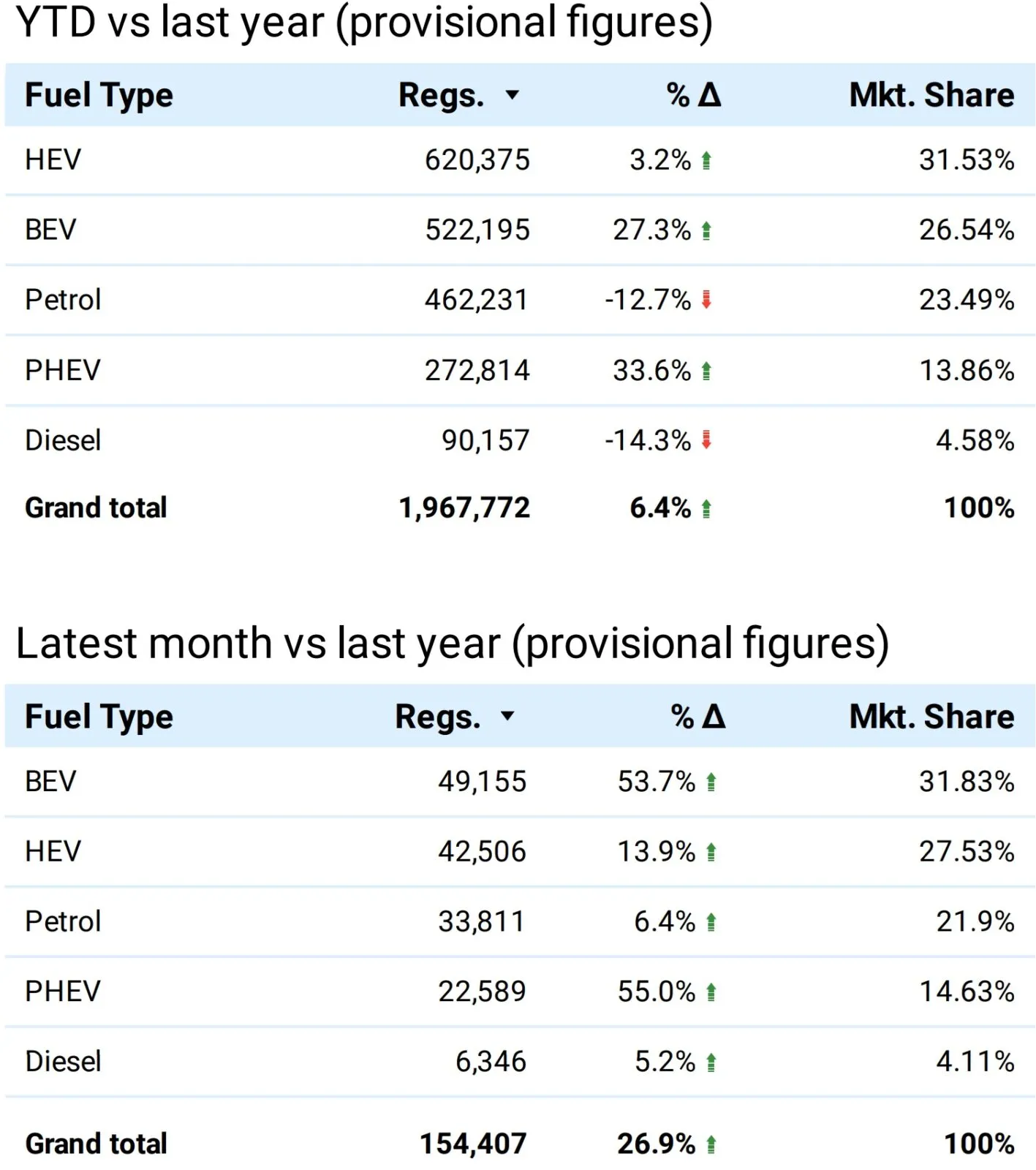
The figures take battery electric vehicle registrations to 522,195 for the first ten months of 2026, up 27.3% on the same period last year. Their share has reached 26.5%, above New AutoMotive’s estimated effective mandate requirement of 24.6% after compliance flexibilities are taken into account.
“Almost one in three new cars sold in October was fully electric, more than any other fuel type, and electric car sales are up by more than half on last year,” said Ben Nelmes, chief executive of New AutoMotive.
“The ZEV mandate is working. With the cost of living at the top of the political agenda, ministers should stick with a policy that is putting cheaper motoring within reach of millions of households.”
The distinction between the headline mandate target and the estimated effective requirement is significant. The headline target for cars in 2026 is 33%, but manufacturers can use flexibilities, including credits generated by lower CO₂ emissions from their remaining combustion vehicle sales, to help meet their obligations.
New AutoMotive calculates its effective target using the CO₂ ratings of newly registered cars that are not zero emission. Its analysis indicates that the market collectively has more credits than required for compliance, although these are unevenly distributed between manufacturers.
Hyundai’s manufacturer group moved into an estimated credit surplus during October, while BMW’s group was effectively level with its requirement. Stellantis, Nissan, Volkswagen, Tata, Toyota, Mazda, Ford and Mercedes remained in deficit, according to the tracker. Volkswagen and Stellantis nevertheless reduced their shortfalls during the month.
These estimates describe the position with two months of registrations still to come. An overall market surplus does not establish that every manufacturer has met its annual obligations, with individual businesses able to use the credit market to address shortfalls.
The government’s mandate review consultation closed on 23 October. It sought views on annual targets, compliance flexibilities and possible changes to the framework. New AutoMotive argues that October’s results strengthen the case for maintaining the policy rather than weakening it.
The Department for Transport has framed the review around keeping the transition practical for industry amid difficult global economic conditions, supply chain disruption and tariff uncertainty. It says the exercise is intended to support investment and competitiveness while retaining its existing 2030 and 2035 phase-out commitments.
Melanie Lane, chief executive of charging business Pod, said the figures showed the importance of cost, choice and making electric vehicles an easy decision for drivers.
“The last thing the market needs now is another shifting of the regulatory goalposts, when the current framework is clearly creating the right conditions to make the switch,” she said.
October’s wider new car market grew 26.9% to 154,407 registrations. Non-plug-in hybrids accounted for 42,506 cars, or 27.5%, followed by petrol cars at 33,811 and 21.9%. Plug-in hybrids reached 22,589 registrations, taking 14.6%, while diesel accounted for 6,346 cars and 4.1%.
Plug-in hybrid registrations grew slightly faster than battery electric cars, rising 55%. However, their volume remained less than half that of fully electric models. Petrol and diesel registrations also increased during October, but their much slower growth meant both lost market share.
Across the year so far, the picture is different: petrol registrations are down 12.7% and diesel down 14.3%. Non-plug-in hybrids remain the biggest category over the ten months, accounting for 31.5% of registrations, ahead of battery electric cars.
Gurjeet Grewal, chief executive of Octopus Electric Vehicles, attributed the electric market’s performance to expanding choice and competition.
“To keep the momentum going, Government needs to provide consistent direction while manufacturers keep innovating and bringing affordable EVs for every type of driver,” he said.
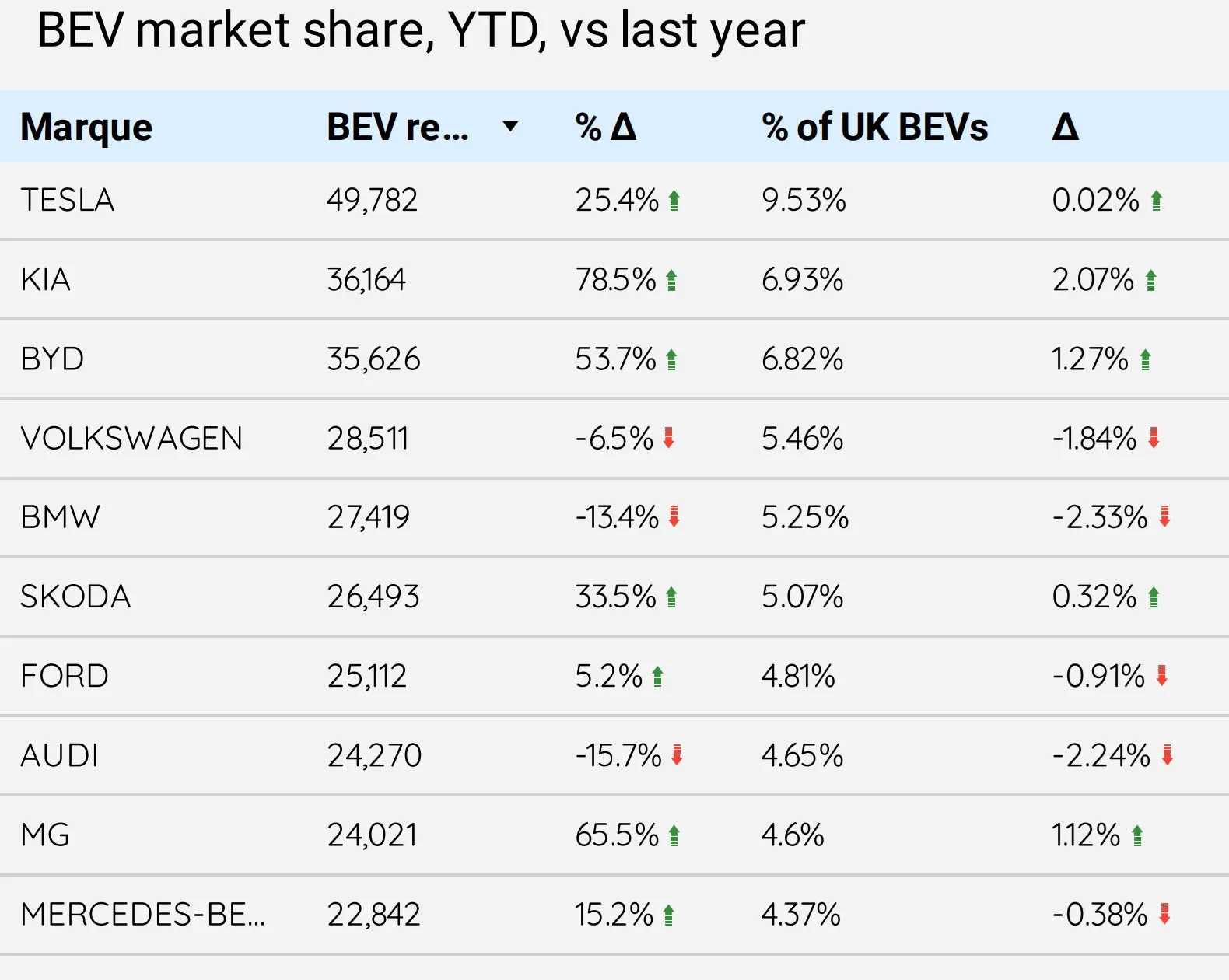
Kia led the battery electric car market in October, ahead of BMW, Volkswagen and BYD. Tesla registered just 235 cars during the month, following what New AutoMotive described as a September surge, but retained its lead for the year overall.
Tesla’s 49,782 registrations give it 9.5% of the battery electric market so far in 2026. Kia follows with 36,164 and 6.9%, narrowly ahead of BYD’s 35,626 and 6.8%. Kia’s electric registrations have increased 78.5% compared with the same period last year.
Growth has also been uneven across brands. Volkswagen’s battery electric registrations were down 6.5% over the first ten months, while BMW and Audi recorded falls of 13.4% and 15.7% respectively. MG increased its electric registrations by 65.5%.
Industry responses also highlighted the need to support buyers beyond the new car market. Toby Poston, chief executive of the British Vehicle Rental and Leasing Association, said fleet registrations would help supply cheaper electric cars to subsequent owners.
“The vehicles entering fleets today will become the affordable used cars of tomorrow. We need a healthy second-hand market, strong residual values and confidence in battery longevity if the transition is to work for businesses and households alike,” he said.
Charging costs remain another concern. Ginny Buckley, chief executive of Electrifying.com, called for action over the difference between VAT on public charging and domestic electricity, warning that drivers without driveways faced a disadvantage.
“Drivers are paying more tax to power the same car, making the same journey, simply because of where they live,” she said. “If we’re serious about making electric motoring affordable for everyone, we must close this divide.”
Electric vans also recorded strong growth, with 3,376 registrations in October, up 53.3% year on year and representing more than one in eight new vans. Battery electric models now account for 11.1% of van registrations across 2026, substantially below their share of the car market.
Diesel retained a commanding position, accounting for 19,889 vans in October, or around 77% of registrations. Volkswagen leads electric van registrations for the year with 8,191, followed by Ford on 7,620 and Kia on 5,271, according to the bulletin.
New AutoMotive identified depot grid connections, charging provision for drivers without off-street parking and public charging costs as priorities for accelerating van adoption. It also called for support for used electric van buyers as the fleet grows and ages.
The Electric Car Count uses a snapshot of the DVLA vehicle licensing database taken in the first few days of each month. Its latest car registration figures are provisional and cover newly registered vehicles, rather than the composition of the entire UK car fleet.