
China’s 19-passenger electric aircraft completes first crewed flight

A Chinese battery-electric commuter aircraft designed to carry 19 passengers completed its first crewed flight on Saturday, 14 November, after 19 uncrewed autonomous test flights. The CE-25A spent 16 minutes and 38 seconds in the air, covering 60.4 km over Binzhou in eastern China’s Shandong province.
The 10-tonne battery-electric aircraft is the CE-25A, which is designed to carry 19 passengers and boasts a cruising speed of 300 km/h, a cruising altitude of 2,400 metres, and a range of 400 kilometres.
Developed by the Commercial Aircraft Corporation of China (COMAC), Chinese battery manufacturing giant CATL, the Shanghai Jiao Tong University, and other partners, the CE-25A’s maiden manned test lasted for 57 minutes and 46 seconds, including 16 minutes and 38 seconds in the air, during which the aircraft reportedly covered 60.4 kilometres.
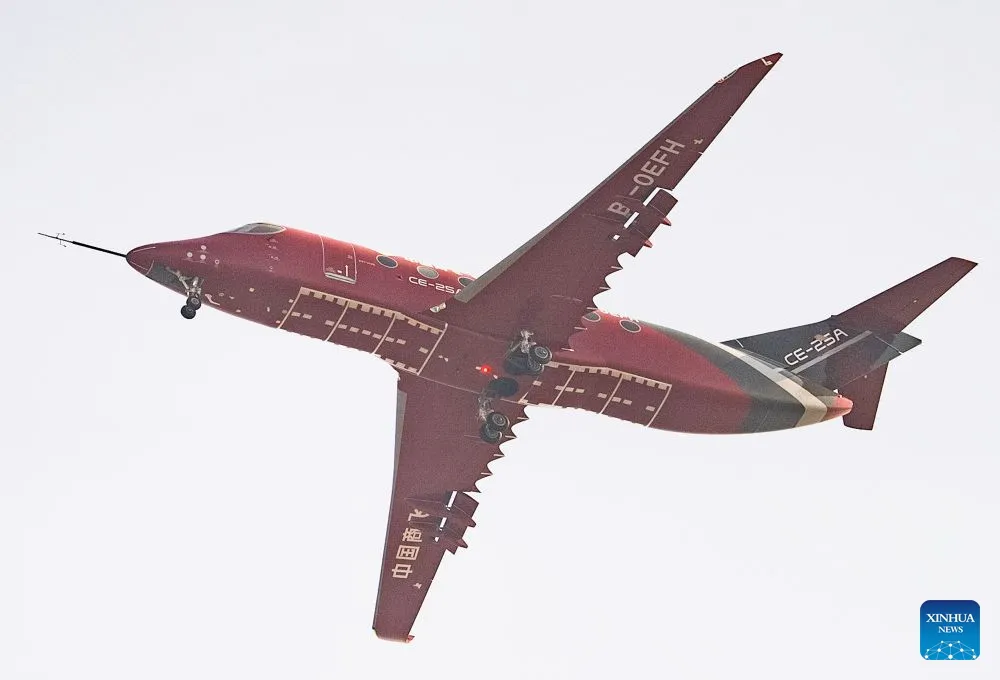
With a maximum take-off weight of 10 tonnes, the CE-25A is powered by a distributed electric ducted-fan propulsion system mounted on the wings.
For this first manned flight, the manifest included two pilots and a single flight test engineer.
According to a statement to Chinese media, COMAC said that the aircraft performed normally and that all test results met expectations. The flight comes after 19 unmanned autonomous flight tests completed during the aircraft’s development.
China’s civil aviation regulator has accepted COMAC’s application for a type certificate
Despite the headline-grabbing nature of a first manned flight for a battery-electric passenger aircraft, there is still a lot of runway left before electric flight becomes ubiquitous.
British market research firm IDTechEx applauded COMAC’s achievement, describing the maiden manned flight as “important for both the future of electric passenger aviation and the potential role of next-generation battery technologies in enabling it,” but warned that “there remains a long journey ahead before large commercial passenger aircraft are entirely battery-powered, with many players instead pursuing hybrid systems or using hydrogen to counteract the limited maximum energy density of lithium-ion batteries.”
Specifically, electric aircraft hopefuls must overcome the relatively low energy density of lithium-ion batteries, according to IDTechEx. High-nickel NMC cells for automotive applications currently offer around 250-300 Watt-hours per kilogram (Wh/kg) at the cell level.
In comparison, however, jet fuel can provide around 10,000 Wh/kg, meaning that electric aircraft require a higher mass of batteries to achieve the same energy, resulting in the need to compromise on overall range and payload.
This was somewhat evident in the fact that the CE-25A travelled only 60.4 kilometres with three passengers, but it is unknown what restrictions COMAC might have placed on this test flight that could be responsible for its relatively short distance travelled.