
Battery storage startup Rebaba secures nearly €4 million
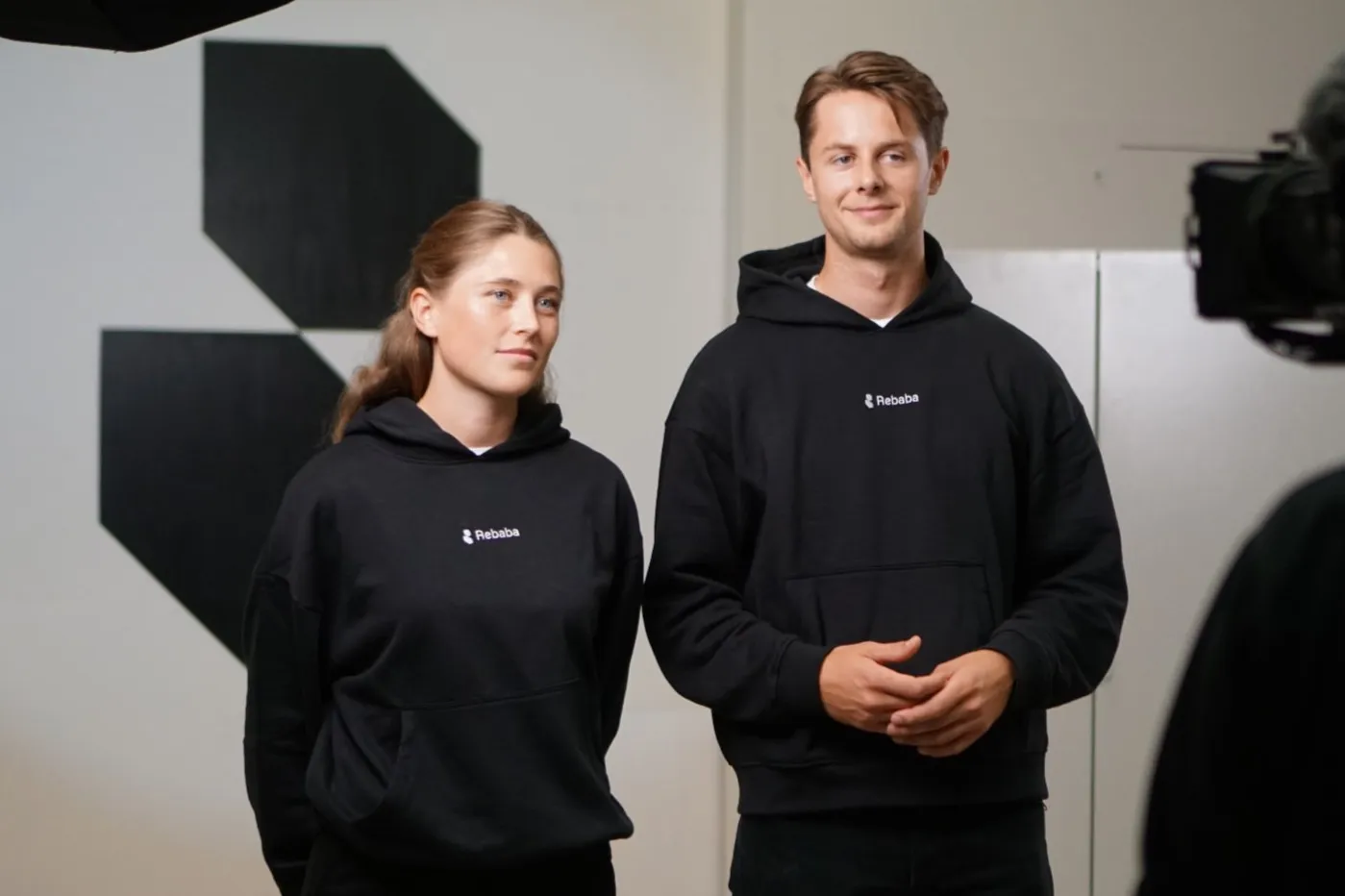
Rebaba, a startup from Sweden founded by former Northvolt employees, has raised just under €4 million euros in a seed funding round. The company plans to use the funds to expand its business with second-life battery storage systems.
Rebaba founders Paula Runsten and Felix Kruse
Image: Rebaba
Founded in Stockholm in 2023, Rebaba focuses on the concept of a second life. Similar to German battery storage startup Voltfang, decommissioned EV batteries are given a second life in stationary energy storage systems. Rebaba refers to these as circular battery storage systems.
Rebaba has now raised 44.1 million SEK in an oversubscribed seed funding round led by Sistafund and EIT Urban Mobility, with participation from existing shareholders and new European investors. This amount is equivalent to nearly 4 million euros.
Advancing circular battery storage systems
This capital injection will enable Rebaba to advance its mission of delivering circular battery storage systems that address the challenges of climate change as well as globally growing demand for stable and cost-effective energy on a large scale. By combining reclaimed EV batteries with its patent-pending Rebaba technology, the company aims to help its customers reduce energy costs, avoid grid congestion, increase operational reliability, generate revenue from green energy, and simultaneously build a circular economy for batteries.
Rebaba currently offers two energy storage products: Companion, a compact, cabinet-based 40-kWh system for private and small commercial applications, and Containerised, a larger-scale system for commercial and industrial applications. The latter enables customers to implement load shifting, local generation storage, peak shaving, and grid balancing services.
Rebaba plans to increase the capacity of its CircularHub production facility in Stockholm to 40 MWh per year, which could avoid approximately 4,000 tonnes of CO₂ annually. Additionally, the company intends to open further production sites in Europe. For the distribution of its battery storage systems in Europe, Rebaba has already entered into partnerships with various companies, including a collaboration with Cologne-based startup Nanuq (link in German).
Paula Runsten, co-founder and CEO of Rebaba, explains: “Demand for energy storage is accelerating globally, driven by AI, electrification, and the transition to renewables. Conventional thinking is that we must produce new batteries for every energy storage system being deployed, but this simply isn’t true. Electric vehicle batteries are retired with 70-80% of their useful life remaining, and by 2028, returning EV batteries are projected to offer more usable capacity annually than the entire global demand for stationary battery storage. The batteries already exist. Our job is to make reuse scalable.”
Marie Geneste, Partner at investor Sistafund, adds: “Europe’s energy transition depends on scaling storage fast, without creating new dependencies on scarce raw materials or costly imports. Rebaba turns retired EV batteries into high-performance storage systems that can be built locally and compete on price. That is what convinced us to lead this round: circularity without compromise, and a team with the potential to build a European leader in energy storage.”