
Balancing inhomogeneities, or why a LFP bus sometimes stops [The Battery Cycle #5 | 2026 RELEASE]
![Balancing inhomogeneities, or why a LFP bus sometimes stops [The Battery Cycle #5 | 2026 RELEASE]](https://api.ev-route.com/storage/news/2026-09/balancing-inhomogeneities-or-why-a-lfp-bus-someti-1.webp)
Five years ago, with insights from Claudius Jehle, CEO of volytica diagnostics GmbH, we launched “The Battery Cycle” series of articles, aiming to shedding light on the complexities of Li-Ion batteries.
The series provided a huge amount of valuable insights for anyone involved in electric mobility.
Now, five years later, we return to those same topics – still thanks to the collaboration with Claudius Jehle – enriched by real-world data and lessons learned.
The full series of articles, freshly updated, is also published in a monographic special feature accompanying Sustainable Bus (and sister platform Sustainable Truck & Van and Powertrain International) issues throughout 2026.
We welcome your questions, feedback and contributions at info@sustainable-bus.com.
Credit picture: Forsee Power
A battery is not one cell, although we might want to reduce it to that in everyday conversation. Ideally, it should behave like it, but as always, things are more complex in reality.
In a battery system, dozens or typically hundreds of single cells are connected in series (that is, the plus of one is connected to the minus of the next and so on), forming a string. Each additional cell raises the total system voltage. As ‘power’ is ‘voltage x current’, doubling the voltage (by putting cells in series) cuts the necessary current half, and as cable diameters is mainly determined by maximal current, raising system voltage by putting cells in series basically helps to reduce cable size, weight and costs. As simple as that*. If we want more capacity, we add whole strings in parallel.
But by this simple trick new problems occur: disbalance, inhomogeneity, inaccessible energy and the necessity for balancing.
Inhomogeneity: a thought experiment
If we depart from a system where all cells are the same, we run into serious problems that we will explain here. As usual, we start with simple analogies that we (almost) perfectly suitable for everyday conversations. Consider a single string system (works perfectly the same with multistring systems) and figure it – attention: metaphor – as a cascade of the already introduced glasses, discharging into one another.
Would you agree that, as long there is no leak, the amount of liquid going in on the top completely passes unchanged through each and every single cell?
So, if now all have exactly the same capacity (SoH, later articles), and all start at the same filling height (voltage), then all of them have the same starting content (SoC). If current flows through the cascade, each cell in this perfect example is being filled/emptied by the exact same amount of liquid. If you keep discharging them, they all approach 0% SoC simultaneously**. Vice versa, if you keep filling them up, they all will be 100% full at the same time.
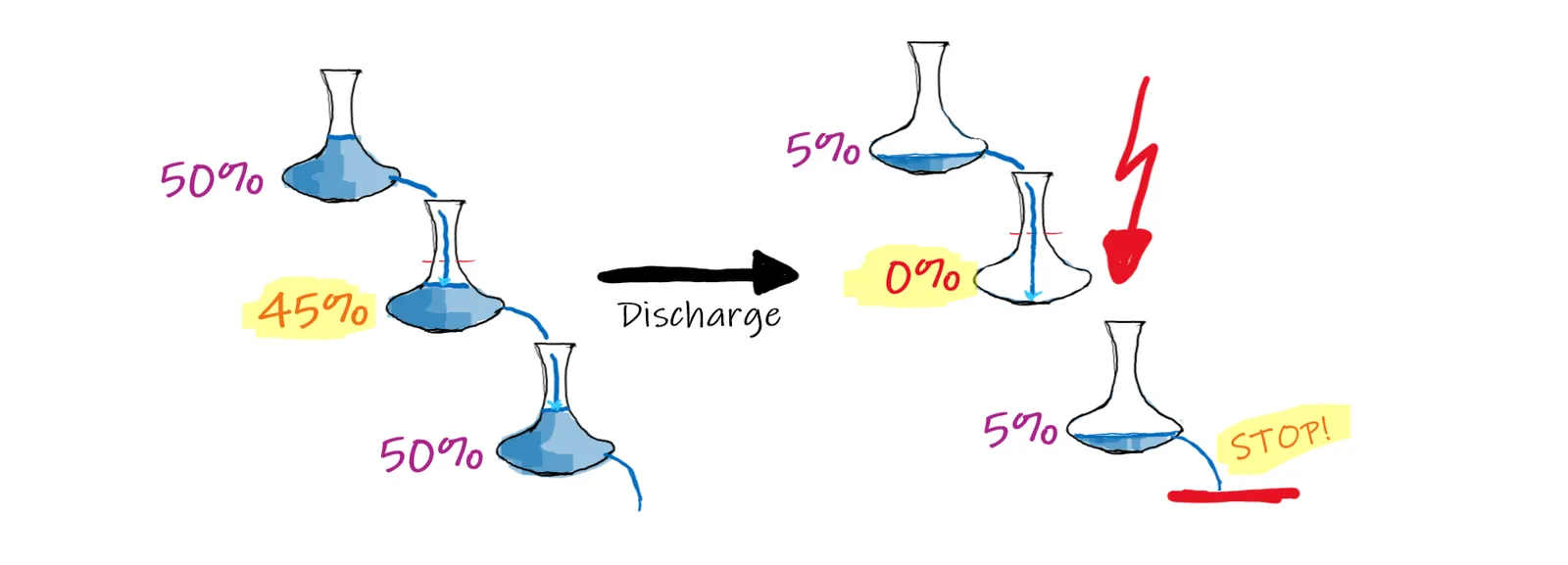
The battery appears suddenly empty. The consequence is system emergency shutdown we sometimes call a Sudden Depletion Event (SDE) – a vehicle that until minutes ago displayed a substantial and unproblematic SoC suddenly stops and the SoC drops to 0%. By the way: if you followed all articles so far, you should have a feeling why especially LFP is prone to that effect.
Balancing is key!
What is balancing now doing? In very simple terms: the balancing circuit in the Battery Management System must take care that all cells have the same SoC (filling content), ideally at all times, so that the weakest link doesn’t limit overall performance in the described way. The simplest, but also the most common, approach is often called passive balancing, and it seems wasteful: a master logic determines the SoC of the ‘lemon’ (or lemons) and discharges all other cells****. Yes, in above’s example, a passive balancing system would start leaking ca. 5% from all the 99 good cells, almost ‘bleeding’ them out*****. This energy is lost.
There are also active balancing systems in place, which are way more sophisticated and themselves prone to failures due to their complexity, and more invest intensive. The result is also that all 100 cells would end up at the same SoC, but by actively shifting excess charge from the 99 others to back up the lemon, no charge is lost in the process.
When does balancing happen?
In large and very busy stationary systems, active balancing is gaining some foothold. However, the simplicity and robustness of passive systems still make them the means of choice in almost all applications, bus and truck included. So, to keep it simple, the following is true only for passive systems.
As said, a balancing system must first determine the SoC of every cell. As you learned in the past article, this is particularly difficult for electronics in dynamic or ‘foamy’ situations, i.e. during operation or charging, and for battery chemistries with flat OCV curves – like LFP. So the balancing system will want long, ‘relaxed’ idle periods without any power flowing, and is even more happy if the SoC is very high, as the ‘glass shape’ of most chemistries allows for an accurate voltage-to-SoC-conversion when almost full (or empty, btw). The longer the idling, the more disbalance can be ‘heated away’ by leaking.
Hands-on tips: 1)Plan for passive balancing. After charging to 100 %, follow the OEM’s recommendations for idle time to allow the BMS to balance the cells effectively. 2) Request granular battery diagnostic data. Ask for SoC spread, cell voltages, and deviation metrics, ideally at cell level, or at least per module or string. 3) Specify it in tenders. Require a defined balancing strategy, a max cell imbalance, and long-term access to raw battery data.
Now you understand why OEMs recommend an extended idling phase directly after charging to 100%? Exactly: idling at high SoC facilitates balancing – the longer the better.
We have not answered the questions why at all the cells don’t behave the same. We brought up the example where one cell is slightly emptier than the others (i.e. SoC). The reality is very complex, with many interactions. To highlight one very mean – because self-enforcing – reason: due to manufacturing imperfections, uneven cooling/heating flows, welding issues, electronics imperfections etc. some cells degrade slightly faster than others – really only slightly – leading to a spread in capacity (SoH). When continuously charged and discharged, the differences in SoH will lead to the SoCs of all cells starting to diverge in a manner comparable to the first thought example.
To make things worse, a cell that is slightly smaller than the others experience more current per capacity (C-rate), even increasing degradation stress, and making it even smaller than the rest. Also, it is likely to have slightly increased resistance, leading to increased temperature. Also, the SoC window is affected. A ‘pre-lemon cell’ is thus likely to continue an irreversible downward spiral.
While the balancing system is always trying to level out SoC, it cannot affect the irreversible SoH spread. This can be mitigated by a balancing system for some months or years, at least the operator will not directly feel the ongoing process. But at one point in time, balancing times would take so long to completely level everything out, that operation would be severely affected. Or, if it was kept still too short, the risk for SDEs would significantly increase.
So, what?
OEMs and manufacturers are very aware of what we wrote above, and the systems are typically well-equipped with the right balancing setups. It is however instrumental that customers are aware of the (dis)balance and risk of system underperformance due to it for each asset, and that a proper balancing strategy and adherence to the OEM’s recommendations are met.
At a glance
Battery systems are complex. They consist of hundreds of cells pretending to be one: if they don’t, one cannot extract all seemingly available energy.
In worst-case situations, unbalanced systems can suddenly appear to ‘self-deplete’ in Sudden Depletion Events, leading to sudden, costly, and potentially dangerous en-route standstills.
Balancing requires time and specific conditions. It most often occurs during extended idle phases after a full charge.
The reasons for imbalance and inhomogeneity are complex. A pre-imbalance can lead to self-reinforcing internal degradation, which worsens the problem.
It is advisable to adhere to OEM recommendations and independently keep track of inhomogeneity (reversible and irreversible) and balancing effectiveness.
* Many readers might object – the power electronics perform better at higher voltages, too! Correct, but mainly due to comparable reasons, i.e. current density.
** Note that for the moment we think of the process to be extremely quick, i.e. that the resistance of the cells in extremely low, and again the same for each and every cell. This is of course not the case in reality.
*** Actually, it is 49.95% (1×45% + 99×50%), but never is a SoC given with 2 decimals.
**** In fact, every cell with SoC > lemon is discharged using small heating resistors.
****** In fact, this process is sometimes called ‘bleeding’, the circuit using ‘bleeding resistors’
The post Balancing inhomogeneities, or why a LFP bus sometimes stops [The Battery Cycle #5 | 2026 RELEASE] appeared first on Sustainable Bus.