
Alpitronic adds compact depot dispenser to HYC1000 Range
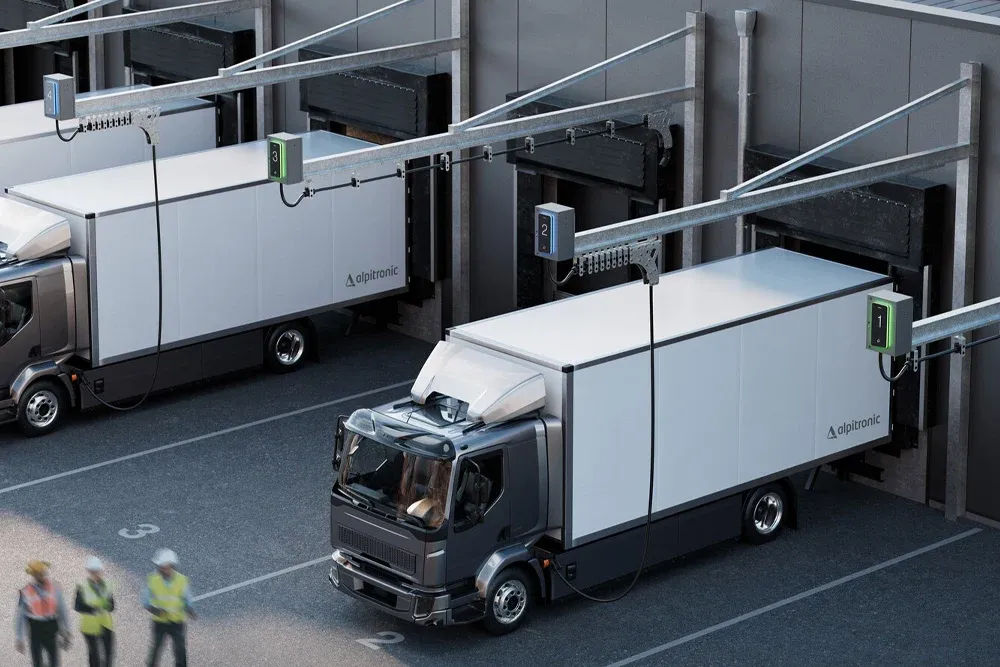
Alpitronic has expanded its HYC1000 megawatt charging system to include a compact dispenser for use in bus and truck depots, capable of providing up to 400 kW in charging power. Notably, the dispenser can be mounted on walls, pedestals, or traverses. The new solution will make its debut at the IAA Transportation.
Image: Alpitronic
In February 2025, Alpitronic unveiled the HYC1000, a charging system in which the power modules are not housed in the charging columns – as is typical for the Italian manufacturer – but instead in a separate Power Cabinet.
This Power Cabinet contains eight Power Stacks, each rated at 125 kW, enabling a total charging power of up to one megawatt. The system distributes this power in 62.5-kW increments across as many as eight outputs. Alpitronic now specifies the efficiency of the Power Cabinet at up to 98.2 per cent, an improvement from the 97.5 per cent quoted at its launch.
Previously, the Power Cabinet supported three dispenser types: the MCS Dispenser with an MCS plug (maximum 1,500 A, 1,000 kW), optionally supplemented by a CCS plug (600 A, 600 kW); the HP Dispenser with a CCS plug for over 1,000 A and up to 1,000 kW; and the EV Dispenser with up to two CCS plugs (600 A, 600 kW). The new Depot Dispenser, specifically designed for charging e-bus and e-truck fleets at depots, is now joining the lineup.
Compact and flexible mounting
The Depot Dispenser differs visually from the other HYC1000 dispensers. Instead of a 2.32-metre-tall column weighing up to 350 kg, it features a compact housing measuring 600 × 400 × 250 mm. Depending on the configuration, this dispenser weighs up to 35 kg, excluding the charging cable.
The dispenser can be wall-mounted, pedestal-mounted, or even installed on a crossbeam or under the depot ceiling. The charging cable is available in lengths of 2.0, 5.5, and 7.5 m. The longest option is likely to be in demand for overhead mounting, as the cable must reach from above to the vehicle’s charging port.
Another key difference is in its charging power. The Depot Dispenser features a CCS connector and operates at voltages ranging from 150 to 1,000 V. Alpitronic specifies a peak current of 400 A, enabling the stated 400 kW—though this is only achievable with vehicles operating near 1,000 V. This places the Depot Dispenser on par with the uncooled cable of the EV Dispenser, which also supports 400 A.
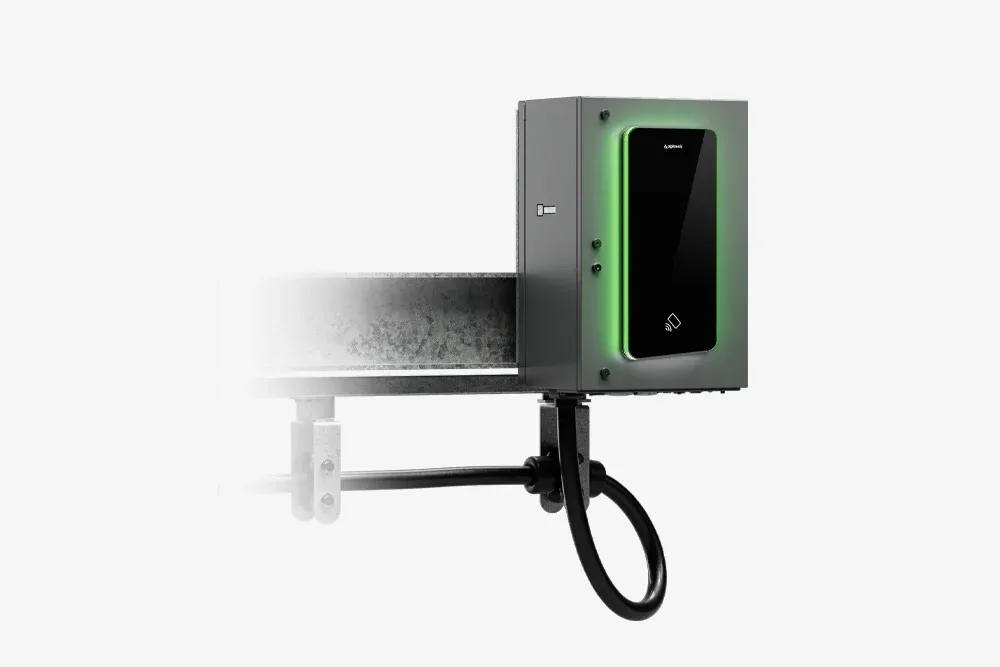
Image: Alpitronic
- 1/4
- 2/4
- 3/4
- 4/4
For the Depot Dispenser, Alpitronic has omitted the touchscreen commonly found on its larger charging stations. Instead, a status LED indicates charging status. Authentication is provided via RFID, with optional card readers for credit and debit cards, as well as a QR code reader. This setup allows operators to enable charging for both their own fleet and guest vehicles.
This aligns with depot-sharing models, such as those recently introduced by Smatrics (DE), TST Logistik with dragonize, or the Depotcharge platform, where activation and billing are managed via the backend. With a card reader, the dispenser is also suitable for publicly accessible charging points, which, under the EU AFIR regulation, must support ad-hoc card payments for chargers above 50 kW.
An optionally available, legally compliant DC meter is also offered. The housing meets the IP55 protection rating and is designed for indoor and outdoor use in temperatures ranging from -30 to +55 °C. For the larger dispensers, Alpitronic specifies an IP54 rating. In standby mode, the Depot Dispenser consumes less than 25 W, while the other dispensers require up to 82 W.
Dwell time over peak power
Amid growing electrification of bus and truck fleets, Alpitronic is now expanding its portfolio to include depot charging. Here, factors such as grid connection, dwell times, available charging windows, and fleet development determine how much power is actually needed at each charging point – and when. According to Alpitronic, the HYC1000’s Power Cabinet distributes the available power on demand to the connected Depot Dispensers. This allows operators to align their initial infrastructure with the current vehicle fleet and expand it later as new vehicles are added or operational requirements evolve.
“With the Depot Dispenser, we address the specific requirements of a depot. For fleet operators, the focus is not on providing the maximum possible power at every charging point. What matters is charging vehicles reliably, economically, and in line with their operational and dwell times. This is exactly the flexibility we provide with our charging portfolio,” says Philipp Senoner, CEO of Alpitronic.
The Depot Dispenser will initially launch in Europe, with other markets to follow. Alpitronic has not yet disclosed pricing details. The new Depot Dispenser will make its public debut at IAA Transportation (Pavilion 13, Stand E11).
_Source: Info per E-Mail_, alpitronic.it