
Alpine A390 GT review: electric crossover stays true to Alpine DNA
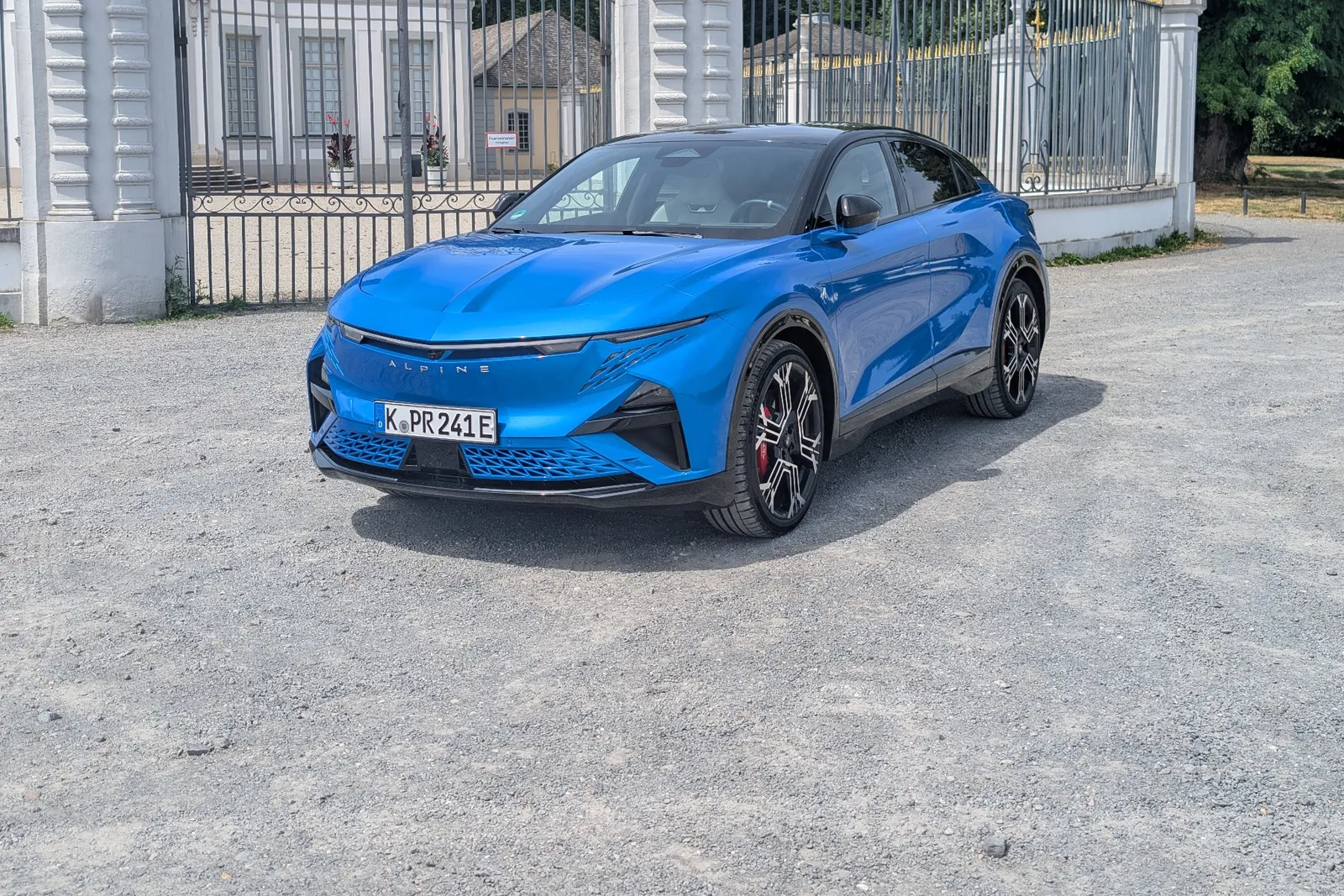
The Alpine A390 is the second model in the brand’s so-called Dream Garage. It slots between the smaller A290, based on the Renault 5, and the upcoming all-electric A110. In an interview with electrive, Alpine Germany chief Amaury Marzloff stressed that electric sports cars are central to the brand’s strategy. For him, sportiness is defined not by top speed or outright power, but by agility, precision and control. The A390 therefore has to deliver on those attributes. At 4.62 metres long and weighing as much as a well-equipped mid-size saloon, however, the fastback is anything but a lightweight.
The A390 is built at Alpine’s historic plant in Dieppe, while Renault manufactures its three electric motors at its Cléon facility. It is based on the AmpR Medium platform, which it shares with the Renault Mégane and Scénic E-Tech. Alpine’s goal is clear: attract new customers—many of them already familiar with electric cars—without compromising the brand’s DNA. I tested the entry-level A390 GT, which delivers 294 kW (400 hp), in urban traffic, on the motorway and, of course, on country roads.
Wide, low, and impossible to miss
Visually, the A390 leaves no doubt about its ambitions. At 1.53 metres tall, it sits noticeably lower than today’s typical SUVs, while the coupé-style roofline slopes towards the rear. Its width is particularly striking: the body measures 1.89 metres without mirrors and 2.06 metres with them. Those are almost sports car proportions, and the car looks the part whether parked or on the move.
The front lighting signature, featuring numerous illuminated triangles that Alpine calls Cosmic Dust, is especially eye-catching after dark. At the rear, the Alpine lettering is illuminated in red between fragmented triangle elements. The GT comes as standard with 20-inch Cristal alloy wheels fitted with specially developed Michelin tyres, although our test car rode on the optional 21-inch Snowflake wheels.
Enthusiasts will also notice the engraved silhouette of the A110 in the corner of the windscreen. Overall, the design works well: the A390 looks purposeful without appearing ostentatious and conveys a more premium impression than its price suggests. Only its generous dimensions are impossible to hide.
Three motors for plenty of power
The drivetrain is the A390’s centrepiece and key differentiator. At the front, an electrically excited synchronous motor (EESM) operates without permanent magnets. At the rear, two permanent-magnet synchronous motors each drive one wheel independently. Together, the three motors form Alpine’s first all-wheel-drive system, producing 295 kW (400 hp) and up to 661 Nm of torque. The A390 accelerates from 0 to 100 km/h in 4.8 seconds and reaches a top speed of 200 km/h. Those are respectable figures, though not class-leading. A Tesla Model Y Performance offers stronger acceleration at a lower price. The table below compares the two Alpine A390 variants.
Alpine A390 GT
Alpine A390 GTS
Drivetrain
All-wheel drive
Three motors
All-wheel drive
Three motors
Power
295 kW / 400 PS
(98.3 kW / 2 × 98.3 kW)
345 kW / 470 PS
(115 kW / 2 × 115 kW)
Torque
661 Nm
(239 Nm / 2 × 211 Nm)
824 Nm
(300 Nm / 2 × 262 Nm)
Acceleration
4.8 s
3.9 s
Top speed
200 km/h
220 km/h
Battery capacity (net)
89 kWh
Lithium-ion – NMC
89 kWh
Lithium-ion – NMC
Range (WLTP)
551 / 497 km
(20″/21″ wheels)
551 / 497 km
(20″/21″ wheels)
Consumption (WLTP)
18.7 / 20.4 kWh/100 km
(20″/21″ wheels)
18.7 / 20.4 kWh/100 km
(20″/21″ wheels)
DC charging power
150 kW
190 kW
DC charging time (10–80 %)
approx. 31 min
approx. 27 min
AC charging power
11 kW (22 kW optional)
11 kW (22 kW optional)
AC charging time (0–100 %)
9 hrs 45 min at 11 kW
4 hrs 45 min at 22 kW
9 hrs 45 min at 11 kW
4 hrs 45 min at 22 kW
Curb weight
2,124 kg
2,121 kg
Boot volume
532 to 1,643 litres
532 to 1,643 litres
Towing capacity
(unbraked / braked)
750 kg / 1,350 kg
750 kg / 1,350 kg
Base price
67,500 euros
78,000 euros
The real highlight is the active torque distribution, which Alpine calls Torque Vectoring. Because each rear wheel is driven by its own electric motor, the system can send more torque to the outside wheel than to the inside wheel when cornering. This generates a yaw moment that helps rotate the car into the bend. The effect is immediately apparent: despite weighing more than two tonnes, the A390 turns in eagerly and feels noticeably smaller than its dimensions suggest. Combined with the direct, quick-ratio steering—reminiscent of the A110, which Alpine will soon launch as an all-electric version—the result is highly convincing.
On winding country roads, the fastback changes direction with surprising agility. However, it cannot defy the laws of physics. Under heavy braking, on uneven surfaces or during abrupt load changes, its weight becomes apparent. The A390 remains agile for a car of its size, but it is not perfectly neutral. Alpine’s software does an impressive job of disguising the car’s mass, yet it cannot eliminate it altogether.
The suspension features Alpine’s sports chassis with hydraulic bump stops, a setup already used in the A110 and A290. It strikes a convincing balance between handling and comfort, offering plenty of feedback without becoming tiring in everyday driving. The braking system, another first for Alpine, combines 365-millimetre front brake discs with six-piston calipers and delivers strong stopping performance. The transition between regenerative and mechanical braking is particularly well executed and remains almost imperceptible.
The red “OV” (Overtake) button on the steering wheel unlocks additional power for up to ten seconds at the press of a button, making overtaking manoeuvres easier. The A390 also features launch control for maximum acceleration from a standstill. Neither function is essential, but both add to the driving experience. That brings us to perhaps the car’s biggest surprise: its sound.
A driving sound that actually delivers
As with most electric cars, the A390 is naturally quiet. Alpine therefore developed its own artificial driving sound rather than simulating an internal combustion engine. The more distinctive of the two available sound profiles, simply called Alpine, emphasises low frequencies and responds to power delivery without trying to imitate a V8. The result feels refreshingly different. Combined with the Overtake boost function, it creates an engaging soundtrack under acceleration that adds to the emotional driving experience. Those who prefer silence can disable the sound entirely, making it a matter of personal preference.
The Drive Mode button on the steering wheel allows the driver to switch quickly between the five driving modes: Save, Normal, Sport, Perso and Track. The controls are intuitive and easy to use. One minor drawback is that the A390 does not remember the previously selected mode. Instead, it defaults to the standard setting after every restart. While this is a requirement under EU regulations, it is only a minor inconvenience in the A390 GT, as changing modes via the steering wheel takes just a second.
Solid range, but hungry on the motorway
The A390 GT uses an 89 kWh lithium-nickel-manganese-cobalt (NMC) battery with a WLTP range of up to 551 kilometres when fitted with the standard 20-inch wheels. Our test car rode on the optional 21-inch wheels, reducing the official range to 497 kilometres. A heat pump comes as standard to improve efficiency in colder conditions.
In mixed driving, the results proved convincing. In urban traffic and on country roads, we recorded average consumption of around 19 kWh/100 km, closely matching Alpine’s official figure of 18.7 to 20.4 kWh/100 km. That translates into a realistic range of around 460 to 500 kilometres on a full charge. At higher motorway speeds, however, the picture changes significantly.
On the motorway, however, the A390’s wide body, large frontal area and weight begin to take their toll. Alpine quotes energy consumption of 23.2 kWh/100 km at higher speeds. In our test, consumption at 130 km/h and above increased to around 26 kWh/100 km. That reduces the realistic motorway range to roughly 340 kilometres, compared with the official WLTP figure of 497 kilometres for the version fitted with 21-inch wheels. At sustained speeds above 150 km/h, the range drops further. That is not unusual for a battery-electric car, but it means the A390 is better suited to daily driving, commuting and medium-distance journeys than to covering long motorway distances at high speed.
Only a 400-volt system
At DC fast chargers, the A390 GT supports charging at up to 150 kW via its CCS port, while the more powerful A390 GTS reaches up to 190 kW. More important than the peak figure, however, is the charging curve. The A390 maintains a high charging rate over a broad state-of-charge window, averaging around 125 kW between 10 and 80 per cent.
As a result, charging from 10 to 80 per cent takes around 30 minutes, while a full charge from 0 to 100 per cent takes about an hour. Those are respectable figures, though not class-leading. The A390 is based on a 400-volt architecture, whereas rivals such as the Polestar 4 Dual Motor, Audi Q6 e-tron and Porsche Macan use 800-volt systems that enable significantly faster charging.
The A390 comes as standard with an 11 kW AC onboard charger, allowing a full charge in around 9 hours and 45 minutes from a compatible wallbox. Alpine also offers an optional 22 kW charger for an additional 1,200 euros, reducing the charging time to around 4 hours and 45 minutes. The upgrade is worthwhile for drivers who regularly rely on public AC charging. The car also supports bidirectional Vehicle-to-Load (V2L), enabling external devices such as an e-bike or electric grill to be powered via an adapter. The charging port is located on the front passenger side.
In everyday use, I found the adjustable charging limit particularly practical. For most journeys, charging to 80 or 90 per cent is sufficient, while longer trips justify charging to 100 per cent. The setting is easy to adjust via the charging menu. The A390 can also precondition its battery automatically when navigating to a charging stop using Google Maps, or manually if preferred.
Annoying sounds can easily be turned off
The interior centres around two large displays: a 12.3-inch digital instrument cluster and a 12-inch portrait-oriented central touchscreen. Alpine’s Android Automotive-based infotainment system with integrated Google services responds quickly and feels as intuitive as using a tablet. Drivers looking to explore the car’s dynamic capabilities also have access to a range of telemetry displays.
The standout control, however, is the ‘My Perso’ button on the left-hand side of the steering wheel. It allows drivers to recall personalised settings at the press of a button, including preferred configurations for the driver assistance systems. At a time when new cars are required to activate numerous warning sounds by default, being able to deactivate them instantly is a genuinely useful feature. Many competitors hide these settings several menu levels deep. Otherwise, the A390 offers a comprehensive suite of assistance systems, including adaptive cruise control with stop-and-go function, lane-keeping assist and a 360-degree camera.
Regenerative braking at your fingertips
Another feature I quickly came to appreciate in everyday driving is the blue rotary dial labelled RCH (Recharge) on the steering wheel, inspired by Formula 1 controls. It allows the driver to adjust the strength of regenerative braking in four stages. In the lowest setting, the A390 coasts freely. The next stage simulates the engine braking of a combustion-engined car, while the highest setting enables one-pedal driving, bringing the car to a complete stop without using the brake pedal.
Using a dedicated rotary dial to adjust regenerative braking is an elegant solution. It is quicker and more intuitive than navigating touchscreen menus or using steering wheel paddles, allowing the driver to change the car’s behaviour without taking their eyes off the road. Even so, I found the highest regeneration setting with one-pedal driving to be the most comfortable in everyday use.
Premium with a small gap
In terms of materials and build quality, the A390 competes in the premium segment. Alcantara, Nappa leather, blue contrast stitching, a flat-bottom sports steering wheel and the gear selector buttons adopted from the Alpine A110 on the raised centre console give the cabin a distinctive character. Ambient lighting with up to 48 colours and the standard Devialet audio system with 13 speakers further enhance the premium feel. The electrically adjustable and heated front seats are comfortable and provide good lateral support.
Not everything is perfect, however. Ventilated seats and a head-up display are unavailable, even as optional extras. In a car priced from 67,500 euros and positioned as an everyday performance model, both features would be welcome, particularly in warmer climates. The omission is all the more noticeable given that significantly more affordable rivals, such as the Kia EV5 GT-Line, offer ventilated seats. Alpine has paid great attention to detail throughout the cabin, but these missing features are difficult to overlook.
Bigger than it feels
In everyday driving, the A390 proves to be a practical companion. The boot offers 532 litres of luggage space, expanding to 1,643 litres with the rear seats folded, providing ample room for family luggage. There is no front boot, however, as the front electric motor occupies the space beneath the bonnet. As a result, the charging cable has to be stored in the rear. It is only a minor compromise, but one that rivals with a frunk avoid. Rear-seat passengers benefit from the 2.71-metre wheelbase, although the sloping roofline slightly limits headroom for taller occupants.
The A390’s biggest surprise is how manageable it feels in urban environments. On paper, a car measuring 4.62 metres in length, 1.88 metres in width and with an 11-metre turning circle should be cumbersome to manoeuvre. In practice, it is anything but. The combination of a 360-degree camera, twelve ultrasonic sensors and direct steering makes parking and navigating tight spaces straightforward. Despite its generous dimensions, the A390 feels remarkably agile in multi-storey car parks, helped by good all-round visibility.
Only four stars in Euro NCAP
In the Euro NCAP (European New Car Assessment Programme), the A390 achieved only four out of five stars. The test was conducted in December 2025 on a left-hand-drive GT, but the rating applies to the entire range, including the GTS. The sub-scores are strong, with 85 per cent for child protection, 80 per cent for vulnerable road users (VRU), and 77 per cent for assistance systems.
The A390 missed out on a five-star Euro NCAP rating largely because it scored 74 per cent for adult occupant protection. The reasons are specific: during the side barrier impact test, one of the doors opened, resulting in penalty points. Euro NCAP also rated protection for the driver’s chest as marginal in both the frontal offset and side pole tests, while the tested GT variant was not equipped with a centre airbag between the front seats. On the positive side, the autonomous emergency braking system performed well in detecting cars, cyclists and motorcyclists, and whiplash protection received a good rating. Even so, a four-star rating is a slight disappointment for a car in this price segment.
The base price is just the beginning
The A390 GT starts at 67,500 euros, while prices for the A390 GTS begin at 78,000 euros. However, the options list quickly drives up the price. Metallic paint costs 1,600 euros, while the matte “Gris Tonnerre” Atelier finish adds 3,900 euros. The forged 21-inch wheels are priced at 1,800 euros, Sabelt sports seats with a massage function cost 2,500 euros, the Devialet XtremeSound system adds 1,200 euros, and the optional 22 kW AC charger is another 1,200 euros. As a result, a well-equipped A390 GT can easily exceed 75,000 euros.
Alpine covers the A390 with a three-year or 100,000-kilometre vehicle warranty. The paintwork is covered for three years, while the anti-corrosion warranty against perforation extends to twelve years. The battery warranty lasts for eight years or 160,000 kilometres and guarantees at least 70 per cent of the original battery capacity.
This positions the A390 in a highly competitive segment. It sits well above the smaller A290, while facing strong rivals at the upper end of the market. The Porsche Macan Electric starts at well over 80,000 euros, making it considerably more expensive. The Tesla Model Y Performance, by contrast, is both cheaper and quicker. Hyundai’s Ioniq 5 N offers more power and significantly faster charging at a similar price point. Another direct competitor is the Polestar 4 Dual Motor, which combines a similarly coupé-like silhouette with 400 kW (544 hp), a 0–100 km/h time of 3.8 seconds and DC charging at up to 200 kW.
Those who judge the A390 solely by the spec sheet will not understand it. Its appeal lies not in raw numbers but in its character, design, and the exclusivity of a brand that is not seen on every street corner.
Conclusion
The Alpine A390 GT achieves something that initially seems unlikely: it makes a two-tonne, five-door crossover feel genuinely agile. Its torque vectoring system, direct steering and thoughtfully designed steering wheel controls give the car a distinct Alpine character. Rather than relying on gimmicks, Alpine has successfully translated the brand’s focus on agility into a significantly larger and heavier package.
The A390 does not match the purity of the A110, and its weight remains noticeable in certain situations. Even so, it stands out as an emotional and distinctive alternative to the German premium mainstream. With a lower starting price than rivals such as the Audi Q6 Sportback e-tron and a unique design, the A390 has carved out a compelling position in the segment.
What ultimately keeps the A390 from becoming a truly outstanding package are a handful of avoidable compromises. The lack of ventilated seats and a front boot are noticeable omissions, while the DC charging rate of up to 150 kW and the four-star Euro NCAP rating leave room for improvement. The extensive options list also pushes the price well beyond the entry level.
Anyone choosing the Alpine A390 is unlikely to do so based on the specification sheet alone. Instead, they will buy it for its driving experience and distinctive design—and in those areas, it delivers. The desire to own one is certainly there. While the A390 GTS offers stronger performance and faster charging, it also costs 10,500 euros more. The A390 GT already provides the qualities that define the car and represents the more convincing value proposition.